ChatGPT Has 900 Million Weekly Users. Is It Recommending Your Business?
Every week, roughly 900 million people open ChatGPT and ask it something — a question, a comparison, a “what should I do” moment that used to start with a Google search. According to OpenAI’s own figures, ChatGPT passed 900 million weekly active users in February 2026, more than double its user base from a year earlier.
That is not a niche audience anymore. It is a mainstream consumer habit, on par with the biggest platforms on the internet, and it is growing faster than almost anything search marketers have tracked before. For a business owner, the uncomfortable question is simple: when someone in your market asks ChatGPT for a recommendation in your category, does your business show up in the answer — or does a competitor?
This post breaks down the exact numbers behind ChatGPT’s growth, what recent research says about how AI recommendations translate into real customer visits, and a practical five-step playbook for making sure your business is part of the answer instead of invisible to it.
The Data: How Fast ChatGPT Is Growing
The scale of ChatGPT’s growth over the past year is the real story here. According to OpenAI’s disclosures, reported by Yahoo Finance and independently confirmed by Search Engine Land:
- 900 million weekly active users as of February 2026 — the first time OpenAI has publicly confirmed this milestone.
- 700 million weekly active users just five months earlier, in September 2025.
- 400 million weekly active users in February 2025 — meaning the user base has more than doubled in twelve months.
- 50+ million consumer subscribers, alongside 9 million paying business subscribers — a fourfold increase in business accounts since September 2025.
Search Engine Land’s coverage adds important context for marketers: “User behavior continues to fragment beyond traditional search. If 900 million people use ChatGPT weekly, discovery, research, and product comparisons are increasingly happening within AI interfaces.” In other words, this isn’t just about people asking ChatGPT trivia questions — it’s becoming a genuine research and shopping tool, sitting alongside (and sometimes ahead of) a traditional Google search in the customer journey. 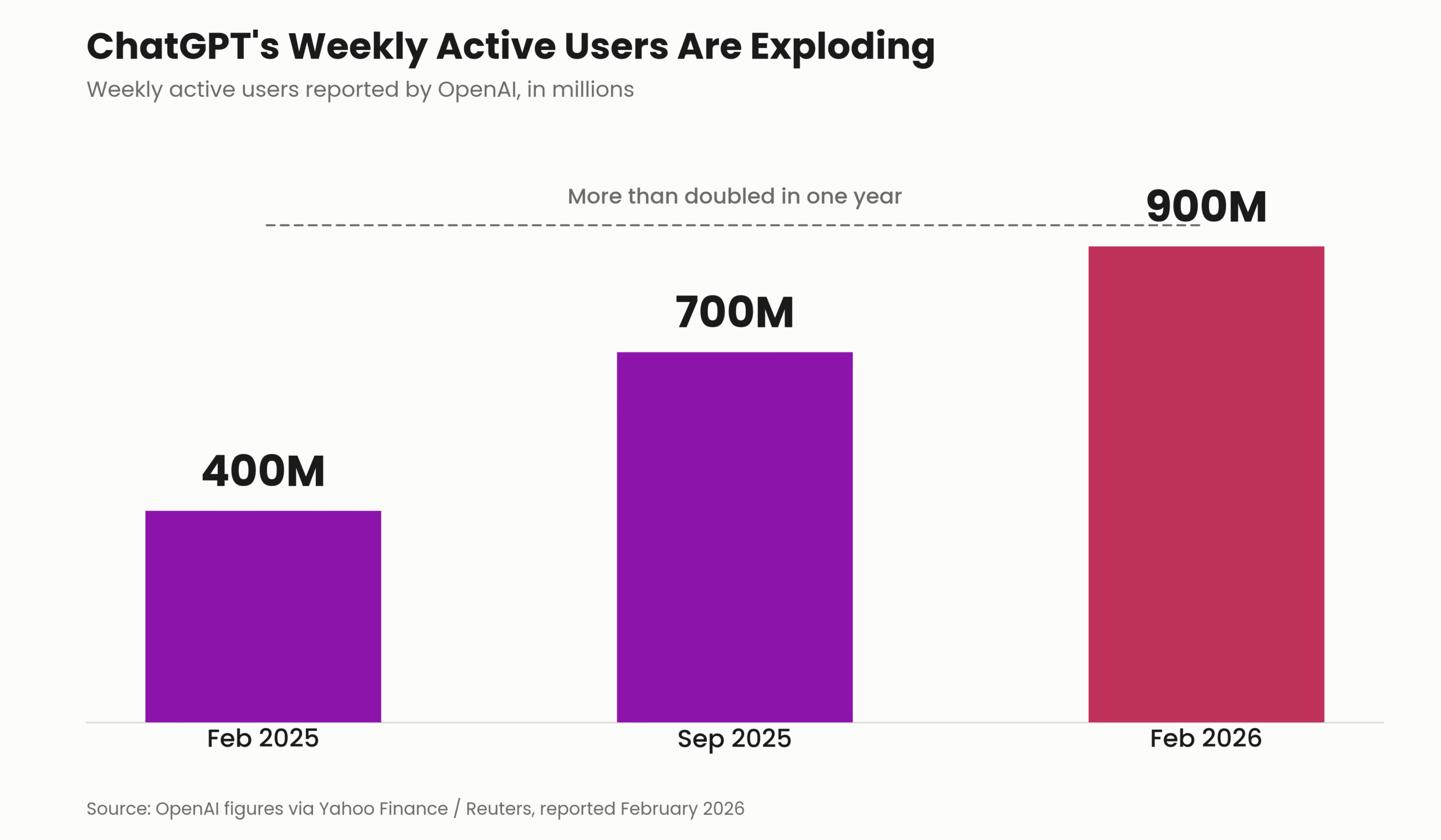
The 2026 Research: AI Recommendations Are Already Driving Real Customers
Growth in usage is one thing — but does it actually change buying behavior? Two recent 2026 studies suggest yes, emphatically.
A Similarweb study covered by Search Engine Land tracked U.S. desktop users across finance, travel, and beauty from mid-to-late 2025 and found that people were 2.5 times more likely, on average, to visit an AI-recommended brand than a direct competitor. Visitors who arrived after an AI recommendation were also dramatically more engaged: they viewed 12 pages per visit and spent 11.8 minutes on site, compared to just 6.5 pages and 5.6 minutes for typical visitors. In the finance vertical alone, American Express saw 7.2% of AI-recommended users visit its site, versus only 3.1% for a named competitor.
Separately, a Semrush study of 50,000 brands across 1,094 categories, published in July 2026, found that only 15.2% of categories currently have a clear “owner” brand in ChatGPT’s answers — meaning most industries are still wide open for a business willing to build real topical authority. Notably, the study found that traditional SEO strength doesn’t guarantee an AI recommendation: brands with higher branded search volume only won the “owner” spot 55.7% of the time, and Authority Score correlated with ownership just 52.5% of the time. The clearer signal was depth of coverage on the specific topic — as Semrush put it, “strong SEO helps you show up, but once several brands are in the running, deep coverage of the specific topic is what turns you from runner-up to owner.”
Together, these studies paint a consistent picture: AI chat recommendations are already sending qualified, highly engaged traffic to the businesses that earn them — and most categories still don’t have a settled winner.
Why This Matters for AI and Digital Marketing
For the last two decades, digital marketing has been built around one core assumption: to reach a customer researching a purchase, you need to rank in a list of blue links. That assumption is now only half true.
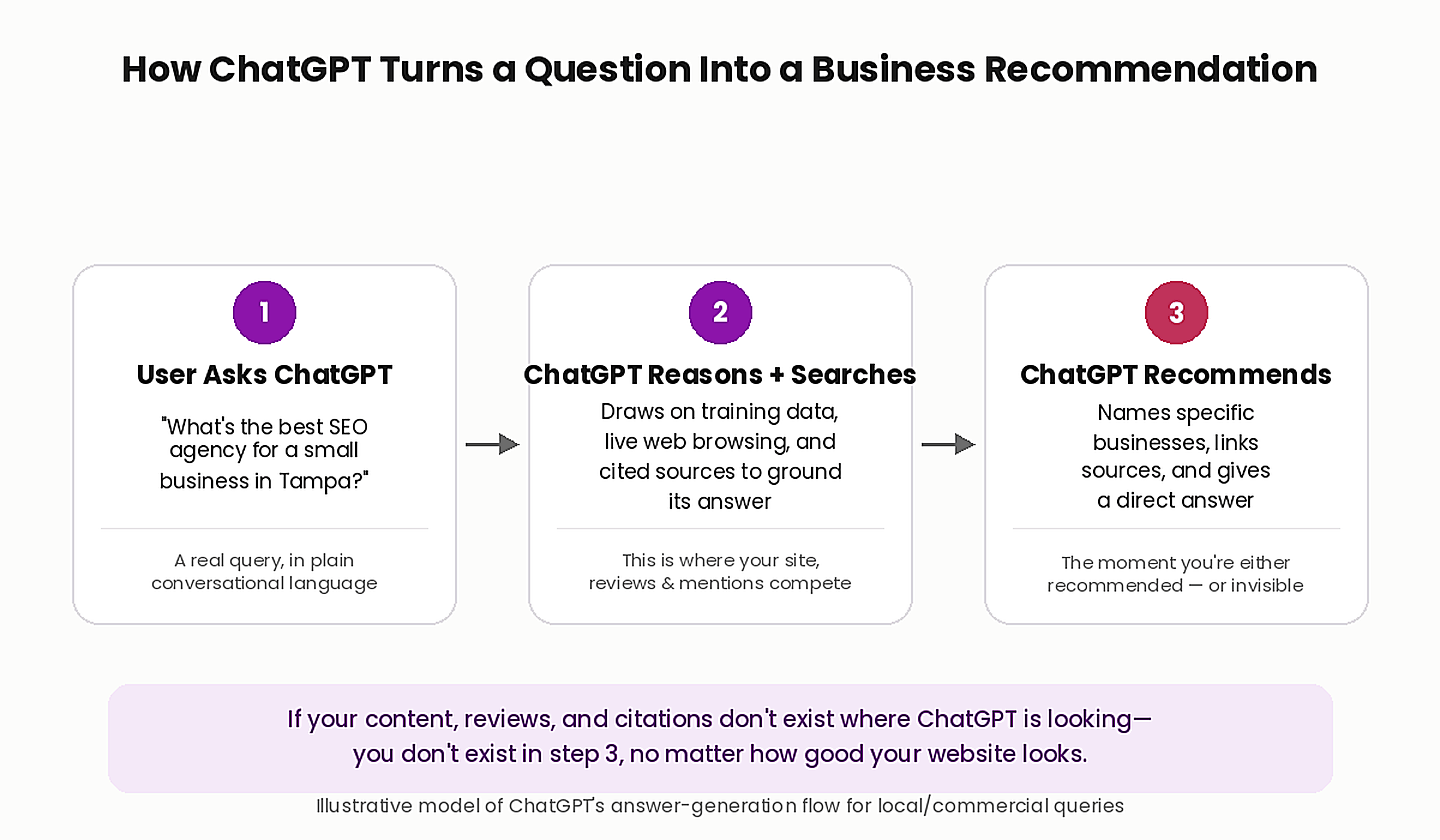
When someone asks ChatGPT “who’s a good [service] near me” or “what’s the best [product] for [use case],” there is no page of ten results to scan. There is one conversational answer, often naming two or three specific businesses by name. If you’re not one of them, you don’t get a chance to make your case — the customer may never even know you exist as an option.
This has three direct implications for brands that have never thought about being “recommended” inside a chatbot conversation:
- Zero-click discovery is now zero-click recommendation. Just as Google’s AI Overviews reduced the need to click through to a website, ChatGPT’s conversational answers can end the customer journey before your website is ever visited — for better or worse.
- Your reputation across the open web matters more than your own site copy. ChatGPT draws heavily on third-party sources — reviews, comparison articles, forums, press coverage — not just what you say about yourself. A pristine homepage means little if the rest of the web is silent about you.
- Being “recommendable” is a new, measurable marketing objective. It’s no longer enough to rank. Businesses now need to actively track and improve whether AI models mention them at all, and how favourably.
How to Adapt: A 5-Step Playbook for Getting Recommended by ChatGPT
Optimizing to be recommended by ChatGPT is a distinct discipline from optimizing for Google’s AI Overviews. ChatGPT leans more heavily on its training data, real-time web browsing, and a wide net of third-party sources, and it tends to reward genuine topical depth over raw domain authority. Here’s a practical, five-step approach.
1. Build Real Topical Depth on Your Core Services
The Semrush study of 50,000 brands found that topic “ownership” goes to the business with the deepest, most specific coverage of a subject — not necessarily the one with the strongest overall domain. Rather than spreading thin content across dozens of loosely related topics, build comprehensive, specific pages and articles around the exact services and questions your best customers actually ask.
2. Earn Mentions and Citations Beyond Your Own Website
ChatGPT’s answers are grounded in more than your homepage — it draws on reviews, industry publications, forums, and independent comparisons. Invest in digital PR, expert-contributed articles, and consistent review generation on the platforms your industry actually trusts (Google, industry-specific directories, niche communities). Every credible third-party mention is a data point ChatGPT can cite.
3. Structure Your Content So It’s Easy to Extract and Quote
AI models favor content that answers a question directly and can be lifted cleanly. Use clear H2/H3 headers phrased as real questions, put the direct answer in the first sentence of each section, add FAQ blocks, and implement structured data (Article, FAQPage, LocalBusiness schema) so both crawlers and language models can parse your key facts unambiguously.
4. Keep Your Brand Facts Consistent Everywhere
Inconsistent names, addresses, service descriptions, or claims across your website, directories, and social profiles create ambiguity that makes an AI model less confident recommending you. Audit your NAP (name, address, phone) data, your Google Business Profile, and your top ten directory listings, and make sure they tell one consistent story.
5. Test and Track Your Visibility Inside ChatGPT Directly
You can’t improve what you don’t measure. Regularly run the actual questions your customers ask — “best [service] in [city],” “who should I use for [need]” — directly in ChatGPT, and track whether you’re mentioned, how you’re described, and who you’re being compared against. Treat this like rank tracking, but for AI conversations instead of search results pages. 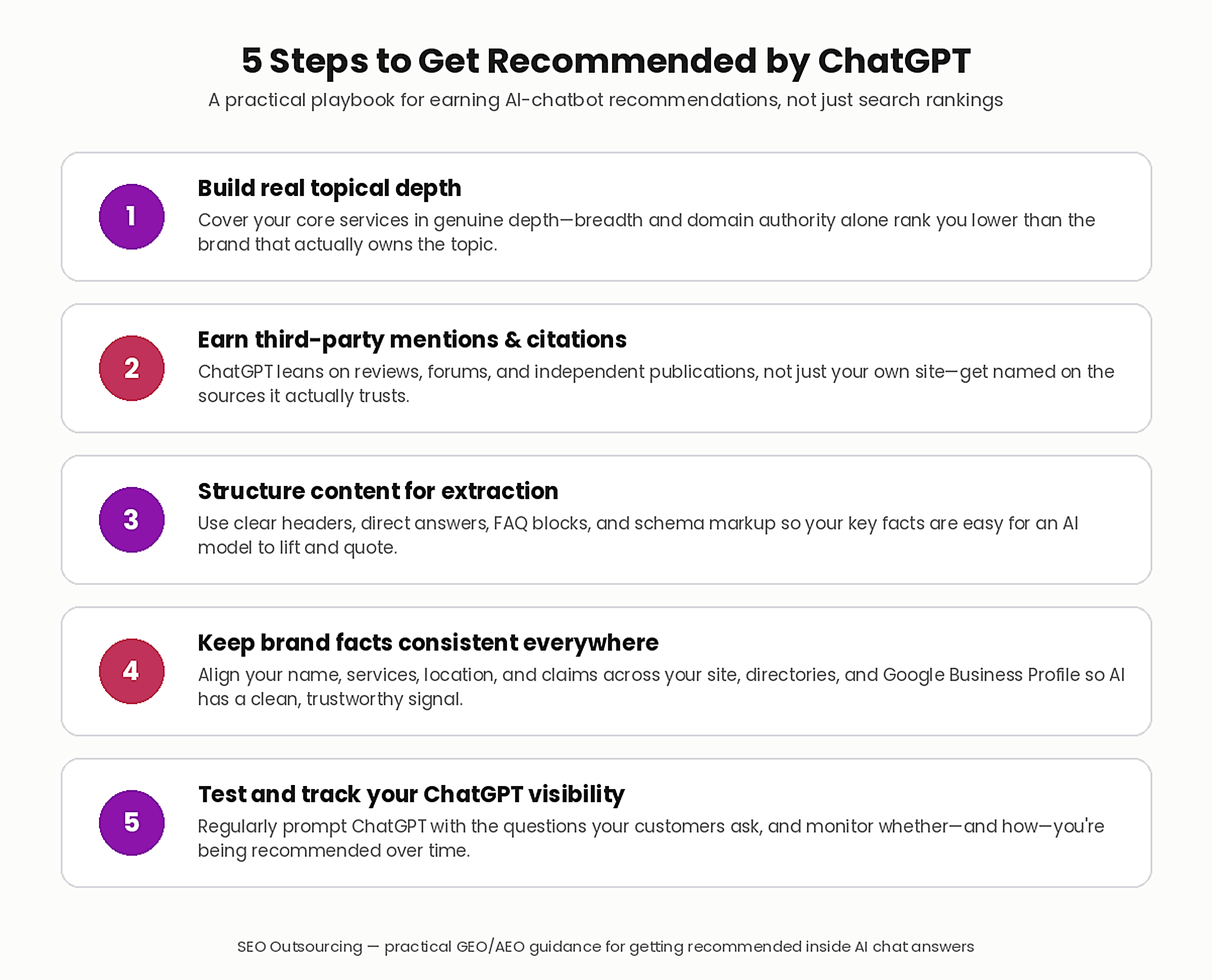
FAQ
Q: How many people actually use ChatGPT every week?
A: According to OpenAI’s own figures reported in February 2026, ChatGPT has more than 900 million weekly active users, up from 700 million in September 2025 and 400 million in February 2025 — more than doubling in a single year.
Q: Is getting recommended by ChatGPT the same as ranking in Google’s AI Overviews?
A: No. While both rely on structured, extractable content, ChatGPT draws more heavily on its own training data plus live web browsing and a broad range of third-party mentions, and research shows it rewards deep topical coverage over raw domain authority more than Google’s AI Overviews typically do.
Q: Does an AI chatbot recommendation actually lead to real customers, or just traffic?
A: Early 2026 research from Similarweb found that users are 2.5 times more likely to visit an AI-recommended brand than a competitor, and that AI-referred visitors browse roughly twice as many pages and spend roughly twice as long on-site as typical visitors — a strong signal of purchase intent.
Q: My industry doesn’t have an obvious “ChatGPT leader” yet. Is it too late to compete?
A: Not at all. A Semrush study of 50,000 brands found only 15.2% of over a thousand categories currently have a clear owner in ChatGPT’s answers — meaning the large majority of industries, likely including yours, are still open for a business that builds genuine topical authority now.
Q: What’s the single fastest thing I can do to improve my chances of being recommended?
A: Start by testing the exact questions your customers ask directly in ChatGPT to see who currently gets recommended and why, then focus your content and reputation-building efforts on closing that specific gap — rather than trying to optimize for AI visibility in the abstract.
Contact Us
ChatGPT’s 900 million weekly users are already asking the questions your next customers would ask — the only question is whether your business is part of the answer. SEO Outsourcing helps businesses build the topical authority, third-party citations, and structured content that get you recommended inside AI conversations, not just ranked on a search results page. Call 813-397-3665 or visit www.seooutsourcing.com to get an AI visibility assessment for your business today.