68% of Google Searches Now End Without a Single Click — Here’s How to Adapt
Most people who search Google today never visit a website at all. According to new research from SparkToro, 68% of Google searches in 2026 end with zero clicks — meaning the searcher gets their answer directly on the results page, inside an AI Overview, a featured snippet, or a knowledge panel, and never lands on anyone’s site.
That number is up sharply from 60.45% just two years earlier, in 2024. SparkToro founder Rand Fishkin calls it the fastest zero-click acceleration in a decade, and the trajectory suggests it isn’t slowing down. For brands, publishers, and marketers who still measure success primarily in website visits, that is a serious problem: the traffic you’re not getting was never “lost” in the traditional sense — the search happened, the user got an answer, and your site was simply never part of the transaction.
This shift doesn’t mean SEO is dead. It means the goalposts have moved from “get the click” to “get cited, get recognized, and get chosen” — often without ever seeing a visitor in your analytics. Below is what the data actually shows, why it matters, and a practical playbook for adapting.
The Data: How Zero-Click Search Has Accelerated
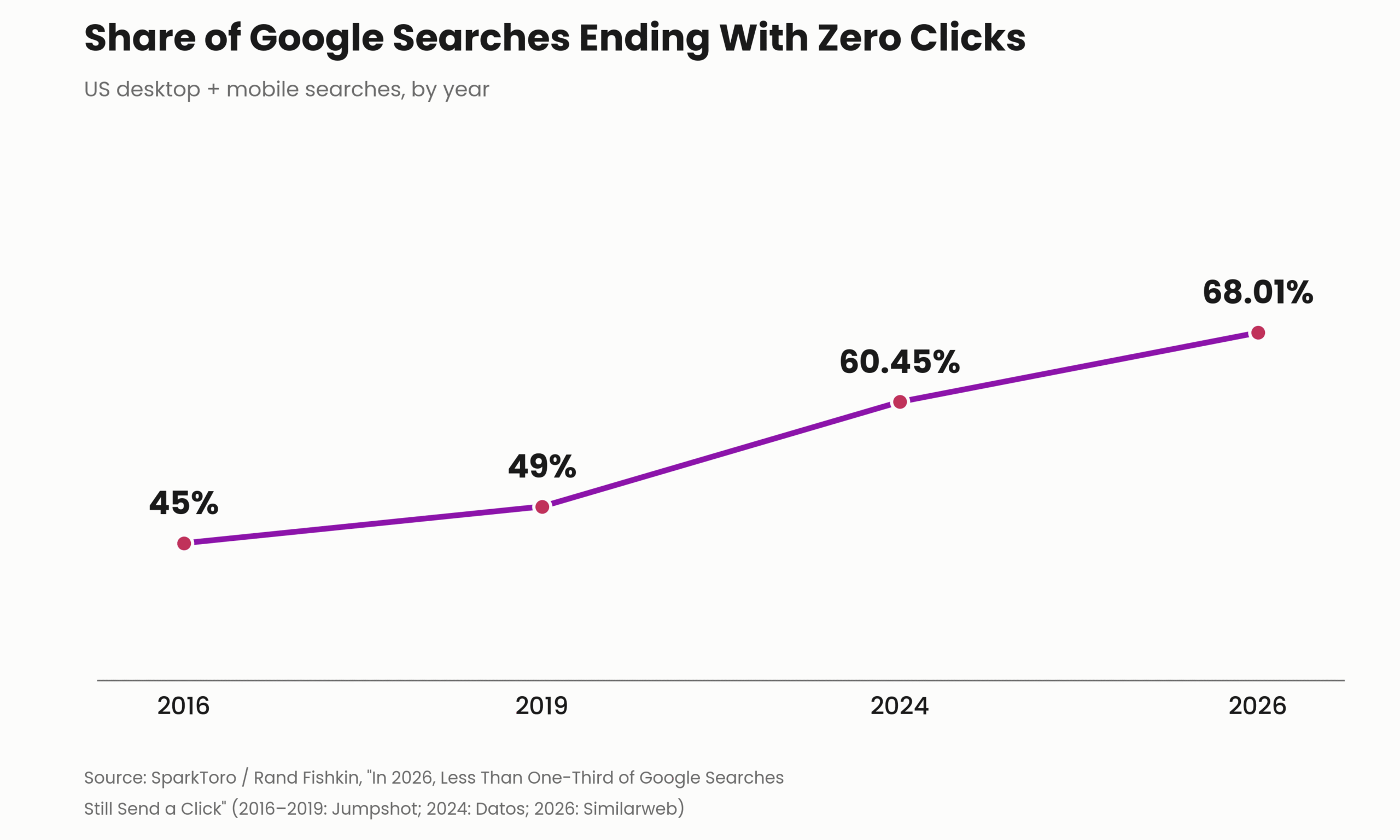
SparkToro’s analysis, led by Rand Fishkin and published in June 2026, tracks the share of Google searches that end without any click to a third-party website. The historical trend line tells the real story — this isn’t a sudden 2026 spike, it’s a decade-long acceleration that just hit a new gear:
- 2016: ~45% of Google searches ended with zero clicks
- 2019: 49% of Google searches ended with zero clicks
- 2024: 60.45% of Google searches ended with zero clicks
- 2026: 68.01% of Google searches ended with zero clicks (first four months of the year)
That’s a 23-percentage-point jump in a decade — with more than a third of that increase (roughly 7.5 points) happening in just the two years between 2024 and 2026. SparkToro’s 2026 figures are built on Similarweb’s desktop and mobile web panel data for the US (January–April 2026), while the 2024 baseline came from Datos (now owned by Semrush) and the earlier 2016/2019 figures used the now-defunct Jumpshot clickstream panel. Notably, the analysis excludes Google’s mobile search app, where zero-click features are described as “even more aggressive” — meaning the true rate across all of Google’s surfaces may be even higher than 68%.
The Broader 2026 Picture: Zero Clicks Vary Sharply by Query Type
SparkToro’s topline number is a US-wide average, but zero-click behavior is not evenly distributed. A complementary 2026 analysis from Digital Applied breaks the rate down by query type and finds a wide spread: informational queries hit a 74.3% zero-click rate (with simple factual lookups like definitions climbing as high as 86–91%), while transactional queries — the ones closest to a purchase — sit much lower, at 39.4%. Commercial investigation queries land in between at 51.2%, and local queries run high at 68.7%, roughly matching the overall average.
Industry data tells a similar story: dictionary/definition sites see zero-click rates near 89%, health and finance content sits in the 74–78% range, and e-commerce/retail queries stay comparatively low at 38%. Separately, research from Contently on AI Overviews found that when an AI-generated summary appears on a results page, users click a traditional organic result only about 8% of the time, compared to 15% when no AI summary is shown — but the clicks that do happen convert notably better, since they represent higher-intent, more qualified traffic.
The takeaway: zero-click loss is not uniform. If your content lives in the “quick fact” zone, you should expect the steepest declines. If it lives in the “help me decide and buy” zone, clicks are eroding more slowly — but even there, they’re eroding.
Why This Matters for AI and Digital Marketing
For more than two decades, digital marketing has run on a simple assumption: rank well, earn the click, count the session. That model is breaking down. When 68 out of every 100 searches never send a visitor anywhere, click-through rate and organic sessions stop being reliable proxies for how visible — or how trusted — a brand actually is.
This creates a measurement blind spot. A brand can be the answer Google (or an AI Overview) surfaces for thousands of searches a day and see almost none of that reflected in Google Analytics. Meanwhile, a competitor with a smaller footprint but a page structured to earn direct citations might build outsized brand awareness that never shows up in a traffic report either. Marketers who report success purely on sessions and click-through rate are increasingly measuring an ever-shrinking slice of their actual reach.
The practical implication is that “being findable” and “being cited by name” are becoming more valuable than “being clicked.” Search is turning into an attribution engine for brand impressions as much as it is a traffic-referral engine — and marketing plans, budgets, and KPIs built entirely around click volume need to catch up.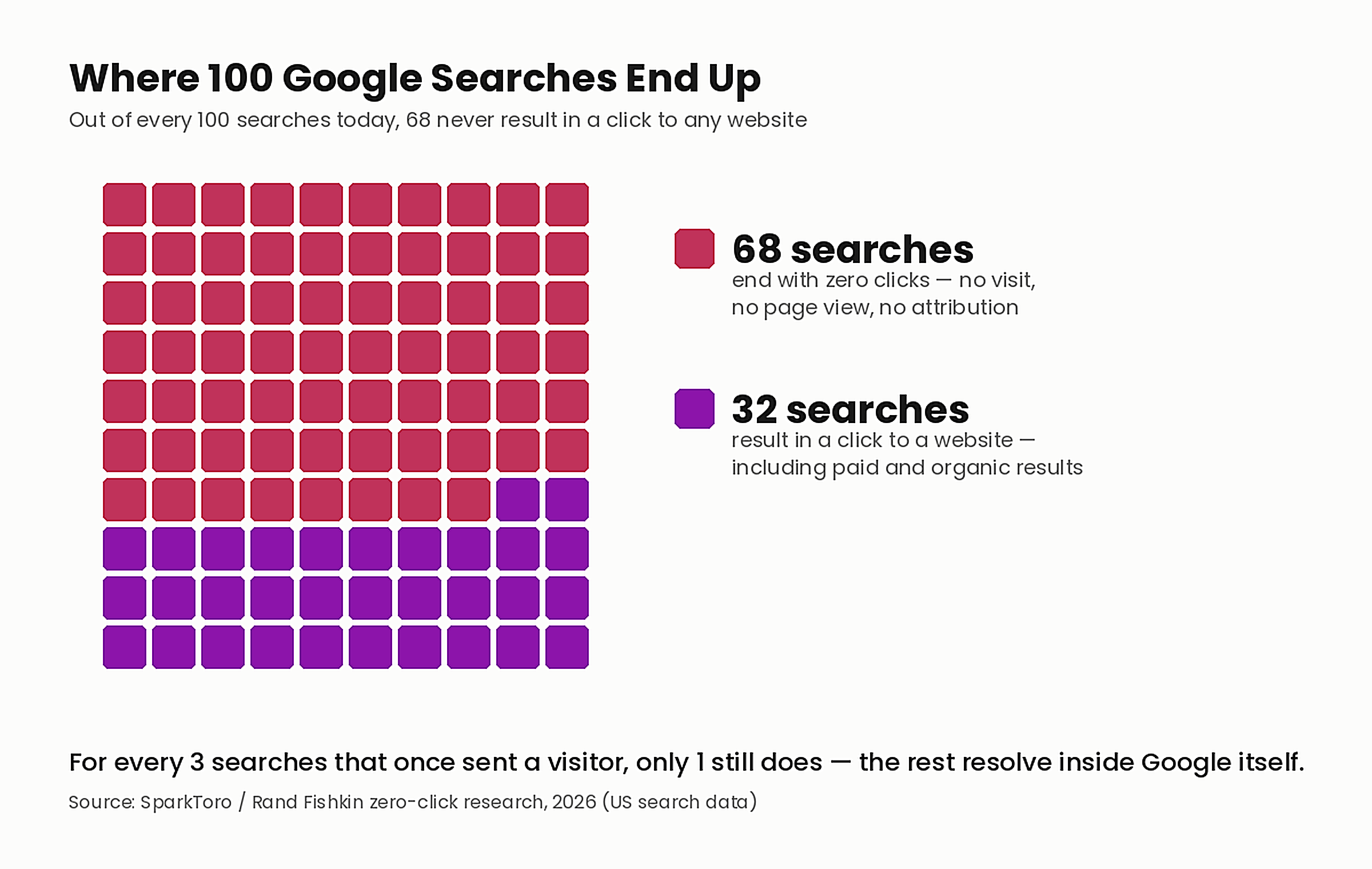
How to Adapt: A 5-Step Playbook for a Zero-Click World
Winning in a zero-click environment means optimizing for visibility, citation, and trust — not just clicks. Here’s a practical, five-step approach.
1. Earn citations, not just rankings
Structure content so AI Overviews, featured snippets, and answer engines can quote you directly, by name. That means clear, direct-answer formatting near the top of a page: concise definitions, numbered steps, and well-labeled data — content built to be lifted and cited, not just scrolled.
2. Track brand mentions, not only clicks
Add citation and mention tracking to your reporting alongside traditional analytics. Monitor how often your brand is named in AI Overviews and chatbot answers, how your knowledge panel performs, and how branded search volume trends — these are now leading indicators of visibility that clicks alone can’t capture.
3. Build entity authority off-site
Search engines and AI systems increasingly reason about brands as “entities,” pulling signals from Wikipedia, Wikidata, review platforms, and third-party press coverage. Investing in a strong off-site presence helps engines trust — and cite — your brand even when a user never visits your site directly.
4. Optimize for the searches that still click
Not all queries are equally zero-click. Prioritize commercial-investigation and transactional keywords, where click-through rates remain comparatively healthy (39–51% still result in a visit) and where a click is far more likely to convert into a lead or sale. Put your best content and internal linking behind these terms.
5. Diversify demand generation beyond organic search
If organic click volume is structurally shrinking, growth can’t depend on it alone. Build direct channels — email lists, communities, branded search demand, partnerships — so that visibility earned in zero-click search results (brand recall, trust, awareness) has somewhere else to convert.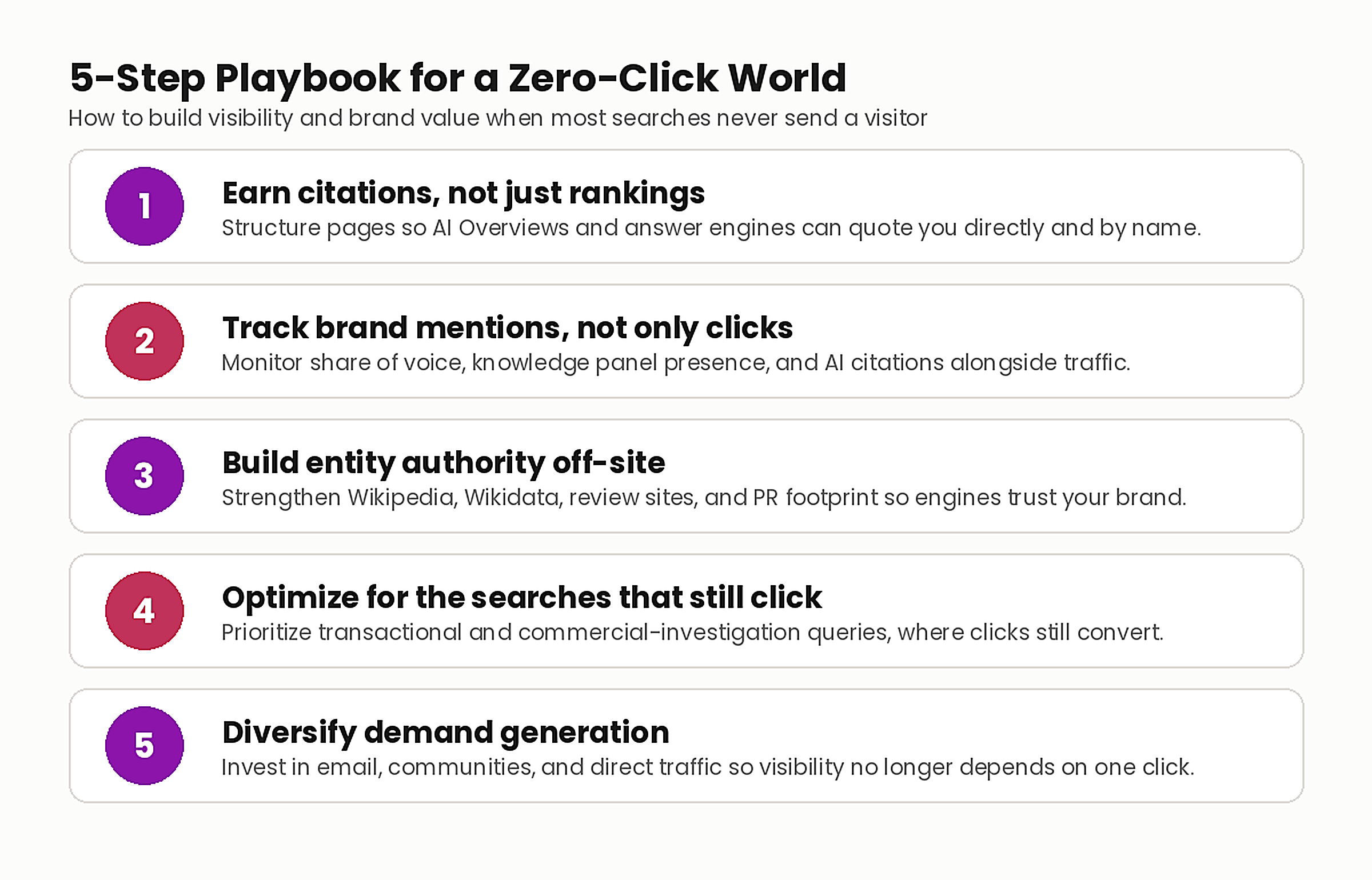
FAQ
What does “zero-click search” mean?
A zero-click search is a Google search where the user finds their answer directly on the search results page — through an AI Overview, featured snippet, knowledge panel, or similar feature — and never clicks through to a website.
What percentage of Google searches are zero-click in 2026?
According to SparkToro’s 2026 research, 68.01% of Google searches in the US ended without a click in the first four months of 2026, up from 60.45% in 2024.
Is the zero-click rate the same for every type of search?
No. Zero-click rates vary widely by query type: informational and definition-style queries can exceed 85–90% zero-click, while transactional and commercial-investigation queries — closer to a purchase decision — see rates closer to 39–51%.
Does zero-click search mean SEO no longer matters?
No — it means the goal of SEO is expanding. Ranking and earning clicks still matter, especially for transactional queries, but brands now also need to optimize for being cited and recognized inside AI Overviews and other zero-click features where no click occurs.
How can a business measure success if fewer searches send traffic?
Businesses should pair traditional traffic and conversion metrics with citation tracking, branded search volume, knowledge panel visibility, and AI mention monitoring to get a fuller picture of search-driven brand value.
Contact Us
Zero-click search isn’t a reason to abandon SEO — it’s a reason to modernize how you measure and pursue it. If your reporting still treats organic sessions as the whole story, you’re likely underselling the visibility your brand is already earning — and missing opportunities to earn more of it. SEO Outsourcing helps brands build strategies for both worlds: content and technical SEO that still wins clicks, plus citation, entity, and AI-visibility optimization for the two-thirds of searches that don’t. Call (813) 397-3665 or visit www.seooutsourcing.com to get a free zero-click visibility assessment for your site.