Your Business Is Being Seen More and Visited Less
If your search impressions are climbing while your website traffic stays flat — or falls — you’re not imagining it, and you’re not alone. According to BrightEdge’s one-year analysis of Google AI Overviews, total Google search impressions rose 49% between May 2024 and May 2025, while click-through rates dropped roughly 30% over the same period.
That combination — more visibility, fewer visits — is the defining shift in search since AI Overviews launched. Google is answering more questions directly on the results page, which means your brand can appear prominently and still never get the click. Rankings and impressions used to be a reliable proxy for traffic. That relationship is breaking down.
This isn’t a temporary dip while users adjust to a new interface. It’s a structural change in how search works, and it’s accelerating in 2026. Brands that keep measuring success by impressions and rankings alone are optimizing for a metric that no longer predicts revenue.
The Data: What BrightEdge Found One Year Into AI Overviews
BrightEdge’s May 2025 report, marking one year since AI Overviews debuted, laid out the scope of the shift with hard numbers. Here’s what the research found:
- Search impressions rose 49% year-over-year as Google surfaced more results, including AI-generated summaries, for a wider range of queries.
- Click-through rates fell approximately 30% across the same period, even as impressions grew.
- AI Overviews now appear on more than 11% of Google queries, a 22% increase in coverage since their debut.
- Longer, complex queries answered within AI Overviews grew 49%, showing Google is increasingly resolving multi-part questions without sending users anywhere.
- Ranking-style queries (“best,” “top,” “vs.”) saw AI Overview-driven traffic patterns shift, with associated click behavior down 60%.
- Comparison queries declined 14%, another category where users historically clicked through to compare options and now often don’t.
- Industry exposure varies widely: Healthcare, Education, B2B Tech, and Insurance see the strongest AI Overview presence; Travel and Entertainment see moderate growth; Ecommerce has seen limited AI Overview penetration so far, leaving more of its click behavior intact.
Google still commands over 90% of search market share, so this isn’t a story about losing ground to ChatGPT or Perplexity — it’s a story about Google itself changing what a “result” means. 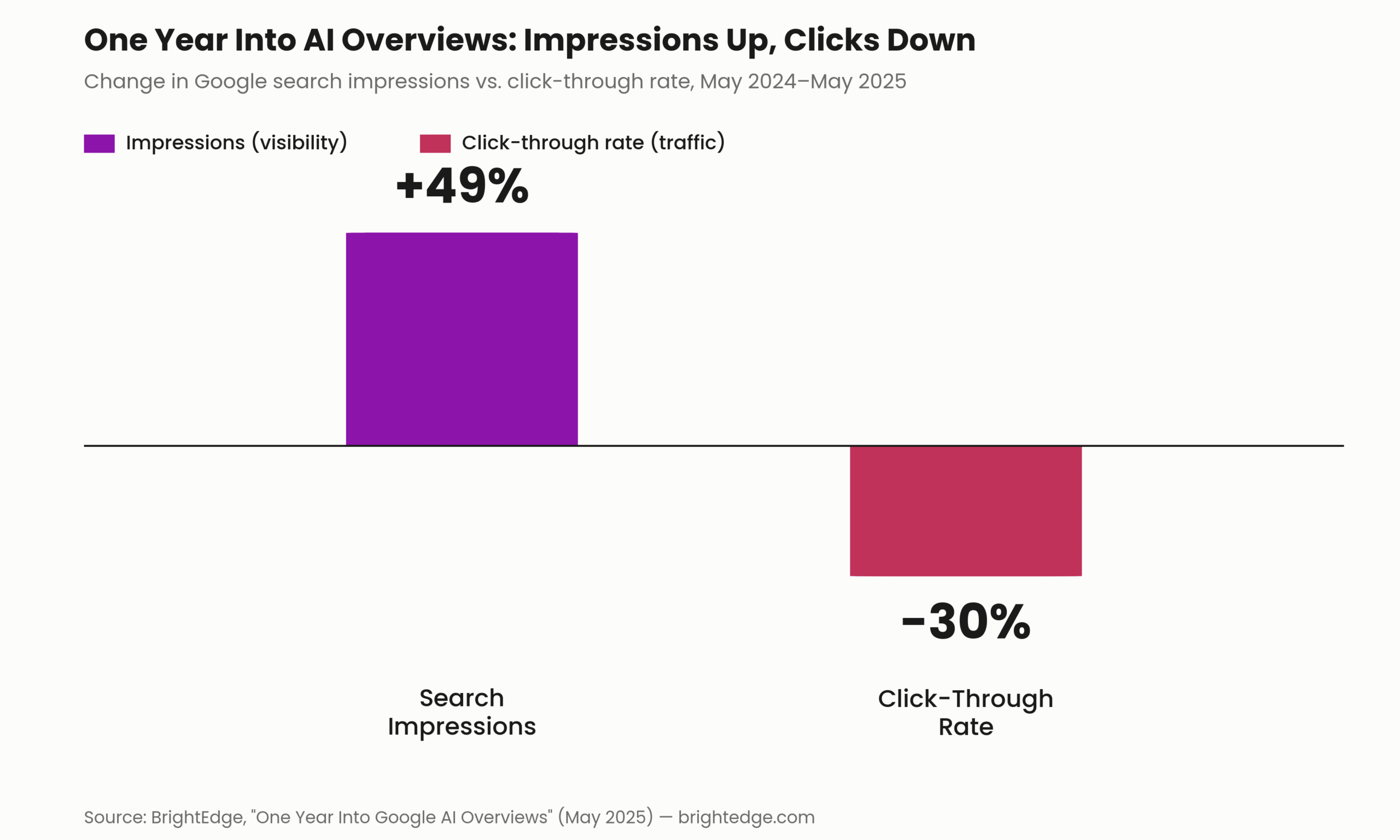
The Gap Is Widening in 2026
If anything, the trend BrightEdge documented in 2025 has deepened. A June 2026 analysis by SparkToro, built on Similarweb clickstream data covering U.S. searches from January through April 2026, found that Google searches ended without any click 68.01% of the time — up 7.56 percentage points from 60.45% in 2024. The share of searches that generated at least one click fell by 22.9% over that same window. Most notably, the report found that when AI Overviews appear on a results page, click-through rates drop by nearly 60% compared to results without them.
Put the two studies together and the pattern is unmistakable: visibility is up, and the conversion of that visibility into a website visit is down, and the gap is not closing. It’s widening as AI Overviews expand into more query types and more industries.
Why This Matters for AI and Digital Marketing
For years, impressions and average ranking position were treated as leading indicators of business results — if you ranked higher and showed up more, traffic and revenue followed. That assumption is now unreliable. A brand can win the impression, appear in an AI Overview citation, and still see zero incremental visitors, because the user got their answer without leaving the search results page.
This has three practical implications for AI and digital marketing teams:
- Impressions and rankings are visibility metrics, not business metrics. They tell you that you were present, not that you were valuable to the visitor or the business.
- CTR benchmarks from 2023 or earlier are no longer a fair baseline. A “declining” CTR on a query where an AI Overview now appears may still represent a strong competitive position relative to peers on the same query.
- Budget and reporting built around impression share will overstate performance. Executives reading impression and ranking dashboards can be misled into thinking a program is working when actual site traffic and leads are stagnant.
None of this means visibility is worthless — appearing in an AI Overview or a featured snippet still builds brand recognition and can influence buyers who click later or search your brand name directly. But visibility can no longer be the finish line for a marketing report. It has to be reconnected to what happens after the impression: clicks, conversions, and revenue. 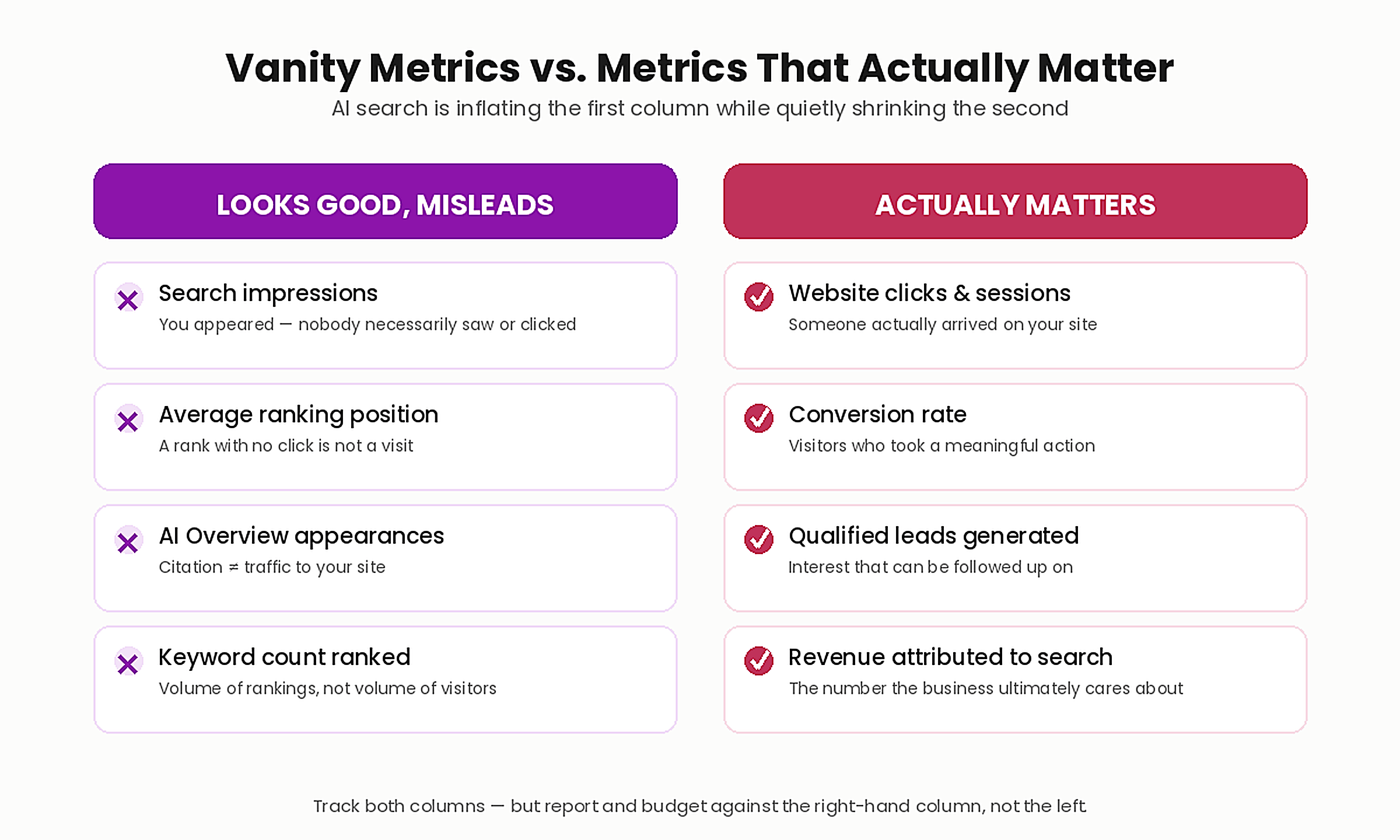
How to Adapt: A 5-Step Playbook
Raw CTR decline is a market-wide trend you can’t reverse on your own. What you can control is how much of your remaining visibility converts into traffic, leads, and revenue. Here’s a practical playbook for doing that.
1. Audit the Gap Between Impressions and Clicks
Start in Google Search Console. Pull impressions and CTR by query and by page, then flag queries where impressions are rising but clicks are flat or falling — that’s where AI Overviews or other SERP features are likely absorbing clicks. This audit tells you exactly where the visibility-to-traffic gap is widest for your site, rather than relying on industry-wide averages.
2. Optimize to Be the Cited Source, Not Just a Listed Result
When Google does generate an AI Overview, being the source it cites still drives brand exposure and some referral traffic, and it strengthens topical authority signals. Structure content with clear, direct answers near the top, use descriptive headers, back claims with original data or expertise, and mark up content with schema so it’s easy for AI systems to parse and attribute.
3. Build Traffic Capture Outside the Click
If fewer users click through from a given search, you need more paths back to your site: branded search (which converts at higher rates and is less affected by AI Overviews), email capture, retargeting, and content distributed on platforms your audience already uses. Treat the AI Overview era as a reason to diversify acquisition, not a reason to abandon search.
4. Re-anchor Reporting Around Revenue, Not Rankings
Replace “we improved our average ranking” or “impressions grew 20%” as headline KPIs with metrics tied to business outcomes: qualified leads, conversion rate by landing page, and revenue by channel. Keep impressions and rankings as diagnostic metrics in the background, not the primary measure of program success.
5. Prioritize High-Intent Queries Where Clicks Still Happen
Not all query types are affected equally — BrightEdge’s data shows ecommerce and transactional intent queries have seen more limited AI Overview penetration than informational queries. Shift content and optimization effort toward the bottom-funnel, high-intent searches where users still need to visit a website to complete an action, and treat top-of-funnel informational content as a visibility and authority play rather than a direct traffic driver. 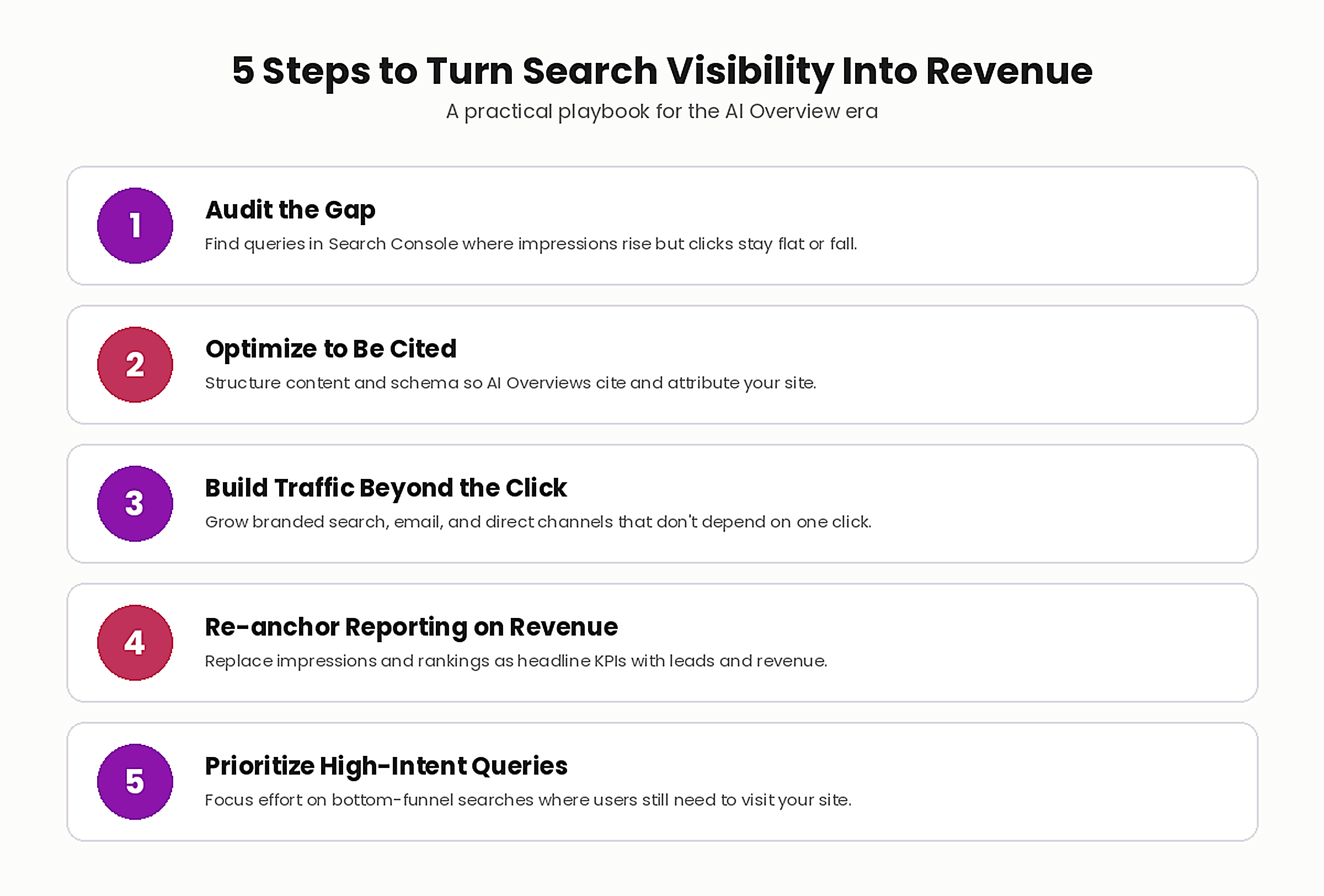
FAQ
Did AI Overviews really cause a 30% drop in click-through rates?
BrightEdge’s one-year analysis found that Google click-through rates fell roughly 30% between May 2024 and May 2025, the same period AI Overviews expanded to cover over 11% of queries. The two trends are correlated and mechanistically linked — when Google answers a question directly on the results page, fewer users need to click through — though other SERP changes contributed as well.
Is this trend continuing in 2026?
Yes. A June 2026 SparkToro analysis of Similarweb data found that 68.01% of U.S. Google searches ended without a click in early 2026, up from 60.45% in 2024, and that click-through rates drop nearly 60% specifically on searches where an AI Overview appears.
Does losing clicks mean losing business?
Not necessarily, but it does mean impressions and rankings alone are unreliable indicators of business performance. Some of that visibility still builds brand awareness and drives later branded searches or direct visits. The key is tracking conversions and revenue directly rather than assuming visibility automatically translates into traffic.
Which industries are least affected?
BrightEdge found ecommerce currently has the most limited AI Overview penetration compared to healthcare, education, B2B tech, and insurance, meaning transactional and product-focused queries have, so far, retained more traditional click behavior.
What should businesses do differently right now?
Audit the gap between impressions and clicks in Search Console, optimize to be the cited source within AI Overviews, diversify traffic acquisition beyond organic clicks, and re-anchor reporting around leads and revenue instead of rankings and impressions.
Contact Us
Impressions still matter, but they aren’t the scoreboard anymore. If your search visibility is climbing while your traffic and leads aren’t, it’s time for a strategy built around what actually happens after the impression. SEO Outsourcing helps businesses turn AI-era search visibility into real, measurable traffic and revenue. Call 813-397-3665 or visit www.seooutsourcing.com to get a search strategy built for how Google works today, not how it worked two years ago.