Traditional Search Is Shrinking: Where Are Your Customers Going?
In February 2024, Gartner predicted that traditional search engine volume would drop 25% by 2026, as consumers shifted their queries to AI chatbots and virtual agents. It was one of the boldest forecasts to come out of the SEO industry in years, and it set off two years of anxious “is SEO dead?” headlines from marketers who built their entire acquisition strategy around ranking on Google.
Now that 2026 is actually here, we can check the prediction against reality. The short version: the 25% collapse Gartner warned about did not happen at the aggregate level — but the underlying story it was trying to tell is playing out anyway, just in a more fragmented, harder-to-track way. Search hasn’t shrunk so much as it has splintered, with a growing share of buying-stage questions now getting answered inside ChatGPT, Gemini, Perplexity, and AI Overviews instead of on a results page a brand can rank on.
For any business still measuring “search visibility” solely by blue-link rankings, that fragmentation is the real threat. This post breaks down what Gartner actually predicted, what 2026 data shows really happened, and a practical five-step playbook for making sure your customers can still find you no matter which engine, chatbot, or assistant they ask.
The Data: Gartner’s 25% Search Volume Prediction
Here is exactly what Gartner said, and how it’s held up two years later:
- The prediction: By 2026, traditional search engine volume would drop 25%, with search marketing losing market share to AI chatbots and other virtual agents, according to Gartner’s February 19, 2024 press release.
- The reasoning: Gartner VP Analyst Alan Antin said generative AI tools were “becoming substitute answer engines, replacing user queries that previously may have been executed in traditional search engines” — meaning the threat wasn’t fewer questions, it was the same questions going somewhere else.
- The warning to marketers: Gartner urged brands to “rethink their marketing channels strategy,” since organic and paid search have historically been the primary channels for awareness and demand generation.
- The reality check, two years later: Independent 2026 analysis of search traffic data found that aggregate organic search traffic actually declined only about 2.5% year-over-year — nowhere near the 25% Gartner projected — and that total search engine traffic, including Google, was essentially flat to slightly up.
- What did change: Click-through rates on the roughly 30% of queries that trigger AI Overviews dropped sharply, even as raw query volume held steady, and a separate channel of AI-native traffic grew explosively alongside traditional search rather than replacing it outright.
So the 25% figure, taken literally, was too aggressive. But treating that as “nothing changed” would be a mistake — the next section shows why. 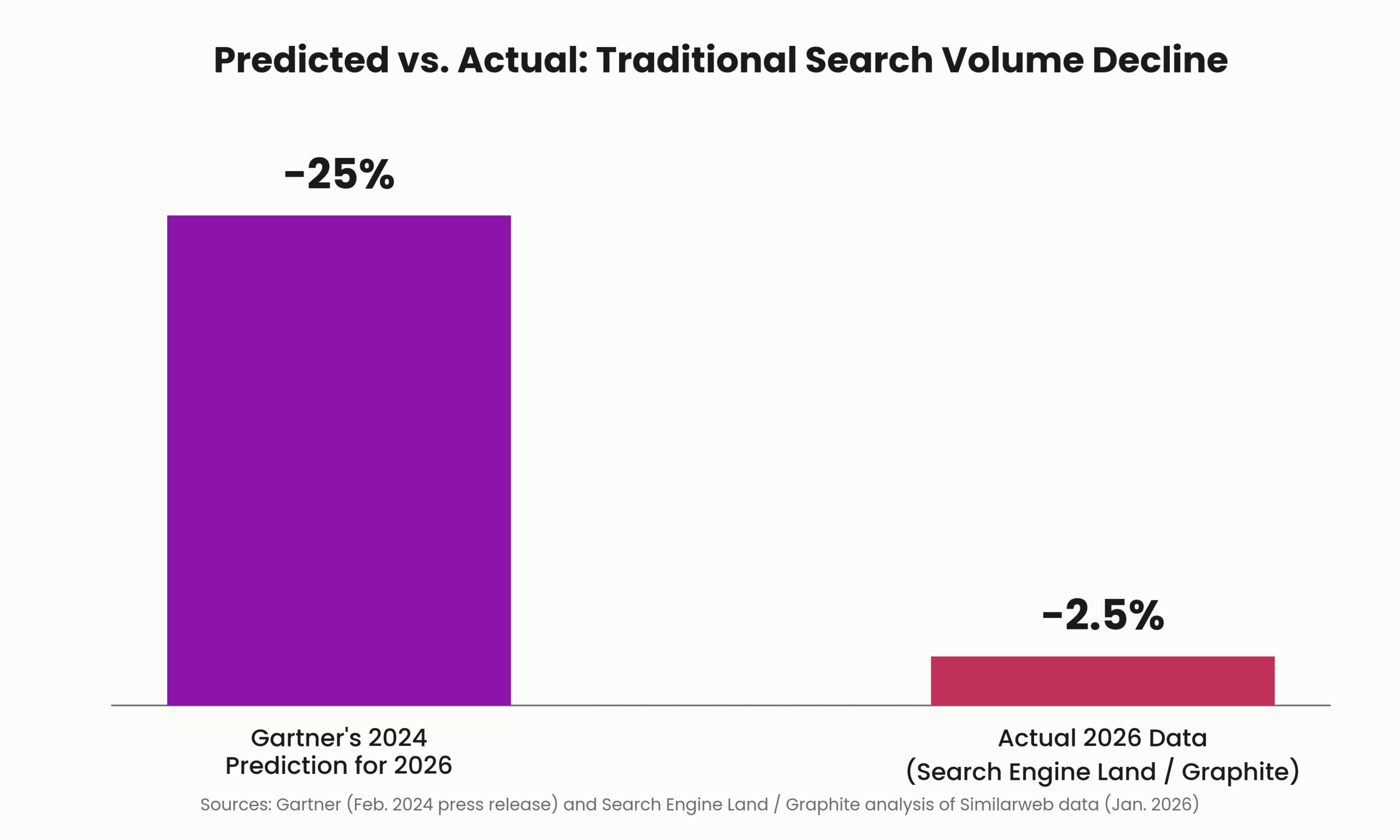
What 2026 Data Actually Shows About Search
The most rigorous check on the Gartner number comes from Search Engine Land’s January 2026 report, built on Graphite’s analysis of Similarweb data across more than 40,000 major U.S. websites. It found organic search traffic down just 2.5% year-over-year, with Google’s own traffic actually rising about 0.8% over the same period. Graphite validated the pattern against first-party Google Search Console and Analytics data from participating sites, so this isn’t a vanity estimate — it’s a fairly rigorous cross-check. The same analysis found that when AI Overviews appear (roughly 30% of search results pages), click-through rates on the organic listings below them fall by about 35%.
At the same time, a separate but related shift is happening in a channel Gartner’s aggregate search number doesn’t capture at all. Similarweb’s July 2026 generative AI traffic data shows monthly visits across generative AI platforms grew 70% year-over-year, reaching 9.5 billion visits with 655 million unique visitors — up 57% year-over-year. Notably, ChatGPT’s own share of that AI traffic fell from roughly 76% to 53% as Gemini and Claude gained ground, meaning the AI-answer category as a whole is growing even faster than any single chatbot.
Put those two data points together and a clearer picture emerges than “search is shrinking 25%.” Traditional search query volume is holding up. What’s shrinking is the certainty that a click on a traditional search result is where a customer’s research journey starts and ends. Attention is splitting across AI Overviews, standalone chatbots, and traditional blue links simultaneously, and each one now needs to be treated as its own discovery surface with its own optimization requirements.
Why This Matters for AI and Digital Marketing
For brands whose entire customer acquisition strategy is built around ranking in traditional Google search, this fragmentation creates three specific risks that don’t show up in an aggregate traffic dashboard:
Visibility without clicks. A brand can be accurately summarized inside an AI Overview or a ChatGPT answer and receive zero traffic credit for it. Traditional analytics were built to measure clicks, not mentions, so marketing teams can be losing share of voice without any dashboard alerting them to it.
A new, unfamiliar ranking system. AI chatbots decide what to cite based on different signals than classic SEO — structured data, clear factual statements, third-party corroboration, and content that’s easy for a model to extract and summarize. A page perfectly optimized for the Google algorithm circa 2022 is not automatically optimized to be cited by an AI answer engine in 2026.
Concentration risk. Businesses that draw 80–90% of qualified leads from organic and paid Google search are effectively making a single-channel bet at exactly the moment the market is diversifying. Even a modest shift in where research-stage questions get answered can quietly erode a pipeline that looked healthy on paper.
None of this means traditional SEO is obsolete — Google still processes billions of searches a day and remains the largest single discovery surface on the internet. It means “search visibility” now has to be defined more broadly than rankings on a results page. 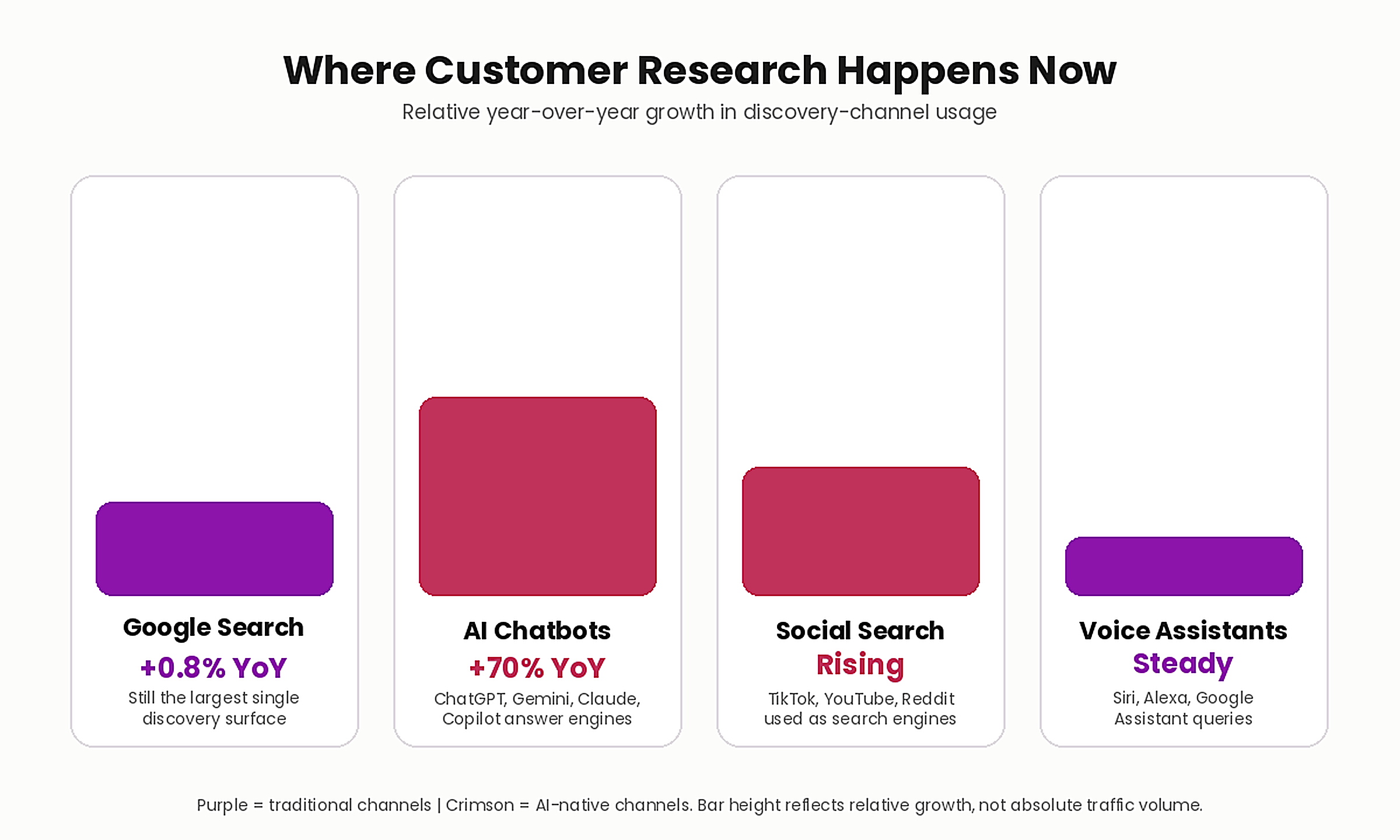
How to Adapt: A 5-Step Playbook
Diversifying beyond traditional Google search doesn’t mean abandoning SEO — it means expanding what “being found” means. Here’s a practical playbook.
1. Audit Where You’re Currently Overexposed
Start by quantifying how concentrated your lead flow really is. Pull the last 12 months of traffic and lead-source data and calculate what percentage comes from organic and paid Google search specifically, versus everything else combined. Most businesses that haven’t looked at this in a while are surprised by how lopsided it is. This number is your baseline for measuring diversification progress.
2. Optimize Content for Answer Engines, Not Just Search Engines
Answer engine optimization (AEO) means restructuring content so AI models can easily extract and cite it: lead with direct answers to specific questions, use clear headers that mirror how people actually phrase queries, back claims with specific numbers and sources, and avoid burying the key fact three paragraphs deep. Content that reads well to a language model tends to also read well to an impatient human — it’s rarely a tradeoff.
3. Strengthen Structured Data and Third-Party Authority Signals
AI systems favor content they can verify. Implement schema markup (Article, FAQPage, Organization, Review) so machines can parse your content unambiguously, and invest in getting cited, quoted, or listed by third-party sites your industry already trusts — press mentions, review platforms, and industry directories all function as corroboration signals that make AI tools more confident citing you.
4. Establish a Presence on AI-Native Discovery Channels
Don’t wait for AI chatbots to find you passively. Monitor how your brand and competitors are described in ChatGPT, Gemini, Perplexity, and Copilot responses for relevant queries, and identify gaps where competitors are being recommended and you aren’t. Some of this is addressable through the same authority-building work in Step 3; some requires direct engagement on platforms like Reddit, YouTube, and industry forums that AI models heavily draw from.
5. Track New Metrics Beyond Rankings and Clicks
Add AI referral traffic, brand mention frequency in AI answers, and share-of-voice tracking to your regular reporting alongside traditional rankings and organic traffic. These metrics are newer and less standardized than classic SEO KPIs, but treating them as “nice to have” rather than core reporting is how teams miss the shift while it’s happening. 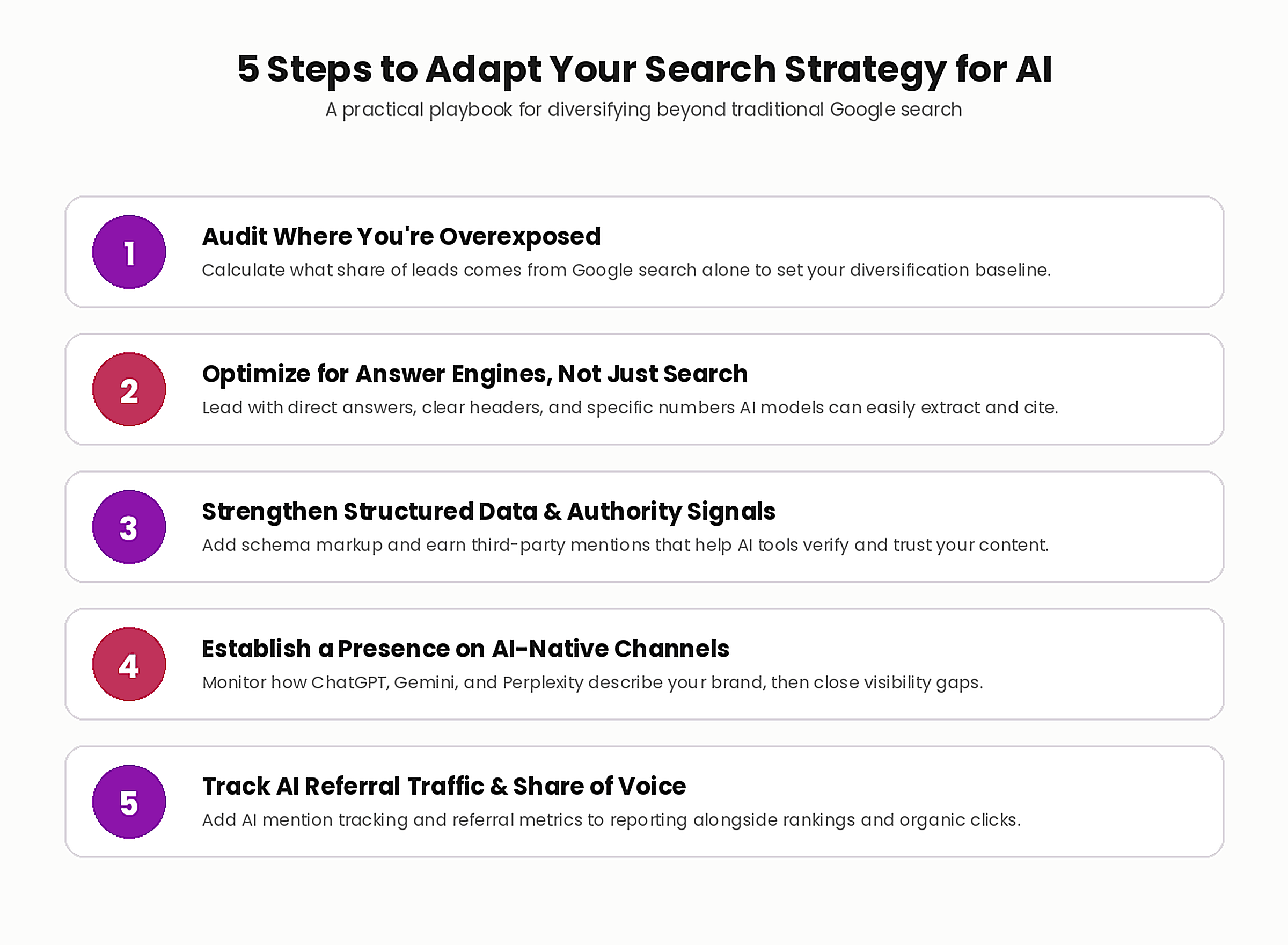
FAQ
Did search engine volume actually drop 25% by 2026 like Gartner predicted?
No. 2026 data shows organic search traffic declined only about 2.5% year-over-year, and total Google search traffic was roughly flat to slightly up. The aggregate 25% decline did not materialize, though click-through rates dropped sharply on the subset of queries where AI Overviews appear.
If the prediction didn’t come true, why does this still matter for my business?
Because the underlying shift Gartner was pointing at — attention moving from traditional results pages to AI-generated answers — is real and accelerating, even if it isn’t showing up as a raw volume decline. Generative AI platform traffic grew 70% year-over-year through mid-2026, and a growing share of research-stage questions are being answered inside chatbots rather than through a click to your website.
What is answer engine optimization (AEO)?
AEO is the practice of structuring content so AI chatbots and answer engines can easily extract, understand, and cite it — using clear direct answers, strong structured data, and verifiable facts — as a complement to traditional SEO.
Should I stop investing in traditional SEO?
No. Google still handles billions of searches daily and remains the single largest discovery channel. The right move is to add AI-focused visibility work alongside your existing SEO program, not replace it.
How do I know if AI chatbots are already mentioning my brand?
You can prompt major chatbots directly with the kinds of questions your customers ask, review analytics tools that track AI referral traffic, and monitor for brand mentions in AI-generated summaries. An SEO partner experienced in AI visibility tracking can set this up as ongoing reporting.
Contact Us
Search isn’t disappearing — it’s fragmenting across Google, AI Overviews, chatbots, and voice assistants, and businesses that only optimize for one of those surfaces are leaving visibility on the table. SEO Outsourcing helps brands diversify their search strategy for the AI era, from technical SEO and content optimization to answer engine visibility tracking. Call 813-397-3665 or visit www.seooutsourcing.com to get a for a free assessment of where your customers are searching now—and whether they can actually find you there.