AI Overviews Cut Organic CTR 61% on Informational Queries — Is Your Content Ready?
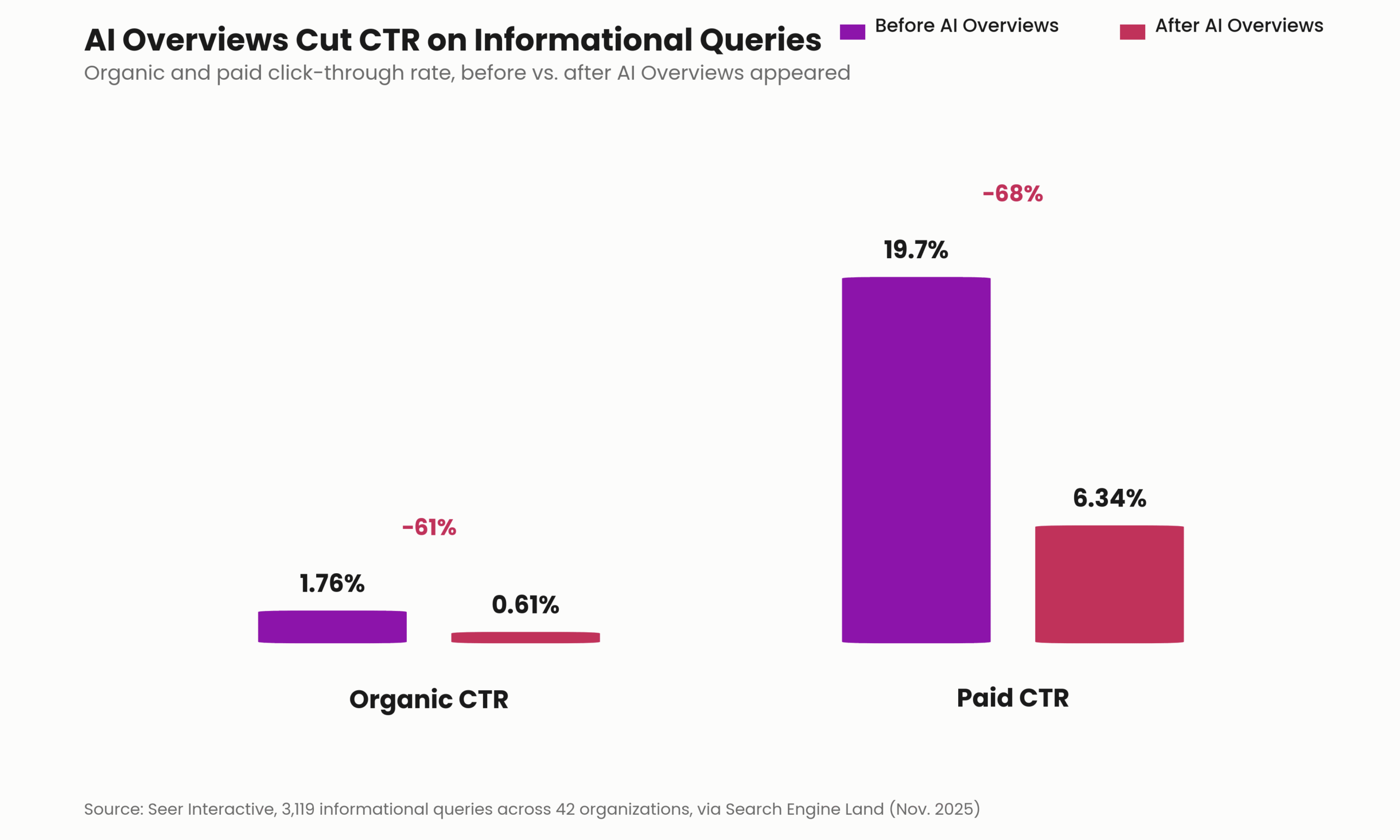
If your site leans on blog posts, guides, and other informational content to drive organic traffic, a new dataset should get your attention. According to a Search Engine Land report on research from Seer Interactive, organic click-through rate on informational queries fell 61% — from 1.76% to 0.61% — once AI Overviews appeared in the results. That is not a rounding error. It is a fundamental shift in how much traffic even a well-ranked page can expect to earn.
Informational content is exactly the kind of content most sites rely on to build topical authority, capture top-of-funnel demand, and feed a content marketing engine. It’s also, according to this data, the content type getting hit hardest by AI Overviews. If a meaningful share of your traffic comes from “how does X work,” “what is Y,” or “best ways to Z” queries, this study is describing your business.
What makes the finding more striking is what happened to paid search in the same dataset. Advertisers did not simply absorb the clicks organic lost — paid CTR fell too, by 68%. That is a genuinely counterintuitive result, and it changes the conversation from “shift budget to ads” to “the entire click economy on these queries is shrinking.”
The Data: What the Study Found
The underlying research was conducted by Seer Interactive and published via Search Engine Land on November 4, 2025. Here are the exact figures:
- Organic CTR fell 61% on informational queries once AI Overviews appeared — from 1.76% to 0.61%.
- Paid CTR fell 68% on the same queries — from 19.7% to 6.34%.
- The analysis covered 3,119 informational queries across 42 organizations, drawing on 25.1 million organic impressions and 1.1 million paid impressions.
- The data spans June 2024 through September 2025, using Google Search Console, Google Ads, and Seer’s generative AI tracker to classify queries by AI Overview presence and citation status.
- Even queries without AI Overviews saw organic CTR decline 41% year-over-year, suggesting some of the drop reflects broader changes in search behavior — not AI Overviews alone.
- Being cited inside an AI Overview mattered a lot: cited brands earned 35% more organic clicks and 91% more paid clicks than brands that weren’t cited on the same query set.
Read the full breakdown at Search Engine Land.
The Story Continues Into 2026
Seer Interactive has continued tracking this data, and its April 2026 update adds important nuance. Drawing on 5.47 million tracked queries across 53 brands from January 2025 through February 2026, the newer report found that organic CTR on AI Overview queries actually rebounded in early 2026 — climbing from 1.3% in December 2025 to 2.4% in February 2026. The researchers attribute much of the earlier volatility to impression volume changes (more queries triggering AI Overviews) rather than a permanent collapse in clicks.
Citation status remains the biggest lever: informational queries where a brand was cited in the AI Overview averaged 2.07% CTR across 2025, versus just 0.94% when not cited, and 3.35% when no AI Overview appeared at all. In other words, even being cited doesn’t fully close the gap to a traditional result — but it more than doubles your odds compared to being ignored.
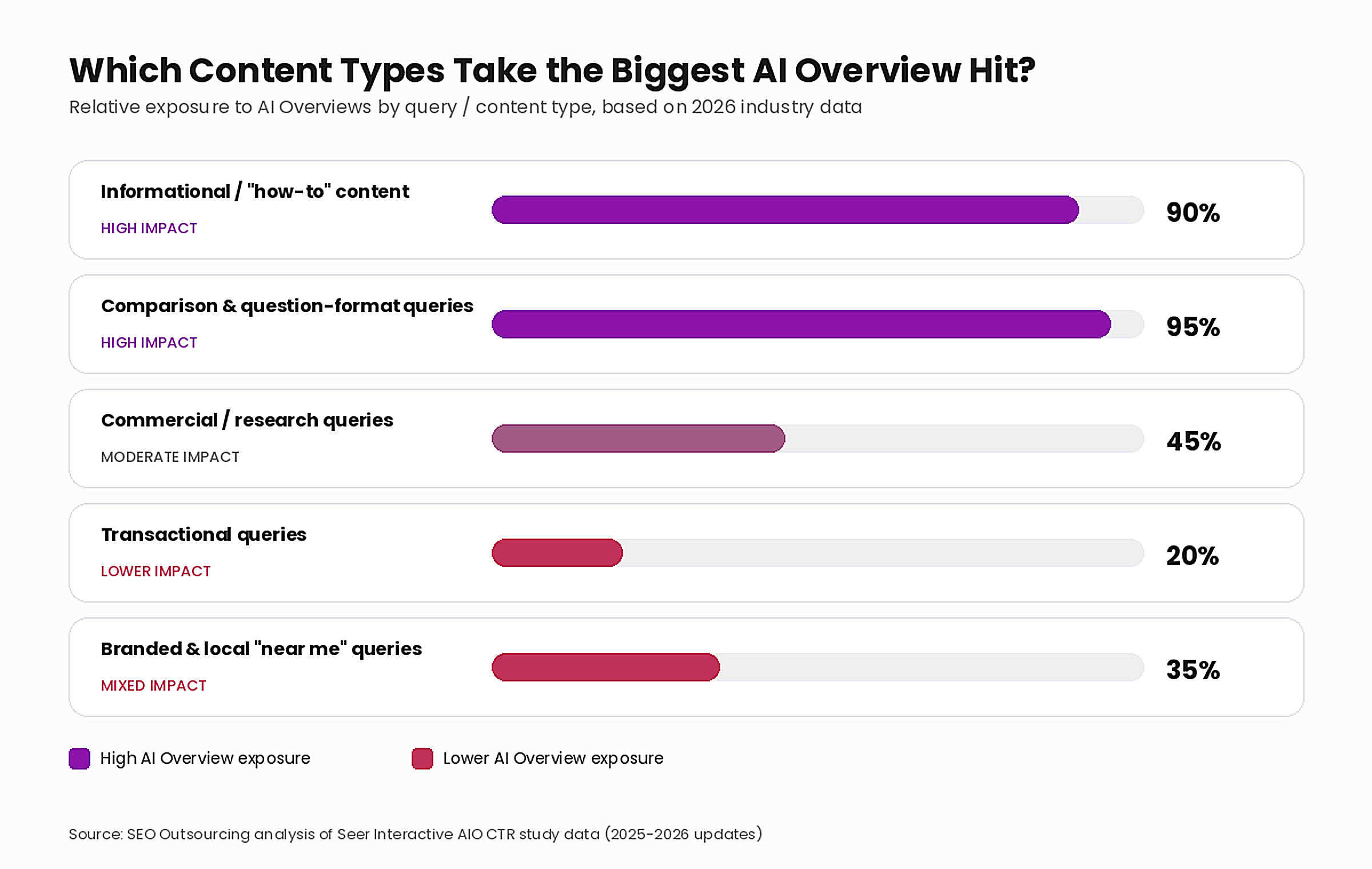
The 2026 update also breaks down AI Overview prevalence by query intent, and the pattern confirms exactly what the original 61% figure suggested: informational queries show AI Overviews 36% of the time, compared to just 8% for commercial queries and 5% for transactional queries. Comparison queries (95.4%) and question-format queries (85.9%) are the most exposed formats of all.
Why This Matters for AI and Digital Marketing
For any team running a content marketing program, this data reframes what “success” looks like for top-of-funnel content:
- CTR is no longer a reliable proxy for content quality. A page can rank #1 and still see clicks evaporate simply because it answers a question AI Overviews can summarize directly. Judging informational content purely on click volume will make good content look like it’s failing.
- Informational content is disproportionately exposed. With AI Overviews appearing on 36% of informational queries versus single digits for transactional intent, the traffic mix most content teams have optimized for over the last decade — guides, explainers, listicles — is exactly where the risk is concentrated.
- Citation is the new ranking #1. Being quoted or linked inside an AI Overview delivers dramatically more clicks than being absent from it, even when overall CTR is compressed. Structuring content to be citable is now as important as structuring it to rank.
- Paid isn’t a safety net here. Because this dataset showed paid CTR falling too, marketing teams can’t assume they can simply reallocate budget from SEO to PPC and expect the same return on these query types.
How to Adapt: A 5-Step Playbook
Informational content isn’t dead — but treating it the way you did in 2022 will keep costing you clicks. Here’s a practical playbook for making it resilient.
1. Audit which content is AI Overview-exposed
Start by segmenting your Search Console data by query type and, where possible, by AI Overview presence. You’re looking for the pages where impressions are flat or growing but clicks and CTR are falling — that’s the signature of AI Overview exposure, not a ranking problem. Prioritize your audit around your highest-traffic informational URLs first.
2. Optimize for citation, not just rank position
AI Overviews pull from pages that answer questions directly and clearly near the top of the content, use clean structure (headers, lists, defined terms), and carry credible schema markup. Rewrite your highest-value informational pages so the core answer is extractable in the first few sentences, then build depth underneath it. Being the source AI cites is now worth more than being the tenth blue link a user scrolls past.
3. Diversify how you measure content success
If CTR is compressing across the board, judging content ROI on clicks alone will undervalue pages that are still doing their job — building authority, earning citations, and supporting conversions further down the funnel. Add citation tracking, branded search lift, and assisted-conversion data to your reporting so you’re not making cut decisions based on one shrinking metric.
4. Shift more investment into transactional and bottom-funnel content
The data is consistent: transactional and commercial queries show AI Overviews far less often than informational ones, and paid CTR on those intents has proven more stable. That doesn’t mean abandon informational content — it means make sure your comparison pages, pricing pages, and local/service pages are getting the SEO investment they deserve, since they’re the more dependable traffic and revenue source right now.
5. Monitor and iterate monthly, not annually
AI Overview prevalence and citation dynamics are moving quickly — Seer’s own data shows organic CTR nearly doubling in two months in early 2026. A content strategy built on a single annual audit will miss both the risks and the openings. Build a lightweight monthly check of AI Overview presence, citation rate, and CTR trend for your top informational pages so you can react to shifts, not just report on them. 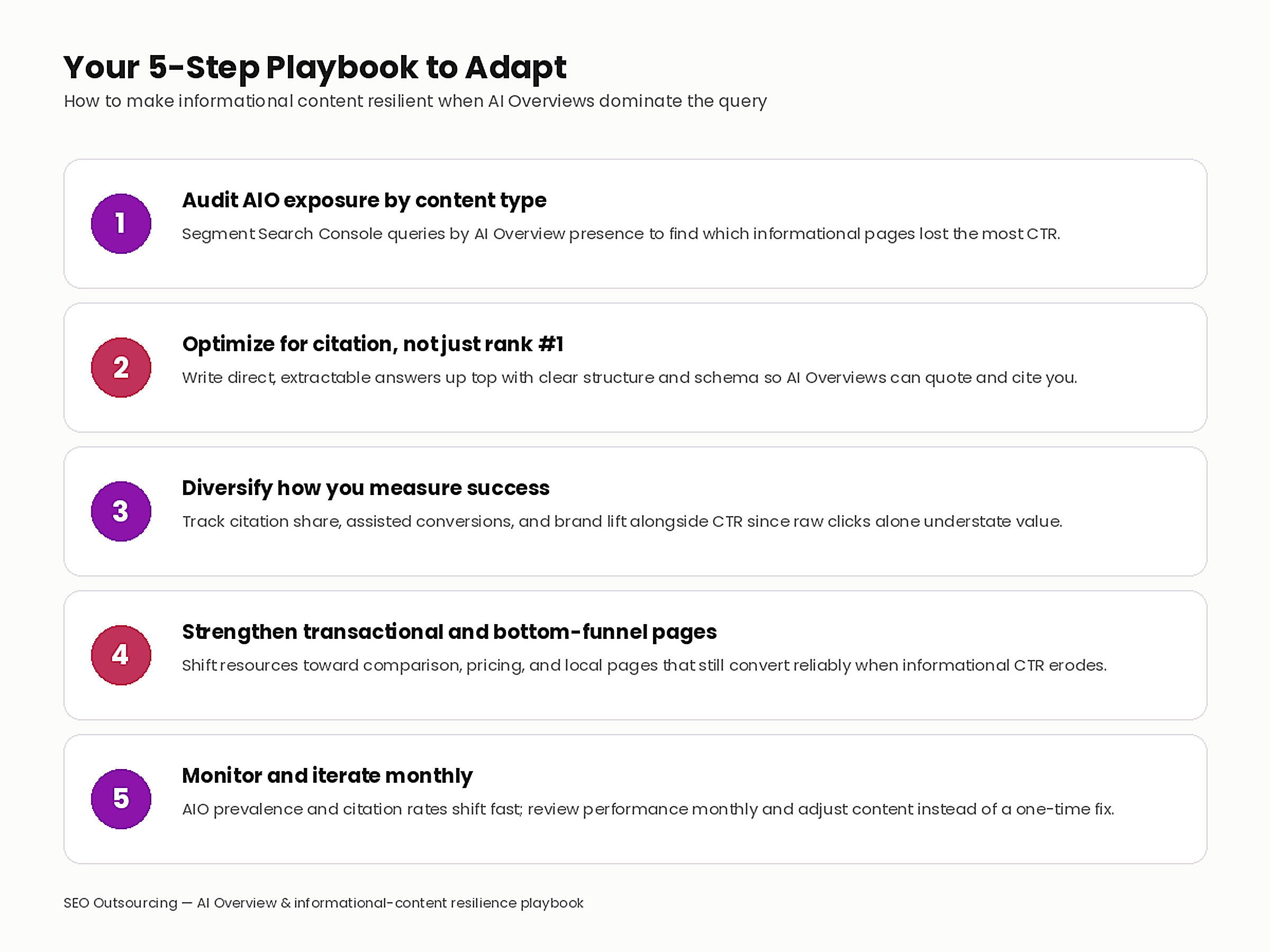
FAQ
Did organic CTR really drop 61% because of AI Overviews?
According to Seer Interactive’s study of 3,119 informational queries, organic CTR fell 61% (from 1.76% to 0.61%) when AI Overviews appeared on those queries, as reported by Search Engine Land. The same research also found that CTR declined even on queries without AI Overviews, suggesting AI Overviews are one factor among several driving lower click rates.
Did paid search pick up the traffic organic lost?
No — this is one of the more surprising findings. Paid CTR on the same queries fell 68% (from 19.7% to 6.34%), so advertisers did not simply capture the clicks organic content lost. Both channels contracted together on informational queries with AI Overviews present.
Which content types are most at risk from AI Overviews?
Informational and question-format content is the most exposed. Seer Interactive’s 2026 update found AI Overviews appear on 36% of informational queries, versus just 8% of commercial and 5% of transactional queries, with comparison queries (95.4%) and question-format queries (85.9%) showing the highest AI Overview prevalence of all.
Does getting cited in an AI Overview actually help?
Yes. Cited brands saw 35% more organic clicks and 91% more paid clicks than brands not cited on the same queries, and Seer’s 2026 data found cited pages averaged more than double the CTR of non-cited pages on informational queries (2.07% vs. 0.94%).
What should I do first if my informational content traffic is dropping?
Start with an audit: segment your Search Console data to find pages where impressions are stable but clicks and CTR are declining. That pattern usually points to AI Overview exposure rather than a ranking or content-quality problem, and it tells you exactly which pages to prioritize for citation-focused optimization.
Contact Us
CTR compression from AI Overviews isn’t a reason to abandon content marketing — it’s a reason to get sharper about which content earns clicks and citations, and which needs a different job to do. SEO Outsourcing helps businesses audit informational content for AI Overview exposure, restructure pages to earn citations, and rebalance investment toward the query types still converting reliably. Call 813-397-3665 to get a content strategy built for how search actually works in 2026.