Ranking #1 on Google Isn’t the Win It Used to Be
For twenty years, the number one organic ranking was the finish line of SEO. Land the top spot on Google and the clicks — and the leads, and the revenue — followed almost automatically. That assumption is now measurably wrong.
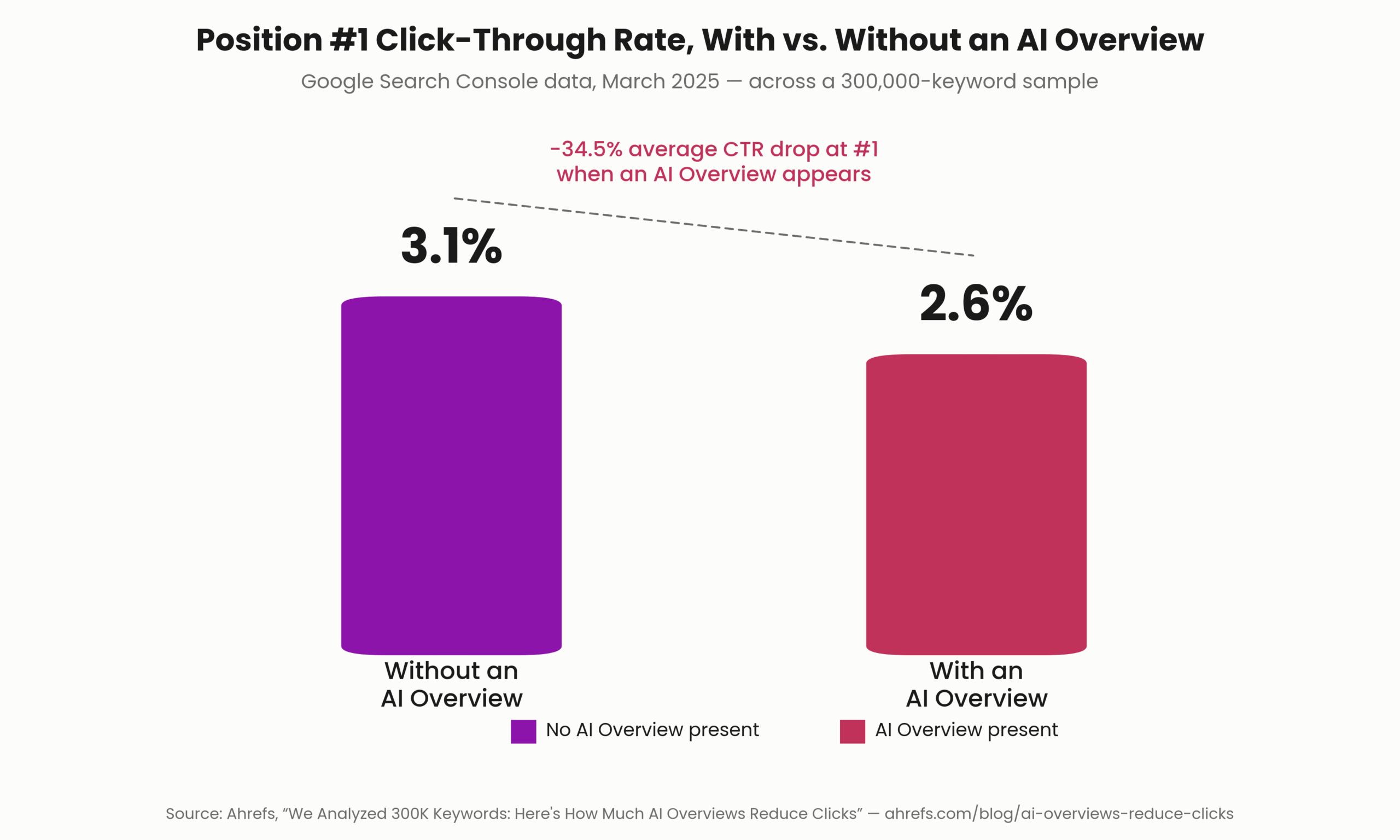
A landmark Ahrefs study analyzing 300,000 keywords found that when a Google AI Overview appears on a search results page, the click-through rate to the #1-ranking organic result falls by an average of 34.5%. The page hasn’t moved. The ranking hasn’t changed. The searcher just never has to scroll down to it, because Google’s AI already gave them an answer at the top of the page.
If your team is still reporting “we’re #1 for our target keyword” as the headline metric of SEO success, it’s time to look at what that ranking is actually worth in 2026. This post breaks down the data behind the shift, adds fresh 2026 research on where things stand now, and lays out a practical playbook for measuring — and earning — real wins in an AI-first SERP.
The Data: What Ahrefs Found Across 300,000 Keywords
Ahrefs analysts Ryan Law and Xibeijia Guan compared Google Search Console click data for the same set of keywords before and after Google’s AI Overviews rolled out broadly, isolating the effect AI Overviews have on organic performance. Here’s exactly what they found, as reported in their April 2025 study:
- Sample size: 300,000 keywords, split into 150,000 that trigger an AI Overview and 150,000 that don’t, using Google Search Console data.
- Headline finding: The average click-through rate to the #1-ranking organic result drops by 34.5% when an AI Overview is present on the results page.
- Position #1 CTR on AI Overview keywords: Fell from 7.3% in March 2024 to 2.6% in March 2025 — before and after AI Overviews became common for those queries.
- Position #1 CTR on comparable informational keywords without an AI Overview: Fell from 5.6% to 3.1% over the same period, showing some erosion is happening industry-wide, independent of AI Overviews.
- Google gives site owners no way to separate “clicks that happened because of the AI Overview” from ordinary organic clicks inside Search Console — the drop shows up only as lower CTR at every position.
- The authors note this aligns with earlier, more anecdotal reports of 20–40% click declines following AI Overview rollouts.
The takeaway is simple and uncomfortable: the #1 position is still valuable, but it converts a much smaller share of the people who see it into an actual visit than it used to.
The 2026 Picture: It’s Not Getting Better, and Citation Isn’t a Full Fix
A more recent analysis from Seer Interactive, updated in April 2026, tracked 53 brands across 5.47 million queries and 2.43 billion organic impressions between January 2025 and February 2026 — and it confirms the Ahrefs finding wasn’t a one-time blip.
By February 2026, organic CTR on queries with no AI Overview averaged 3.82%, compared to just 2.36% on queries where an AI Overview appeared — a gap consistent with the pattern Ahrefs first documented. The study also tested a hypothesis a lot of SEOs have been hoping is true: that being cited inside the AI Overview recovers the lost clicks. It helps, but not enough. Brands cited in an AI Overview earned about 120% more clicks per impression than brands whose content fed the AI Overview without a citation — but cited brands still converted 38% fewer clicks than they would have with no AI Overview on the page at all. Per one million impressions, Seer’s data breaks down to roughly 33,500 clicks with no AI Overview, 20,743 clicks when cited inside one, and just 9,445 clicks when the AI Overview appears but doesn’t cite the brand.
The same research shows AI Overviews aren’t evenly distributed either: they trigger on 95.4% of comparison-style queries (“X vs Y”), 85.9% of question-format queries, and only 27.3% of single-word queries — meaning the #1 spot for a broad head term may still behave close to normal, while the #1 spot for a common informational question increasingly gets bypassed altogether.
Why This Matters for AI and Digital Marketing
For years, rank-tracking software has been the primary scoreboard for SEO programs, and “did we hit #1” has been the metric that got reported up to leadership. That scoreboard is now telling only part of the story.
- Rank without clicks doesn’t pay the bills. A #1 ranking that converts at 2.6% instead of 7.3% delivers less than half the traffic for the same investment — budgets and forecasts built on old CTR assumptions will consistently overpromise.
- Being “correct” isn’t the same as being cited. AI Overviews synthesize an answer from multiple sources; ranking #1 doesn’t guarantee your brand is the one the AI names, links, or credits.
- Query type now determines exposure, not just position. Comparison and question-based queries — often the highest-intent, most commercially valuable searches — are also the most likely to route through an AI Overview instead of the organic list.
- Attribution is getting harder, not easier. Google Search Console still reports impressions and clicks the same way it always has, with no flag for “this impression came with an AI Overview attached,” so teams need new tracking layers to see what’s really happening.
None of this means SEO stopped working. It means the KPI that used to prove SEO was working — rank position — no longer maps cleanly to the outcome that matters, which is people actually reaching your site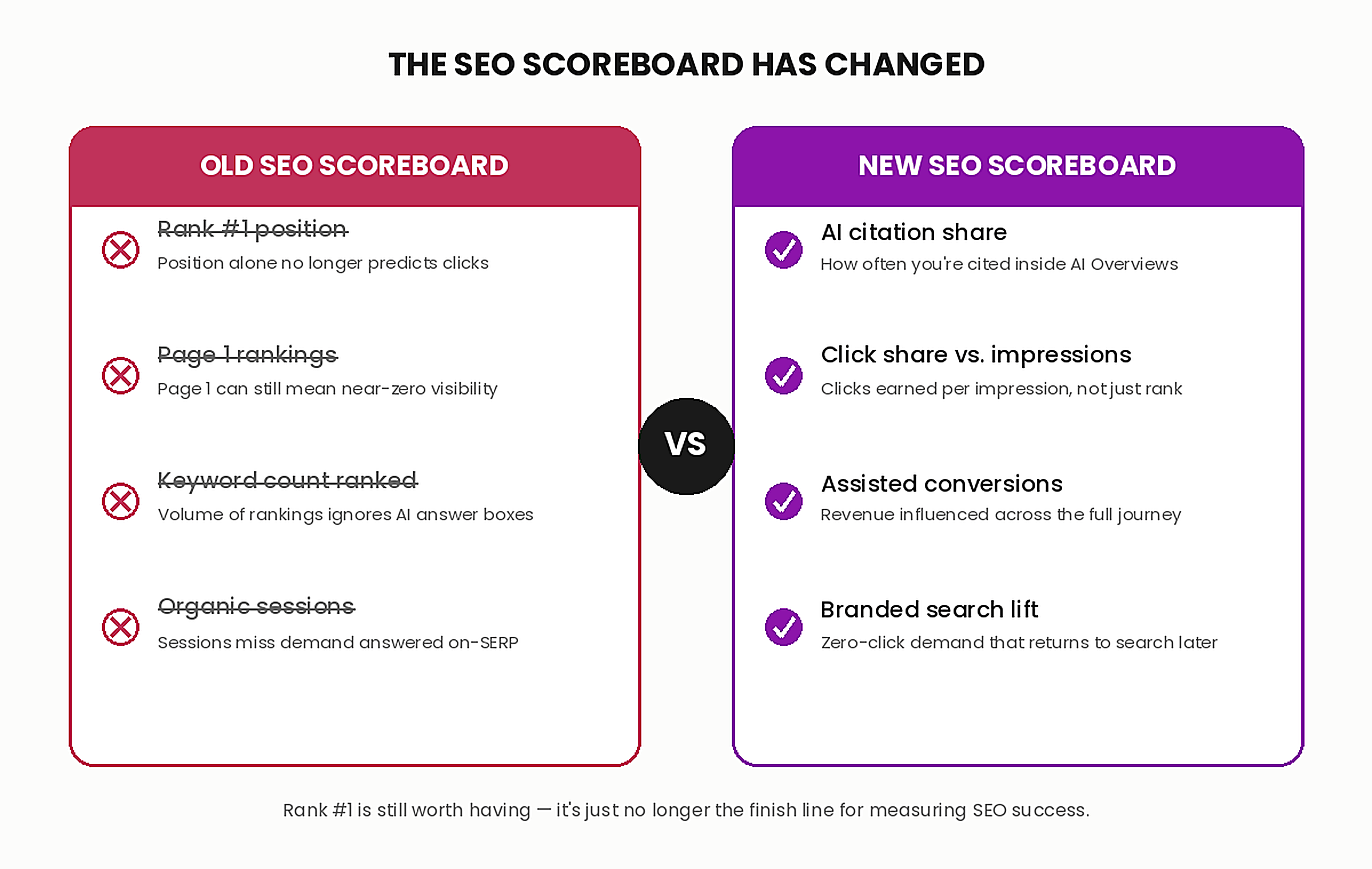
How to Adapt: A 5-Step Playbook for Measuring SEO Success Beyond #1
Ranking #1 is still worth pursuing — it’s simply no longer sufficient on its own. Here’s how to rebuild your measurement approach around what actually drives revenue in 2026.
1. Audit what AI Overviews already show for your money keywords
Before changing any KPI, find out where you stand today. Pull your top 50–100 revenue-driving keywords and check, query by query, whether an AI Overview currently appears, whether your brand is cited inside it, and what your real CTR looks like at your current position. This baseline tells you which parts of your keyword portfolio are most exposed to the CTR compression Ahrefs and Seer both documented.
2. Set a citation and click-share KPI, not just a rank KPI
Add AI citation frequency and clicks-per-impression to your standing SEO reports alongside position. A keyword can hold #1 and still be a losing metric if click share is falling quarter over quarter — you want to catch that trend before it shows up as a revenue miss.
3. Structure content to be the answer, not just the ranking page
AI Overviews pull from content that states a clear answer early, backs it with specific data, and is easy to lift into a summary — short definitional paragraphs, labeled lists, and direct numbers outperform vague, marketing-heavy copy. Optimizing to be quotable is now part of optimizing to rank.
4. Build demand that doesn’t depend on a click
Since a meaningful share of searchers now get their answer without visiting any website, invest in the channels that capture value from that zero-click moment anyway — brand awareness that drives direct and branded search later, email capture, and communities where your expertise is visible without requiring an organic click that may never come.
5. Prove impact with assisted conversions and branded lift
Move your reporting toward multi-touch attribution and branded search trend lines, not click-through counts in isolation. If organic visibility is influencing purchase decisions even when the click doesn’t happen on that first search, your measurement framework needs to be able to show that value to stakeholders.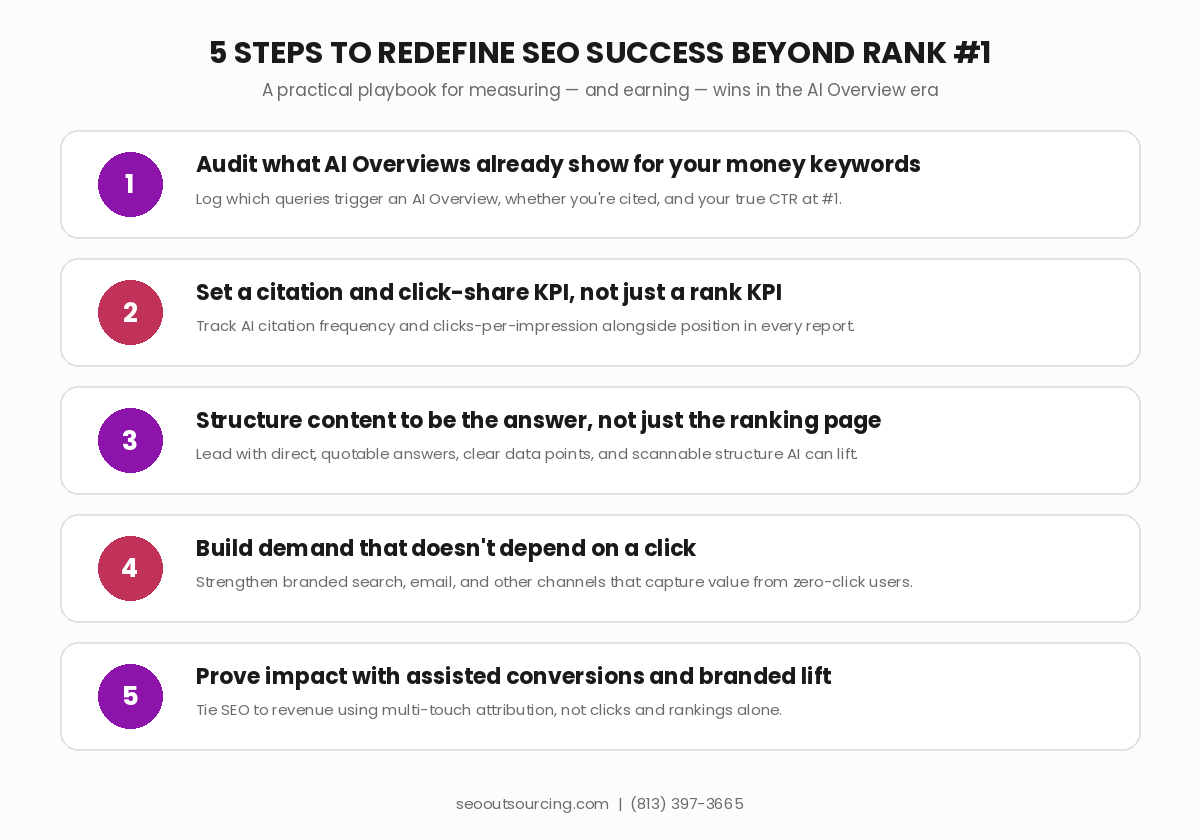
FAQ
Does SEO still matter if AI Overviews are eating clicks?
Yes. Ranking #1 still captures more clicks and more citations than any other position, and appearing in the AI Overview itself still requires strong, authoritative content. What’s changed is that rank position alone is no longer a reliable proxy for traffic or revenue — it needs to be paired with citation and conversion tracking.
What is an AI Overview, and how often does it appear?
An AI Overview is Google’s AI-generated summary that appears above traditional organic results for many searches. According to 2026 research from Seer Interactive, AI Overviews trigger on the large majority of comparison and question-format queries, but far less often on short, single-word searches.
How much do AI Overviews reduce clicks to the top-ranking page?
Across the 300,000 keywords in Ahrefs’ study, the presence of an AI Overview cut click-through rate to the #1-ranking organic page by an average of 34.5%, based on Google Search Console data comparing March 2024 to March 2025.
Does being cited in the AI Overview fix the click loss?
It helps significantly but doesn’t fully close the gap. 2026 data from Seer Interactive found brands cited inside an AI Overview earn about 120% more clicks than uncited brands on the same query, but still receive roughly 38% fewer clicks than they would if no AI Overview appeared at all.
What should I track instead of just keyword rankings?
Alongside rank position, track AI citation frequency, click share relative to impressions, branded search lift, and assisted or multi-touch conversions. Together these show whether your SEO program is actually driving business results in an AI-influenced search landscape.
Contact Us
Rank #1 isn’t a bad goal — it’s just an incomplete one. If your reporting still stops at “we’re ranking,” it’s time for a measurement framework built for how people actually search in 2026. SEO Outsourcing helps brands adapt their SEO strategy, content, and reporting for the AI Overview era — so you’re optimizing for citations and conversions, not just position. Call (813) 397-3665 to talk with our team about a strategy built for how search works now.