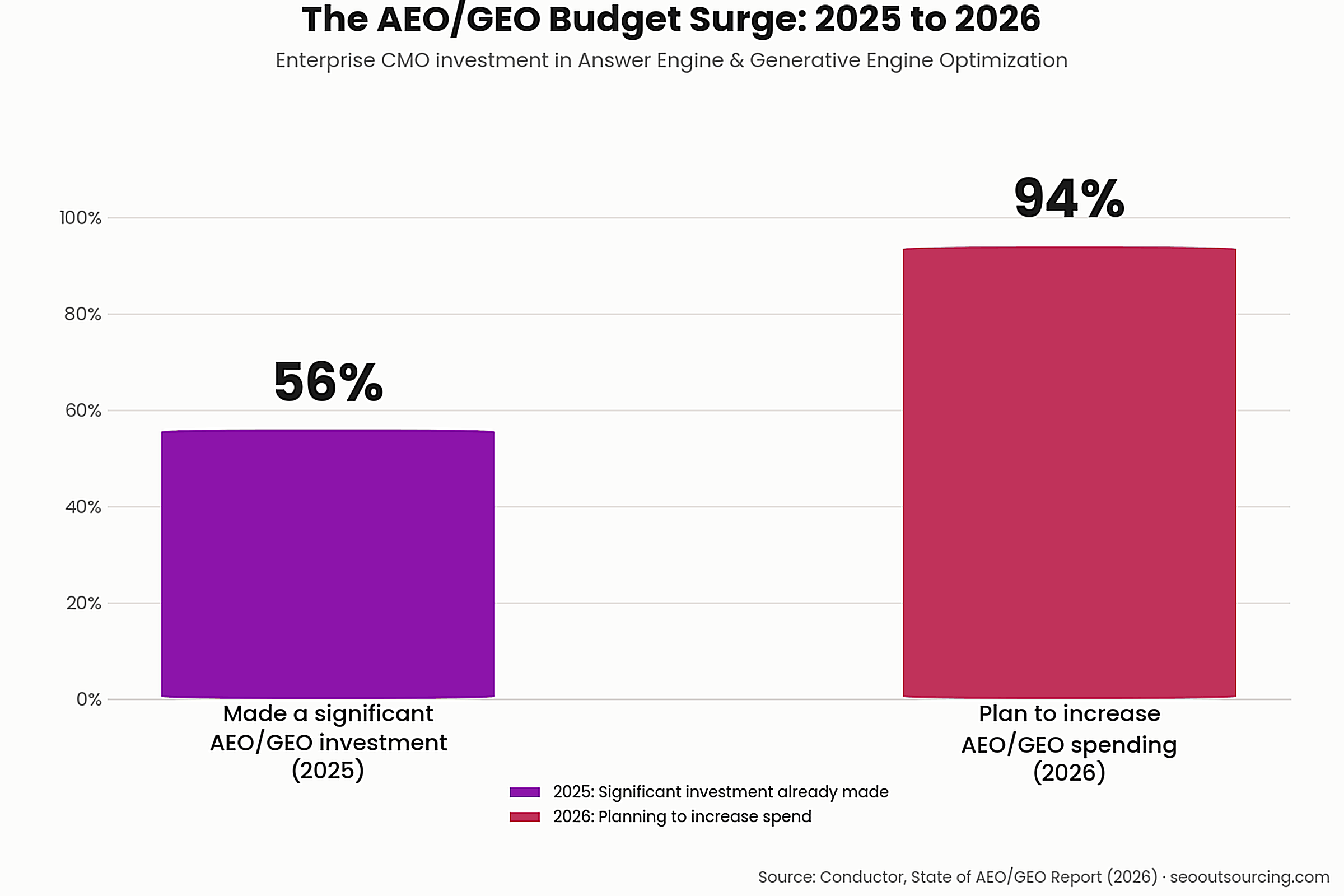
Marketing budgets don’t move this fast very often. But according to Conductor’s newly released State of AEO/GEO report, 94% of enterprise CMOs now plan to increase their answer engine optimization (AEO) and generative engine optimization (GEO) spending in 2026 — and they’re doing it on the heels of 56% who already made a significant or high investment in 2025. That is not a tentative test-and-learn budget line. It is a full-scale, board-approved reallocation of marketing dollars toward the channels that determine whether your brand gets cited by ChatGPT, Perplexity, Gemini, and Google’s AI Overviews.
For marketing leaders building 2026 plans right now, this is the inflection point. The organizations that funded AEO/GEO early are already seeing the payoff, and the remaining budget holdouts are under real pressure to catch up before the next planning cycle locks their spend in place for another twelve months. This article breaks down the data behind the shift, the corroborating research confirming it’s not a one-report fluke, and a practical playbook for reallocating your own budget with confidence.
The Data: What Conductor’s Report Actually Found
Conductor surveyed more than 250 C-suite leaders, VPs, senior content directors, and dedicated AEO/SEO professionals — all from companies with 500+ employees, spanning 12+ industries in the United States. That respondent pool matters: these aren’t marketing generalists guessing at trends. They are the people directly managing AEO and SEO budgets inside large, complex organizations, which makes the resulting numbers a credible read on how enterprise marketing money is actually moving.
The headline finding is straightforward: 94% of respondents said they plan to increase their AEO investment in 2026. That figure sits on top of an already-strong base, since 56% of CMOs and digital leaders reported making a significant or high investment in AEO during 2025. Put those two numbers together and the story becomes clear — this isn’t the early, speculative phase of a new marketing discipline. More than half the market already committed real budget last year, and nearly everyone plans to add more this year.
Conductor’s report treats AEO and GEO as two sides of the same coin. Answer Engine Optimization (AEO) covers the practice of optimizing brand visibility and presence within AI-powered answer engines — think structured content, clear entity signals, and citation-worthy formatting that AI systems can lift directly into a response. Generative Engine Optimization (GEO) is the complementary discipline of shaping how a brand is represented when generative AI systems synthesize an answer rather than just linking to a source. Together, they represent the practical toolkit for staying visible as search shifts from ten blue links to a single AI-generated answer. For the full methodology and findings, see Conductor’s State of AEO/GEO report.
The 2026 Trend: Corroborating Research Confirms the Shift
Conductor’s numbers aren’t an outlier. Gartner’s 2026 CMO Spend Survey, published in May 2026 after surveying 401 CMOs and marketing leaders across North America, the UK, and Europe (the majority from organizations with $1 billion-plus in annual revenue), found that CMOs now allocate an average of 15.3% of their total marketing budget to AI initiatives. More tellingly, “AI-ready” organizations — the ones with mature processes for deploying AI across marketing — allocate 21.3% of their budgets to AI, well above the average. Gartner’s survey also found that 70% of CMOs consider becoming an AI leader a critical goal for 2026, even though only 30% currently rate their organization’s AI readiness as mature. Full details are available in Gartner’s 2026 CMO Spend Survey press release.
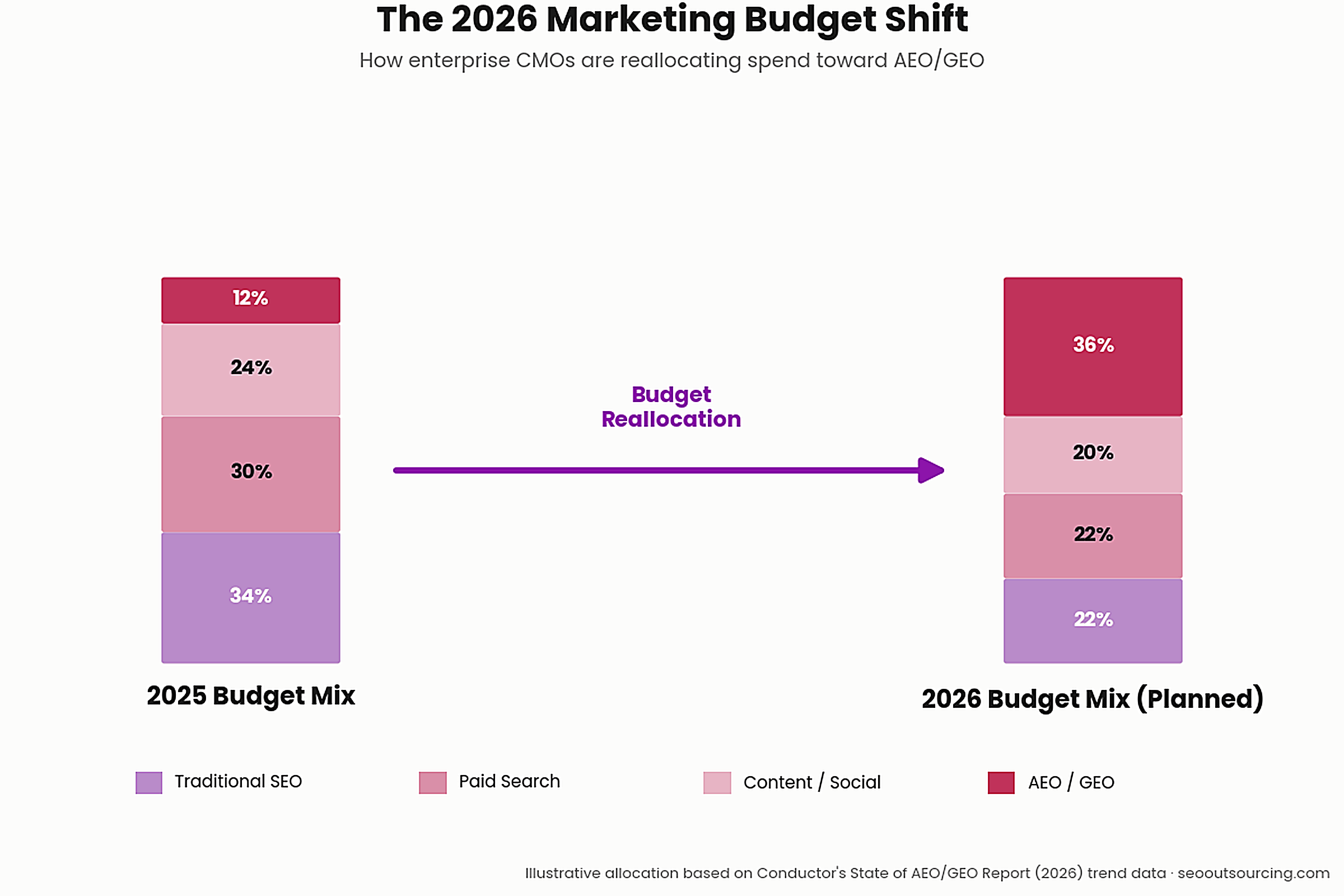
Read together, the two reports tell a consistent story from two independent survey populations: AI-driven search and AI-driven marketing operations are no longer discretionary line items being tested in a innovation sandbox. They are core budget categories that enterprise marketing leaders are actively growing, even in a year when Gartner also found overall marketing budgets remain essentially flat at 7.8% of company revenue. That combination — flat total budgets alongside rapidly rising AI/AEO allocations — is the clearest signal yet that money is being reallocated from somewhere else in the marketing mix, not simply added on top.
Why This Matters for AI and Digital Marketing
The practical implication is budget reallocation, not budget addition. Gartner’s finding that overall marketing budgets are flat while AI/AEO spend keeps climbing means that dollars formerly earmarked for traditional SEO tactics, legacy paid search campaigns, and generic content production are increasingly being redirected toward answer-engine-ready content, structured data, and AI-visibility monitoring. If your 2026 budget plan doesn’t reflect that shift, you are, in effect, choosing to hold spend in channels the rest of the market is actively de-prioritizing.
There’s also a widening competitive gap forming in real time. With 56% of CMOs already having made significant AEO/GEO investments in 2025, a meaningful share of your competitive set has a full year of structured content, technical optimization, and citation-building work behind them. AI answer engines tend to reward brands with an established pattern of clear, well-structured, authoritative content — which means early movers compound their advantage the longer their competitors wait. The 94% figure suggests that even the CMOs who haven’t yet invested heavily now recognize the risk of sitting out another cycle. Waiting for “more data” before shifting budget is, at this point, a strategy that most of the market has already abandoned.
For marketing leaders, the practical question is no longer “should we fund AEO/GEO?” It’s “how much of our existing SEO, paid search, and content budget should move, and how fast?” That’s a budget-planning and prioritization exercise, not a technology pilot.
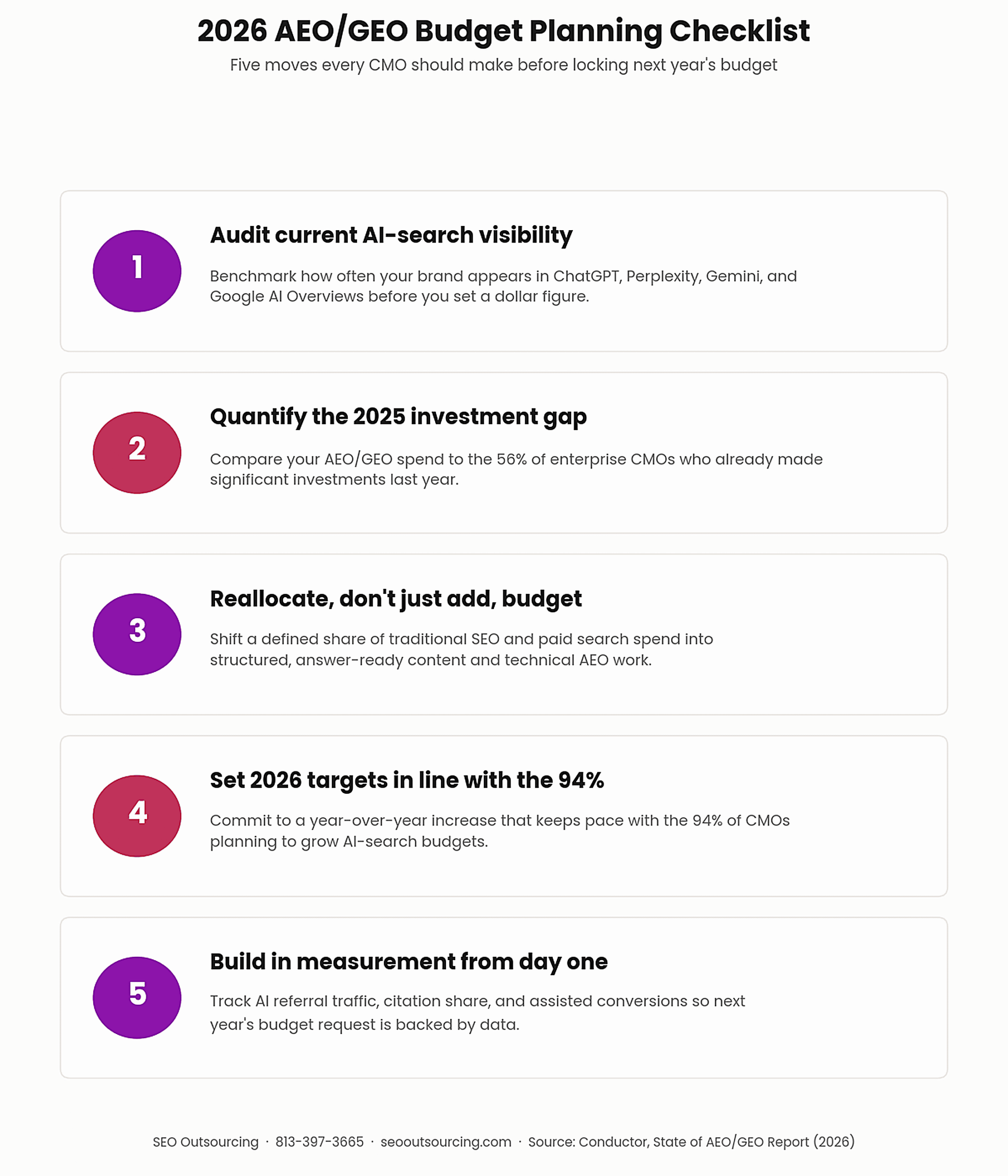
How to Adapt: A 5-Step Playbook
1. Audit Your Current AI-Search Visibility Before Setting a Number
Before proposing a budget figure, find out where you actually stand. Run a structured check of how often your brand, products, and key differentiators show up in ChatGPT, Perplexity, Gemini, and Google AI Overviews responses to relevant queries. This baseline turns an abstract budget request into a concrete gap-to-close, which is far easier to defend in a planning meeting.
2. Quantify Your 2025 Investment Gap Against the 56% Benchmark
Compare what you actually spent on AEO/GEO-related work in 2025 against the 56% of enterprise peers who made a significant or high investment. If you spent little to nothing, that gap is your starting business case: you are not deciding whether to enter a new category, you are catching up to where more than half the market already stands.
3. Reallocate Existing Line Items Rather Than Requesting New Budget
Given that total marketing budgets are staying essentially flat, the fastest path to funding AEO/GEO is usually internal reallocation rather than a fresh budget ask. Identify underperforming legacy SEO tactics, low-yield paid search segments, or generic content production that isn’t tied to measurable outcomes, and redirect a defined percentage of that spend into AEO-specific work.
4. Set a 2026 Growth Target That Matches Market Momentum
Use the 94% figure as a planning anchor. If nearly every enterprise competitor is increasing AEO/GEO spend this year, a flat or token increase effectively means falling behind in relative terms. Set a specific, board-approved percentage increase for 2026 rather than an open-ended “we’ll invest more if it works” commitment, so the budget conversation has a clear target from day one.
5. Build Measurement Into the Budget From the Start
Any new budget line needs its own proof points. Before you spend the first dollar, define how you’ll track AI referral traffic, brand citation frequency across answer engines, and assisted conversions tied to AI-sourced visits. Baking measurement into the initial allocation — rather than retrofitting it later — makes the case for renewing or expanding the budget in 2027 dramatically stronger.
Frequently Asked Questions
What is the difference between AEO and GEO?
Answer Engine Optimization (AEO) focuses on making your content and brand visible and citable within AI-powered answer engines, using structured content, clear entity signals, and formatting that AI systems can extract directly. Generative Engine Optimization (GEO) is the closely related discipline of shaping how your brand is represented when a generative AI system synthesizes a full answer rather than linking out to a source. Most enterprise teams, including those surveyed in Conductor’s report, treat the two as a combined budget category rather than separate disciplines.
How much of my marketing budget should go to AEO/GEO in 2026?
There’s no single universal percentage, but the direction is clear: Gartner found enterprise CMOs now allocate an average of 15.3% of their marketing budget to AI initiatives broadly, with AI-ready organizations allocating 21.3%. A reasonable starting point is to benchmark your current AEO/GEO-specific spend against that range and against the 56% of peers who made a significant investment in 2025, then set a 2026 target that closes any identified gap.
Is this budget shift coming from traditional SEO spend, or is it new money?
The data suggests both, but reallocation is doing most of the work. Gartner’s 2026 survey found overall marketing budgets are essentially flat at 7.8% of revenue even as AI-related allocations climb, which means the growth in AEO/GEO spend is largely coming from shifting dollars out of other line items — traditional SEO tactics, underperforming paid search segments, and generic content production — rather than from net-new budget.
What happens if my company doesn’t increase its AEO/GEO budget in 2026?
Given that 94% of enterprise CMOs plan to increase this spend and 56% already invested significantly in 2025, holding your AEO/GEO budget flat means falling behind on a relative basis, even if your absolute spend stays the same as last year. Because AI answer engines tend to reward brands with an established pattern of structured, authoritative content, delaying investment allows competitors who started earlier to build a compounding visibility advantage that becomes harder to close later.
Ready to Reallocate Your Budget Toward AI Search?
Building the business case for an AEO/GEO budget shift is one thing; executing a strategy that actually earns citations in ChatGPT, Perplexity, Gemini, and Google AI Overviews is another. SEO Outsourcing helps enterprise marketing teams plan, budget, and implement AEO/GEO strategy from the ground up — from visibility audits and competitive benchmarking to content restructuring and ongoing measurement. If you’re finalizing your 2026 budget and want a second set of expert eyes on where your dollars should go, call us at 813-397-3665 to start the conversation.