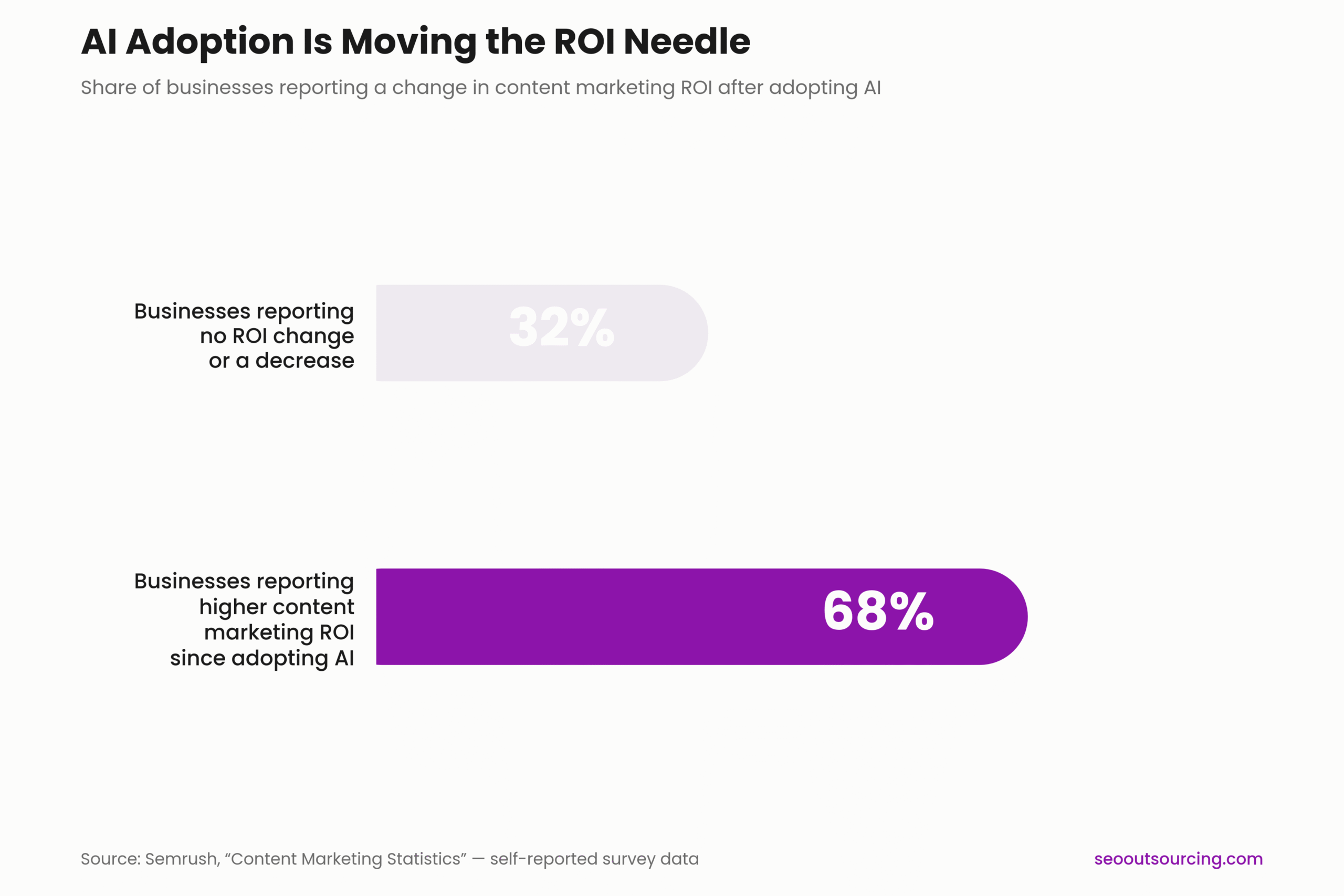
If you approve the content marketing budget, you already know the hardest question in the room isn’t “should we use AI?” — it’s “will it pay off?” New research gives budget owners a real answer: 68% of businesses see an increase in content marketing ROI thanks to using AI. That’s not a vague sentiment about efficiency or convenience. It’s a financial-return signal, straight from the people who own the numbers, and it’s quickly becoming the strongest business case for putting AI content tools in next year’s budget.
This isn’t a story about whether AI-written blog posts sound good or whether they rank well — those are separate questions with their own data. This is a story about the bottom line: when businesses adopt AI in their content operations, most of them report getting more value back for every dollar spent. For a CMO or agency owner building next year’s case for AI investment, that distinction matters. Let’s unpack what the data actually shows, what’s driving it, and how to make sure your organization ends up on the winning side of that 68%.
The Data: What the 68% ROI Statistic Really Means
The headline figure comes from Semrush’s content marketing statistics research: 68% of businesses see an increase in content marketing ROI thanks to using AI. It’s a self-reported outcome measure — companies were asked, in effect, “has AI changed your content marketing return on investment for the better?” — and more than two-thirds said yes.
That framing matters for how you use the stat internally. This isn’t a controlled academic study measuring dollar-for-dollar attribution across a randomized sample; it’s aggregated, self-reported sentiment from marketers and business leaders who are close enough to their own numbers to notice a shift. In practice, that’s exactly the kind of signal a budget conversation runs on: the people managing content spend are telling you, in large majority, that the AI line item is earning its keep.
It’s also worth being honest about the other side of the ledger: roughly a third of businesses are not seeing that lift. That gap is the real opportunity here. The businesses landing in the 68% aren’t succeeding by accident — they’re typically the ones treating AI as an operational upgrade to an existing content strategy, not a replacement for one. The playbook below is built around closing that gap deliberately rather than hoping your organization lands on the right side of the split by default.
The 2026 Trend: Corroborating Research on AI Content ROI
The Semrush figure isn’t an outlier — it lines up with what other major research organizations are finding as AI adoption in marketing matures.
McKinsey’s “Gen AI’s ROI” analysis tracked how often organizations attribute measurable revenue gains to generative AI in marketing and sales specifically. In the first half of 2024, 53% of respondents reported a revenue increase tied to gen AI use in marketing and sales; by the second half of 2024, that had climbed to 66% — with the share of organizations seeing gains above 10% also rising. The trend line is the important part: ROI attribution isn’t a one-time bump, it’s compounding as teams get better at using the tools.
At the content-production layer specifically, HubSpot’s ongoing AI in content marketing research found that nearly 80% of marketers say generative AI has a positive ROI on their content writing tasks. That’s a narrower, content-specific echo of the same pattern Semrush and McKinsey are picking up at the broader marketing level: across multiple independent surveys, a strong supermajority of marketers who’ve actually deployed AI in their content workflows report it’s making their content spend go further, not just faster.
Put together, these three data points tell a consistent story for 2026 budget planning: AI content ROI isn’t a hypothetical upside anymore. It’s a documented pattern across independent research from Semrush, McKinsey, and HubSpot, all converging on the same conclusion — most businesses that adopt AI in content see their returns improve, and that share is trending upward, not flattening out.
Why This Matters for AI and Digital Marketing Budgets
For anyone who owns a content or marketing budget, this data reframes the AI conversation from a creative or productivity question into a finance question — which is exactly where it needs to live to get funded.
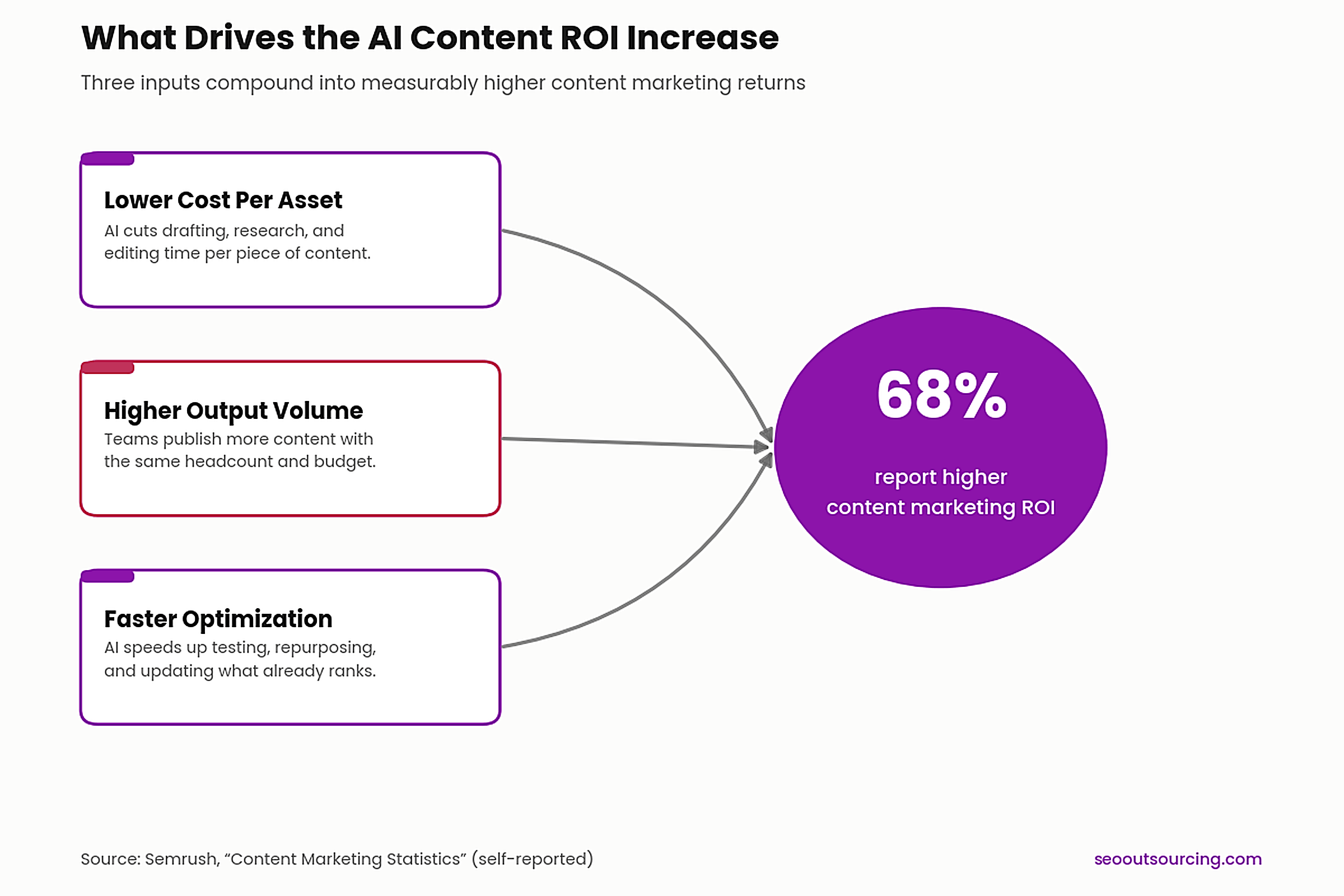
Building the business case gets easier when you can point to three converging forces behind the ROI increase, rather than a single vague claim that “AI makes things faster.” First, AI compresses the cost side of the content equation: drafting, research, outlining, and first-pass editing all take a fraction of the time they used to, which lowers the true cost per published asset. Second, it expands the output side: teams can sustain a higher publishing cadence without proportionally growing headcount, so the same budget produces more shots on goal for organic traffic, leads, and conversions. Third, it accelerates the improvement cycle — updating underperforming pages, repurposing top content into new formats, and testing headlines and angles all happen faster, so existing content assets keep earning longer.
None of that requires cutting corners on quality or strategy — in fact, the businesses seeing the strongest ROI gains are generally the ones still applying real editorial judgment and SEO strategy on top of AI-assisted production. The tool changes the economics; it doesn’t replace the strategy. For a budget owner, that’s the pitch: AI content investment isn’t a bet on replacing your content team’s judgment, it’s a bet on multiplying what that judgment can produce per dollar.
How to Adapt: A 5-Step Playbook for Maximizing AI Content ROI
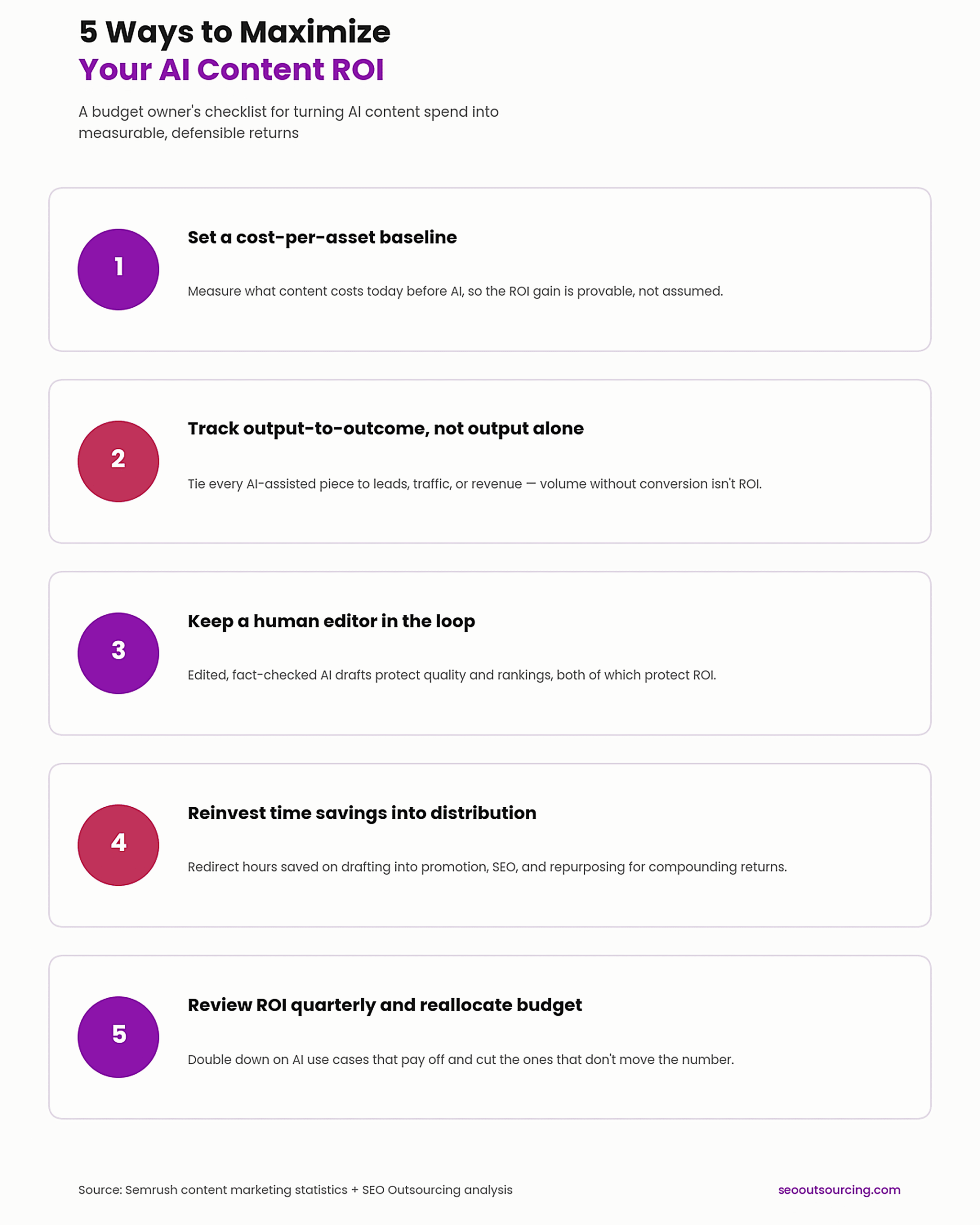
1. Baseline your current cost-per-asset before you scale AI
You can’t prove an ROI increase without knowing your starting point. Before rolling AI tools out further, calculate what a blog post, landing page, or content asset costs today in hours and dollars. This baseline is what makes your eventual ROI case to leadership credible instead of anecdotal.
2. Tie every AI-assisted asset to a business outcome
Publishing volume alone isn’t ROI — it’s an input. Connect each AI-assisted piece of content to a measurable outcome: organic traffic, form fills, demo requests, or revenue-attributed conversions. This is the step that turns “we’re publishing more” into “we’re earning more,” which is the number that survives a budget review.
3. Keep human strategists and editors in the loop
The businesses landing in the 68% aren’t running AI unsupervised — they’re pairing it with human editorial oversight, brand voice, and SEO strategy. A structured editing and fact-checking pass protects the quality and search performance that ROI depends on long-term, so you don’t trade a short-term cost win for a longer-term traffic or trust loss.
4. Reinvest saved hours into distribution and optimization
The ROI gain compounds when the time AI saves on drafting gets redirected into promotion, internal linking, repurposing, and updating existing pages — not just absorbed as slack. Treat time savings as a reinvestable asset, not a bonus, and point it at the activities that most directly move traffic and leads.
5. Review ROI quarterly and reallocate budget toward what’s working
Not every AI use case will pay off equally. Set a quarterly cadence to review which AI-assisted content formats, topics, or workflows are actually driving outcomes, and shift budget toward those while cutting or refining what isn’t. This is how the 68% figure becomes durable instead of a one-time bump.
Frequently Asked Questions
What does “content marketing ROI” actually measure when AI is involved?
Content marketing ROI measures the value generated by content (traffic, leads, conversions, or revenue) relative to what it costs to produce and promote it. When AI enters the equation, ROI typically improves because the cost side of that equation drops — content gets produced faster and cheaper — while the output side often grows, since teams can sustain higher publishing volume with the same budget.
Is the 68% ROI statistic based on real financial data or opinion?
It’s self-reported: businesses were asked whether AI adoption changed their content marketing ROI, and 68% said it increased. It reflects the perception and experience of the people managing content budgets and outcomes, which makes it a strong directional signal, though it should be paired with your own internal cost and outcome tracking rather than treated as a guaranteed result for any specific business.
How long does it typically take to see ROI from AI content investment?
Based on corroborating research like McKinsey’s Gen AI ROI tracking, revenue and cost benefits from AI in marketing tend to build over months rather than appear instantly, with attribution rates climbing as teams refine their workflows. Most businesses should expect to establish a baseline, run AI-assisted content for a full quarter or two, and then compare outcomes against that baseline rather than expecting an immediate before/after jump.
What’s the biggest mistake businesses make that keeps them out of the 68%?
The most common mistake is treating AI as a full replacement for strategy and editorial oversight rather than an accelerant for it. Businesses that publish AI output with no human review, no SEO strategy, and no outcome tracking tend to land in the group that sees flat or declining returns, because volume without quality or measurement doesn’t translate into real ROI.
Ready to Turn AI Content Into Real ROI?
The data is clear: most businesses adopting AI in their content marketing are seeing their returns improve — but landing in that 68% takes a deliberate strategy, not just a subscription to an AI writing tool. SEO Outsourcing helps agencies and in-house marketing teams build ROI-driven AI content strategies that pair AI efficiency with real SEO expertise, editorial quality control, and outcome tracking, so every dollar of content spend is working harder. If you’re ready to build a defensible, ROI-focused content strategy for 2026 and beyond, call us at 813-397-3665 to get started.