Google’s AI Overviews Are Quietly Cutting Your Clicks in Half — Here’s What the Data Says
If you’ve noticed your organic traffic slipping even though your rankings look fine, you’re not imagining it. Google’s AI Overviews — the AI-generated summaries that now sit above traditional search results — are fundamentally changing how (and whether) people click through to websites at all.
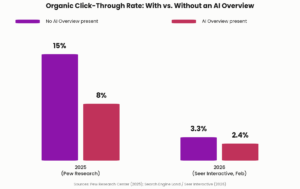
A widely cited Pew Research Center study puts a hard number on what many marketers have felt anecdotally for the past year: when an AI summary appears at the top of a Google results page, users click through to a traditional organic result on 8% of visits — compared to 15% of visits when no AI summary appears. That’s nearly half the click-through rate, on the exact same kind of search.
This isn’t a temporary blip. It’s a structural shift in how search works, and it has direct implications for anyone investing in SEO, content, or AI and digital marketing more broadly. Below, we break down the data, the trend line heading into the back half of 2026, and the AI search optimization playbook that’s actually helping brands hold onto visibility.
The Data: How Much Traffic Are AI Overviews Really Taking?
The Pew Research study, authored by researchers Athena Chapekis and Anna Lieb and published July 22, 2025, is one of the most rigorous looks at this question to date. The team analyzed 68,879 unique Google searches conducted by 900 U.S. adults in March 2025, including 12,593 searches that produced an AI-generated summary. The findings:
-
- 8% vs. 15% — the share of visits ending in a click to a traditional organic link, with vs. without an AI summary present.
-
- Only 1% of visits resulted in a click on one of the AI summary’s own cited sources.
-
- 26% of sessions ended entirely with no further clicks when an AI summary appeared, versus 16% when it didn’t — a clear sign of “zero-click search” behavior taking hold.
-
- AI summaries appeared on 18% of all searches in the study, with a median length of 67 words, and 88% cited three or more sources.
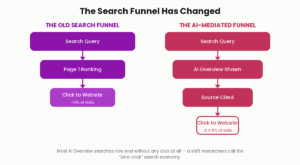
In plain terms: even when Google’s AI summary credits your page as a source, the odds a user actually visits your site are slim. The summary itself is increasingly the destination.
The Trend Is Accelerating in 2026
If anything, the picture has gotten more pronounced since that study was published. A 2026 analysis from Search Engine Land based on a Seer Interactive study of 53 brands, 5.47 million queries, and 2.43 billion impressions between January 2025 and February 2026, found that organic CTR on pages with an AI Overview present bottomed out at 1.3% in December 2025*before recovering somewhat to 2.4% by February 2026. Even with that recovery, CTR without an AI Overview still sits around 3.3% — noticeably higher than the 2.1% seen when a page is cited inside an Overview, and far higher than the 0.9% CTR when a page isn’t cited at all. Meanwhile, paid search ads embedded in AI Overview results saw their own CTR climb from 14.6% to 16.2% over the same period — a sign that Google’s ad inventory is capturing some of the attention organic listings are losing.
A separate, more controlled study reinforces the same conclusion. Researchers from the Indian School of Business and Carnegie Mellon University (published via SSRN in April 2026) ran a randomized experiment with 1,065 U.S. desktop users, using a browser extension to selectively hide AI Overviews for a control group. AI Overviews appeared on 42% of queries in the study, and organic clicks dropped 38% whenever an Overview was shown. Zero-click searches jumped from 54% to 72% in Overview-present sessions. Tellingly, when researchers removed AI Overviews for the test group, outbound clicks per search rose from 0.38 to 0.61 — and over 95% of users never noticed the change, with no measurable drop in satisfaction. The researchers’ conclusion was blunt: AI Overviews “divert traffic away from publishers without delivering measurable improvements in user experience.”
Why This Matters for Your AI and Digital Marketing Strategy
For years, digital marketing plans were built around a fairly predictable funnel: rank on page one, earn the click, convert the visitor. That funnel is being compressed. When a growing share of searches never produce a click at all, “ranking well” stops being the finish line — it becomes just one input into whether your brand gets mentioned inside an AI-generated answer.
This shift matters most for:
-
- Informational and how-to content, where AI Overviews appear most often and satisfy the query directly.
-
- Comparison and research-stage queries, where Search Engine Land’s data shows Overviews now appear on roughly 95% of comparison searches and 86% of question-based searches.
-
- Brands relying on organic search as a primary acquisition channel, since even a “successful” citation inside an Overview converts to a site visit far less often than a traditional blue link.
The businesses that adapt fastest are treating this less as an SEO problem and more as a full-funnel visibility problem — one that spans traditional search, AI search engines, and the AI assistants people now use directly (ChatGPT, Perplexity, Gemini, Claude).
How to Adapt: An AI Search Optimization Playbook for 2026
The good news: none of this means SEO is dead. It means the goalposts have moved from “get the click” to “get cited, then earn the click when it counts.” Here’s what’s actually working right now.
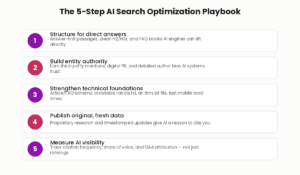
1. Structure content for direct answers, not just rankings
AI Overviews and chat-based AI engines pull from content that answers a specific question clearly and immediately. Break pages into standalone passages, each opening with a direct answer before expanding into detail. Use clean H2/H3 hierarchies and add FAQ blocks — AI systems consistently favor content organized around clear question-and-answer pairs, which is also the foundation of good answer engine optimization.
2. Build entity authority, not just page authority
AI engines tend to trust — and cite — authoritative third-party mentions over brand-owned content. That makes digital PR, guest contributions, detailed author bios, and consistent brand mentions across the web a direct lever for AI visibility, not just a “nice to have” for traditional link building.
3. Get your technical foundation right
Implement Article, Organization, and FAQPage schema markup. Audit your robots.txt to make sure AI crawlers aren’t accidentally blocked. Increasingly, sites are also publishing an llms.txt file to guide AI crawlers toward their most important content. None of this replaces fast load times and solid mobile performance — it adds to them.
4. Publish original data and keep it fresh
Generic, reworded content has little incentive to be cited when an AI model can already synthesize the same information from a dozen other sources. Original research, proprietary data, and clearly timestamped updates give AI engines — and human readers — a reason to point specifically to you.
5. Measure AI visibility, not just rankings
Traditional rank tracking doesn’t capture whether you’re being cited inside AI Overviews or mentioned by ChatGPT and Perplexity. Track AI citation frequency, share of voice against competitors, and how AI-driven traffic shows up in GA4 attribution, so you can see what’s actually moving the needle.
SEO Outsourcing’s SEO services
Our AI search and GEO Optimization services
The Bottom Line
Google’s AI Overviews aren’t a passing experiment — they’re now a permanent, expanding layer of the search experience, and the data is consistent across every major study: organic click-through rates are down substantially wherever they appear, zero-click search is becoming the norm, and the businesses still winning clicks are the ones structuring content for both human readers and AI systems at once.
If your traffic has been quietly declining even as your rankings hold steady, this is almost certainly part of the reason. The fix isn’t to abandon SEO — it’s to evolve it.
Ready to make sure your content still gets found — and clicked — in an AI-first search world? SEO Outsourcing helps businesses build AI search optimization and GEO strategies that work alongside traditional SEO, not against it. Call us at (813) 397-3665 to get started.
FAQ
What are Google AI Overviews?
Google AI Overviews are AI-generated summaries that appear at the top of search results for certain queries, synthesizing information from multiple sources into a direct answer so users often don’t need to click through to a website.
Do AI Overviews really reduce website traffic?
Yes. Pew Research found organic click-through rates drop from 15% to 8% when an AI Overview appears. Separate 2026 studies from Seer Interactive and researchers at the Indian School of Business/Carnegie Mellon found organic clicks fall by roughly 38%, with zero-click searches rising as high as 72% when an Overview is shown.
What is generative engine optimization (GEO)?
Generative engine optimization (GEO), sometimes called AI search optimization, is the practice of structuring and promoting content so it’s more likely to be cited by AI systems like Google AI Overviews, ChatGPT, Perplexity, and Gemini — through clear answer-first content, schema markup, entity authority, and original data.
Is GEO different from traditional SEO?
GEO builds on traditional SEO rather than replacing it. Both rely on relevance, authority, and technical health, but GEO places extra emphasis on direct-answer content structure, third-party entity mentions, and machine-readable markup that AI systems use to select and summarize sources.
Can businesses still rank — and get clicks — despite AI Overviews?
Yes, but it requires adapting content strategy. Sites that structure content around clear answers, build authority through earned media, keep schema markup current, and publish original research are consistently more likely to be cited by AI Overviews and other AI search engines, and to capture the clicks that remain.