Your Site Got Cited by Google’s AI. Almost Nobody Clicked
Getting name-checked inside a Google AI Overview feels like a win. Your content was good enough, authoritative enough, and structured well enough that Google’s AI chose it as a source. Then the traffic report comes in and nothing moved.
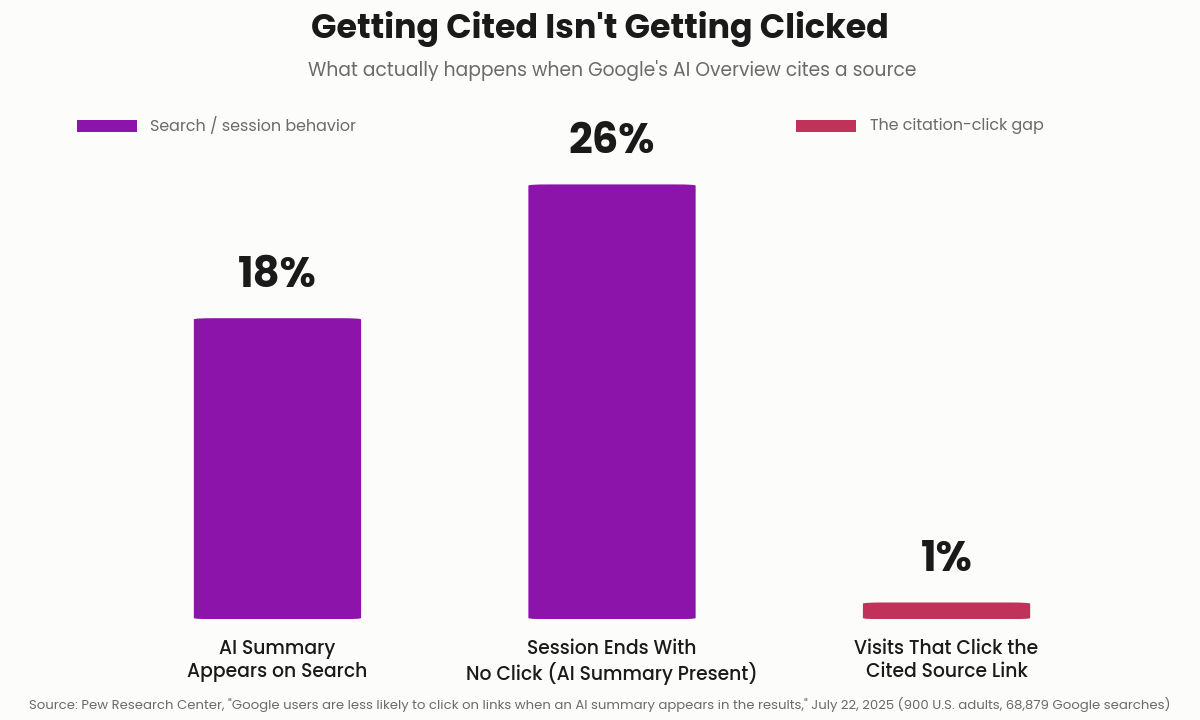
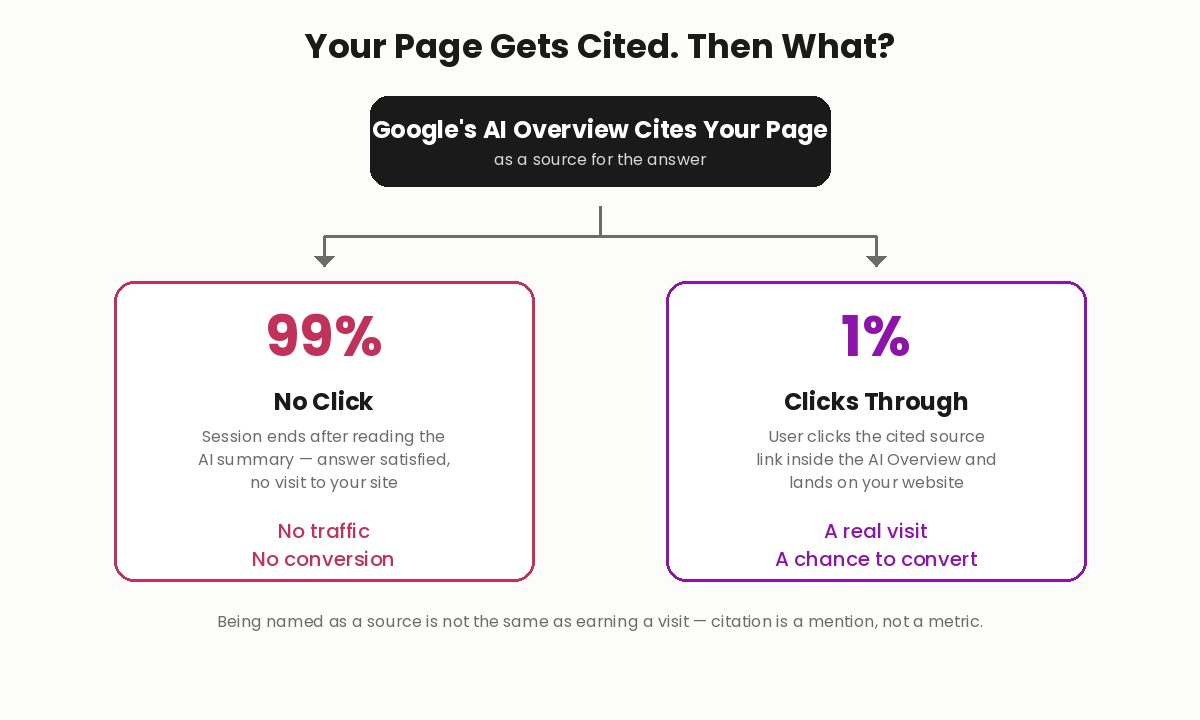
That’s not a fluke. According to Pew Research Center, Google users clicked a source link inside an AI Overview on only 1% of visits — even as AI summaries appeared on roughly 18% of all searches analyzed. Being cited and being visited are two entirely different outcomes, and most of the SEO industry’s attention is still pointed at the wrong one.
This isn’t about whether AI Overviews suppress clicks in general — that broader click-through story is well documented elsewhere. This is about a narrower, sharper problem: even when your page is the source Google’s AI selected, that citation converts into an actual site visit only about one time in a hundred. If your GEO or AEO strategy stops at “get cited,” it stops one step short of the thing that actually pays the bills.
The Data: What Pew Research Actually Found
Pew Research analyzed web browsing data from 900 U.S. adults during March 2025, covering 68,879 unique Google searches, then cross-referenced those visits against scraped search results to identify which pages showed an AI summary. The findings, published July 22, 2025 by researchers Athena Chapekis and Anna Lieb, include:
-
- AI summaries appeared on about 18% of all Google searches in the sample.
-
- Only 1% of visits to a page with an AI summary resulted in a click on a link inside that summary — the citation click rate.
-
- 26% of search sessions ended with no click at all when an AI summary was present, versus 16% when it wasn’t.
-
- 88% of AI summaries cited three or more sources, and only 1% cited a single source — meaning most citations are being split across a handful of competing pages, not awarded exclusively.
-
- 58% of the panel conducted at least one search that produced an AI summary during the study month.
-
- Question-format searches were far more likely to trigger a summary (60%) than short, one- or two-word searches (8%).
Read those numbers together and the picture is stark: nearly nine in ten AI summaries cite multiple sources, but the users reading those summaries click through to any one of those cited sources only 1% of the time. A citation, on its own, is closer to a footnote than a referral.
2026 Research Confirms the Pattern Is Getting Worse, Not Better
Pew’s numbers landed in mid-2025. Newer academic research from 2026 shows the citation-to-traffic gap isn’t a temporary side effect of AI Overviews rolling out — it’s structural, and it’s deepening.
A 2026 study by researchers Mehrzad Khosravi and Hema Yoganarasimhan used a difference-in-differences design across 161,382 matched Wikipedia article-language pairs to isolate the causal effect of AI Overview exposure. Comparing English-language articles (exposed to AI Overviews) against the same content in Hindi, Indonesian, Japanese, and Portuguese (not exposed during the study window), they found that AI Overview exposure reduces daily traffic to the underlying source article by roughly 15% — even for one of the most heavily cited, highest-authority publishers on the web. If Wikipedia, the source AI systems trust and cite constantly, still loses traffic when it’s the cited page, smaller commercial sites should expect the citation-to-click gap to hit even harder.
A separate 2026 study by Xu, Iqbal, and Montgomery analyzed 55,393 real Google queries across 19 topical categories over 40 days. They found AI Overviews activate on 13.7% of searches overall, rising to 64.7% for question-form queries, and that nearly 30% of AI Overview-cited domains don’t appear anywhere in the first-page organic results — meaning citation and ranking are increasingly separate games with separate rules. Most tellingly for publishers: the researchers noted that well over half of AI Overview-cited pages carry display advertising, so publishers are structurally losing ad revenue whenever an AI Overview satisfies the searcher’s intent and suppresses the click, even while Google’s own sponsored ads keep running on that same results page.
The through-line across all three studies, spanning three separate research teams and two calendar years, is the same: getting cited by an AI system is not a proxy for getting traffic. It correlates weakly, if at all.
Why This Matters for AI and Digital Marketing
This gap changes what “winning” in search actually looks like, and it has direct implications for how brands and marketers should measure success.
Visibility metrics can mislead leadership. If your reporting dashboard tracks “AI citations” or “share of voice in AI Overviews” as a headline KPI, you can hit every target on that dashboard while revenue and lead volume stay flat. Citation counts measure exposure, not outcomes — treat them as a leading indicator, not a result.
Content strategy needs a second objective. Ranking well enough to be cited by an AI system requires clear, well-structured, extractable answers. But an answer that’s fully extractable is also fully consumable inside the AI summary itself, which is exactly what suppresses the click. Content now has to do two jobs at once: be citable enough to be selected, and valuable enough beyond the citation that a reader still has a reason to visit.
Ad-supported and lead-gen businesses feel this differently. A publisher monetized by display ads loses revenue directly every time an AI Overview answers the query without a click, as the 2026 Xu, Iqbal, and Montgomery research shows. A service business’s loss is quieter but just as real: a prospect reads your cited advice, has their question answered, and never enters your funnel at all.
Brand and demand generation become the hedge. Since citation-driven clicks are structurally rare, businesses that already have strong branded search volume, email lists, and direct-navigation traffic are far less exposed to this shift than those depending entirely on organic click-through from cited content.
How to Adapt: A 5-Step Playbook for Earning Clicks, Not Just Citations
Chasing citations alone optimizes for the wrong number. Here’s how to build a strategy around the 1% that actually matters.
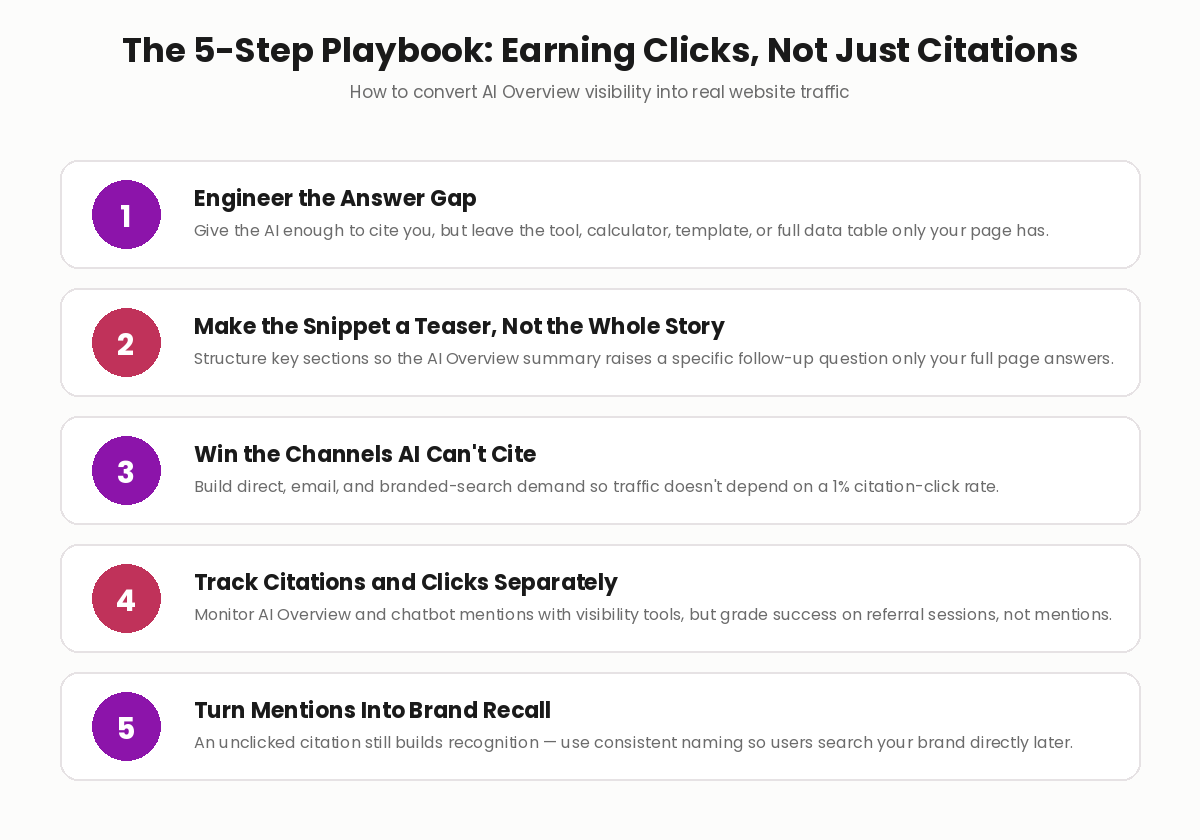
1. Engineer the answer gap
Give the AI system enough well-structured information to justify citing you — clear definitions, direct answers, scannable data. But deliberately hold back the parts that can’t be summarized in a snippet: interactive tools, downloadable templates, calculators, proprietary datasets, or full step-by-step detail. The AI Overview should be able to answer the surface-level question using your content. It shouldn’t be able to fully replace the reason to visit your page.
2. Make the snippet a teaser, not the whole story
Structure your highest-value sections so the summary an AI system pulls naturally raises a follow-up question your page is uniquely positioned to answer. If a searcher reads a two-sentence AI summary of your pricing methodology, cost breakdown, or process, and that summary creates curiosity rather than closure, you’ve built a bridge to the click instead of a replacement for it.
3. Win the channels AI can’t cite
Since only 1% of citation exposure converts into a visit, don’t build a growth plan that depends on it. Invest in direct traffic, email nurture, retargeting, and branded search — channels where the AI Overview layer doesn’t intercept the relationship between you and the customer. These channels become more valuable, not less, as AI-mediated search grows.
4. Track citations and clicks as two separate metrics
Use AI visibility and citation-tracking tools to monitor where and how often you’re mentioned inside AI Overviews and chatbot answers — that’s useful competitive intelligence. But grade your actual performance on referral sessions, assisted conversions, and branded search lift, not on citation frequency. A dashboard that only shows “mentions” will always look better than the business actually is.
5. Turn unclicked citations into brand recall
Even the 99% of citations that don’t generate a click still put your brand name in front of a searcher. Make sure your business name, not just your URL, appears clearly in the content an AI system is likely to quote. Consistent, memorable branding turns a silent impression into a future direct or branded search, even when today’s citation goes uncredited in the analytics.
FAQ
Does being cited in a Google AI Overview help SEO at all?
It can help brand visibility and impression volume, but Pew Research found it converts into an actual site visit only about 1% of the time. Treat AI citation as a visibility signal, not a traffic channel.
Why would an AI system cite a page and then not send it any clicks?
AI Overviews are designed to answer the query directly inside the search results. When the summary already satisfies the searcher’s intent, there’s often no remaining reason for them to click through — even to the exact source the AI relied on.
Is this the same as the general AI Overview click-through decline?
It’s related but more specific. The broader story is that AI summaries reduce overall click rates on a page (Pew found 8% versus 15%). This is narrower: even when your specific page is the cited source inside that summary, the click rate on that citation link is just 1%.
What should businesses measure instead of citation counts?
Referral sessions from AI platforms, branded search volume over time, and assisted conversions are stronger indicators of real impact than raw citation or mention counts, which measure exposure without confirming any resulting action.
Are newer 2026 studies confirming or contradicting the Pew findings?
Confirming, and adding detail. Research from Khosravi and Yoganarasimhan (2026) found AI Overview exposure cuts source traffic by about 15% even for Wikipedia, and Xu, Iqbal, and Montgomery (2026) found nearly 30% of AI Overview-cited domains don’t rank on page one at all, showing citation and traffic are governed by different, disconnected mechanics.
Get Connected With Us
If your content keeps getting cited by Google’s AI but your traffic and lead numbers aren’t moving, the problem isn’t visibility — it’s conversion of that visibility into real visits. SEO Outsourcing helps brands build content and technical strategies designed for both halves of the equation: earning the citation and earning the click. Call us at 813-397-3665 to get an AI-search visibility and traffic audit for your site.