Short-Form Video Marketing: The Highest-ROI Format for 2026
If you had to bet next year’s content budget on a single format, the data says the bet has already been placed — and it isn’t blog posts. According to HubSpot’s newest industry research, 48.6% of marketers now rank short-form video as the highest-ROI content format they produce, putting it well ahead of long-form video (28.6%), livestreaming (25.1%), and traditional blog posts (22.3%). For an agency built on written-word SEO, that’s an uncomfortable number to sit with — and exactly the kind of signal that deserves a clear-eyed look rather than a defensive one.
This isn’t a fringe opinion from a handful of TikTok-obsessed marketers. It’s the plurality answer from a broad industry survey, and it lines up with independent video-marketing research published in 2026. Below, we unpack the HubSpot data, corroborate it with outside studies, and lay out a five-step playbook for adding short-form video into your content mix without abandoning the SEO fundamentals that still drive long-term organic growth.
The Data: Short-Form Video’s ROI Lead Over Every Other Format
The stat comes from HubSpot’s Marketing Industry Trends Report, the same annual survey that tracks how marketers across industries and company sizes are shifting strategy, budget, and skills. Buried inside the report’s content-performance section is a ranking of which formats marketers say deliver their best return on investment. Short-form video takes the top spot at 48.6% — nearly double the next format, long-form video, at 28.6%. Livestreaming trails at 25.1%, and blog posts — long the backbone of organic SEO strategy — come in fourth at 22.3%.
That ranking sits alongside a second, related finding: 37.1% of marketers say video marketing is one of their top planned investment areas for 2026, putting it in the same tier as AI chatbots (37.7%) and paid social (37.4%) on the list of where new budget is headed. And when it comes to producing that content efficiently, the report also found a split in approach — 49.4% of marketers reuse the same content across platforms with little modification, while 39.5% take the time to customize content for each channel. Read together, these numbers describe a format that marketers believe in enough to fund, but that many are still producing inefficiently rather than optimizing for the platforms where it performs best.
This is a genuinely different finding from the AI-search-priority data HubSpot also published in the same report (covered in our companion article on AI search optimization as marketers’ top 2026 priority). That piece is about where marketers are pointing their strategic attention. This one is about which format delivers the best return once content goes live — a content-production question, not a search-visibility one, even though the two absolutely intersect once you start thinking about discoverability. 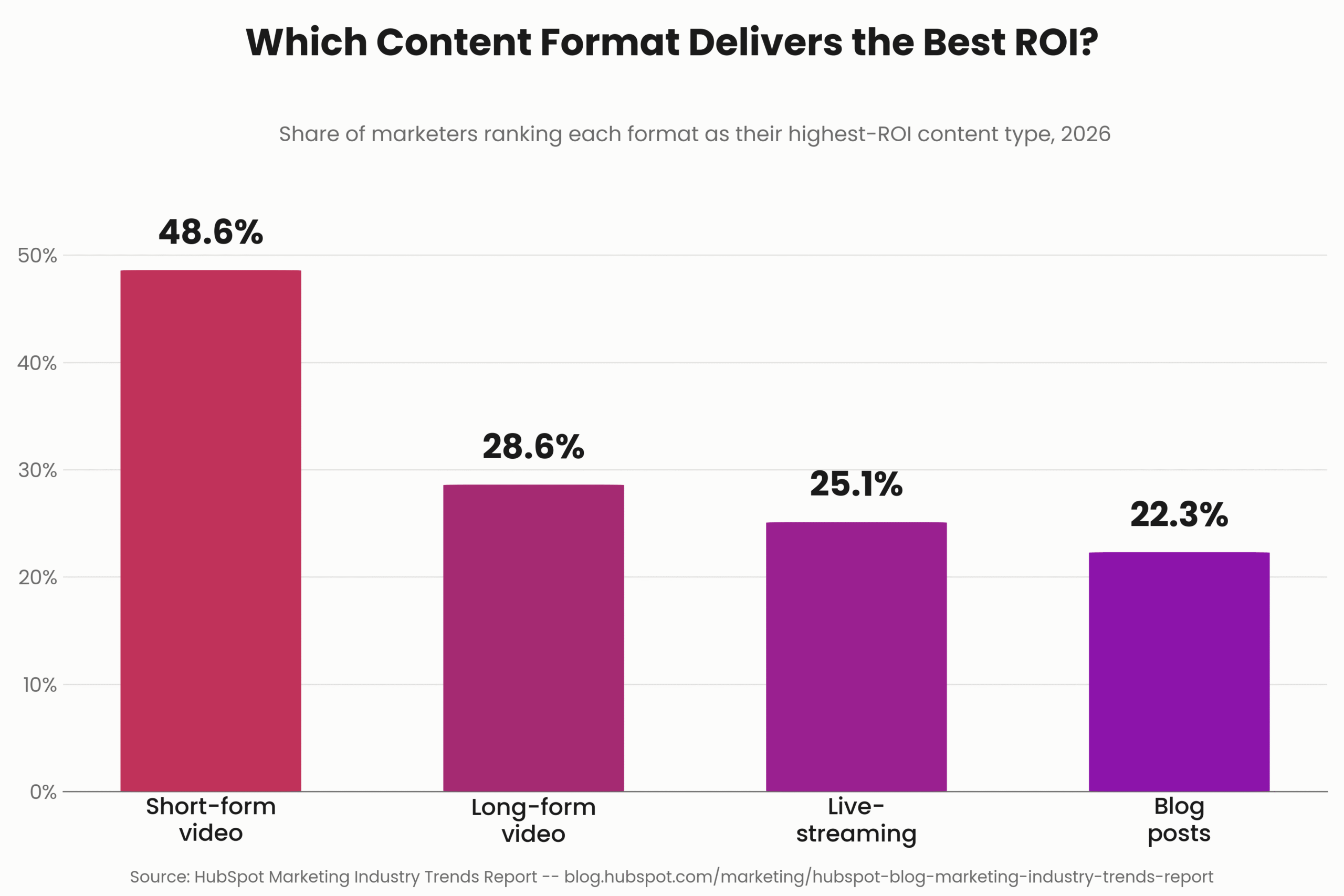
The 2026 Trend: Independent Research Confirms Short-Form Video’s ROI Edge
HubSpot’s ranking isn’t an isolated finding. Two independent 2026 studies back up the same conclusion from different angles — one from a dedicated video-marketing research firm, one from platform-level advertising data.
Wyzowl’s Video Marketing Statistics 2026 report, based on a survey of 266 marketers, found that 93% of video marketers now consider video an important part of their overall marketing strategy — the highest that figure has been in the twelve years Wyzowl has tracked it (Wyzowl). Wyzowl’s companion research on short-form formats specifically notes that short videos are winning attention precisely because they match how people consume content today, reinforcing that the ROI advantage HubSpot measured isn’t a one-report anomaly but part of a broader, sustained shift in how marketers value the format (Wyzowl).
On the platform-advertising side, YouTube’s own advertising data — compiled in Sprout Social’s 2026 social video statistics analysis — found that YouTube Shorts ads deliver 2.3x higher long-term ROAS (return on ad spend) than paid social advertising overall (Sprout Social). That’s a hard, platform-verified performance number sitting right alongside the self-reported marketer sentiment from HubSpot and Wyzowl — three independent sources, three different measurement methods, one converging conclusion.
Why This Matters for AI and Digital Marketing
There’s a temptation to read “short-form video is the highest-ROI format” as a death sentence for written content and SEO. That’s the wrong takeaway. What the data actually shows is a rebalancing of the content mix, not a replacement of one format with another — and that rebalancing has direct implications for how brands show up in AI-driven discovery, not just social feeds.
First, short-form video is increasingly a search surface in its own right. YouTube Shorts, TikTok, and Instagram Reels all have their own search and recommendation algorithms, and Google’s AI Overviews and generative search results increasingly pull in video results and video transcripts alongside written pages. A brand producing zero short-form video is invisible on a discovery surface that a growing share of its audience — particularly younger demographics — now uses as a primary search engine.
Second, the content-reuse data (49.4% reusing identical content across platforms vs. 39.5% customizing) points to a real efficiency opportunity. The brands winning the ROI numbers aren’t necessarily producing more content — they’re repurposing existing long-form assets (blog posts, webinars, case studies) into short-form video clips, which means SEO content and video content should be built as a connected system rather than two separate departments with separate budgets.
Third, the platform-level ROAS data from YouTube Shorts confirms that short-form video’s ROI advantage holds up under paid-media scrutiny, not just organic vanity metrics. That matters for budget conversations: when a CFO asks for hard evidence before approving a video budget increase, “2.3x higher long-term ROAS than paid social” is a much stronger argument than “marketers feel good about it”. 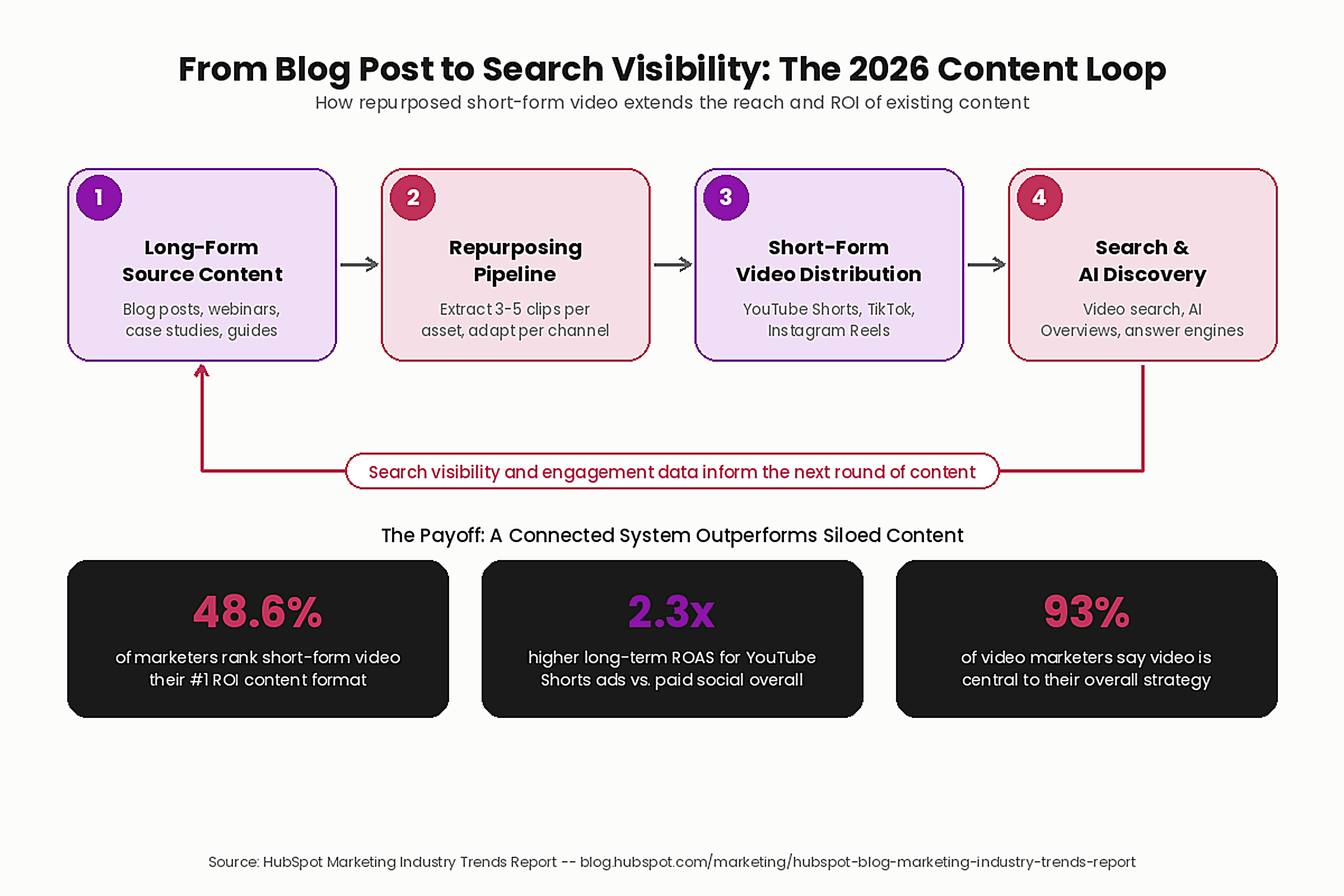
How to Adapt: A 5-Step Playbook
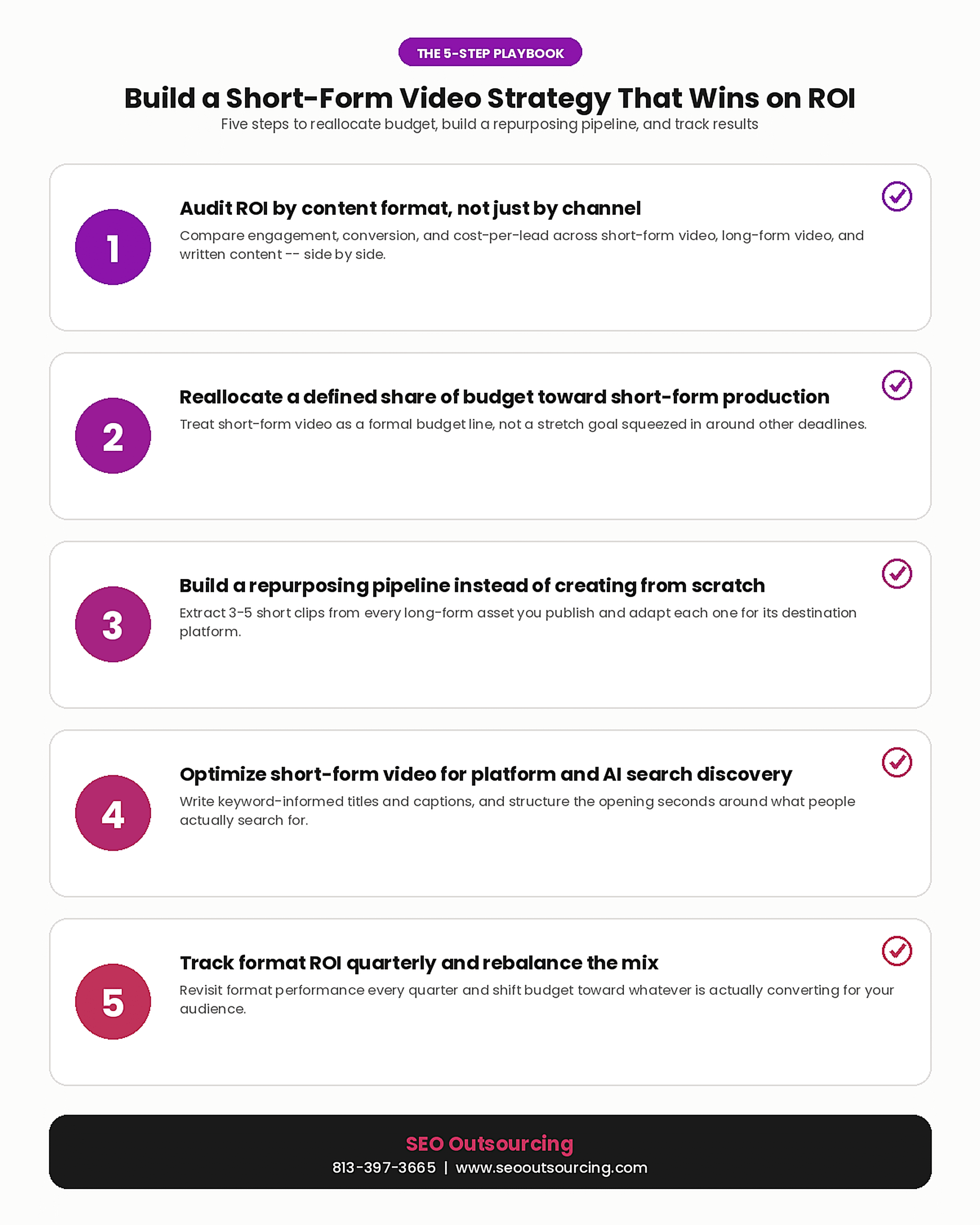
1. Audit ROI by content format, not just by channel
Most teams track performance per platform (Instagram vs. LinkedIn vs. the blog) but rarely compare performance by format across all of them. Pull engagement, conversion, and cost-per-lead data for your short-form video, long-form video, and written content side by side to see where your organization’s numbers actually land relative to HubSpot’s industry benchmarks.
2. Reallocate a defined share of budget toward short-form production
With 37.1% of marketers already naming video a top 2026 investment priority, treat short-form video as a formal budget line — not a stretch goal handled in spare time. Even a modest, fixed monthly production budget (a phone-shot talking-head series, a repurposed-clip pipeline) beats an ad hoc approach that never gets prioritized against other deadlines.
3. Build a repurposing pipeline instead of creating from scratch
Rather than joining the 49.4% who reuse identical content everywhere, build a lightweight system that extracts 3-5 short clips from every long-form asset you already publish — webinars, blog explainers, case study interviews — and adapts each one to its destination platform’s format and captions. This is the fastest way to add volume without adding headcount.
4. Optimize short-form video for platform and AI search discovery
Treat every short-form video like a searchable asset: write a keyword-informed title and description, add accurate on-screen and closed captions, and structure the opening 2-3 seconds around the specific question or claim someone would search for. This is what makes a video eligible to surface in YouTube search, TikTok search, and increasingly in AI-generated answer summaries.
5. Track format ROI quarterly and rebalance the mix
ROI by format isn’t static — audience behavior and platform algorithms shift. Revisit your format performance data every quarter, the same way you’d revisit keyword rankings, and shift budget toward whichever formats are actually converting for your specific audience rather than assuming last year’s mix still applies.
Frequently Asked Questions
What percentage of marketers say short-form video delivers the best ROI?
HubSpot’s Marketing Industry Trends Report found that 48.6% of marketers rank short-form video as their highest-ROI content format — more than double the 22.3% who say the same about blog posts, and well ahead of long-form video (28.6%) and livestreaming (25.1%).
Does this mean blog content and SEO no longer matter?
No. Blog posts still ranked fourth in ROI, not last, and written content remains essential for depth, authority, and the kind of structured information that both search engines and AI answer engines rely on. The data points to adding short-form video alongside SEO content, not replacing it — many high-performing brands now repurpose blog content directly into short-form video clips.
Is short-form video’s ROI advantage backed by anything besides self-reported survey data?
Yes. Wyzowl’s Video Marketing Statistics 2026 report independently found that 93% of video marketers now consider video an important part of their overall strategy — the highest share in the twelve years Wyzowl has run the survey — and YouTube’s own advertising data shows Shorts ads deliver 2.3x higher long-term ROAS than paid social advertising overall, a platform-verified performance metric, not just marketer sentiment.
How should a small or mid-sized business start producing short-form video with limited resources?
Start with repurposing rather than original production: identify your best-performing blog posts, webinars, or customer testimonials and extract short clips from them first. This requires far less time and budget than building a video program from zero, and it lets you test what resonates before committing to a larger production budget.
Ready to Turn Video and SEO Into One Connected Content Strategy?
The data is clear: short-form video is delivering the strongest ROI of any content format in 2026, but the brands winning aren’t abandoning SEO — they’re connecting the two. SEO Outsourcing helps businesses build content strategies where blog content, short-form video, and AI-search visibility work together instead of competing for budget, from content audits and repurposing workflows to format-specific optimization. If you’re ready to build a content mix that reflects where ROI actually is, call us at 813-397-3665 to get started.