For most of the last two decades, “rank well on Google” and “get recommended by the internet” were basically the same job. If you held a top-10 spot, you were the answer — whether a human clicked through or a search engine’s featured snippet quoted you.
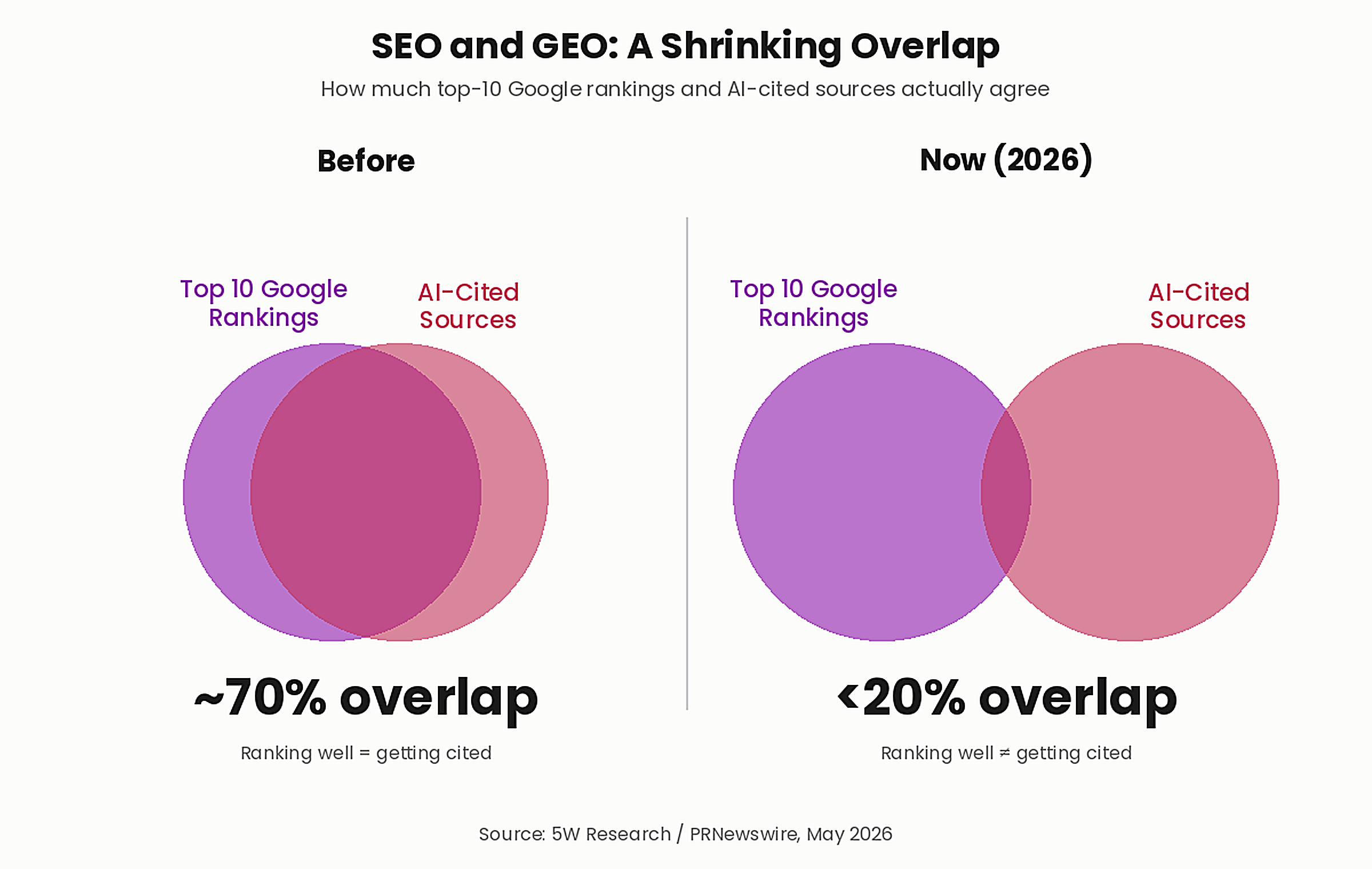
That assumption just broke. According to new research covered by PRNewswire, the overlap between top-10 Google rankings and the sources cited in AI answers has collapsed from 70% down to under 20%. In other words, four out of five pages that used to be safely “the source” for their topic are now invisible to the AI engines answering that same query.
“When the overlap between Google’s top results and AI citations was 70%, optimizing for Google was effectively optimizing for both. At under 20%, that thinking is broken,” said Ronn Torossian, founder of 5W Public Relations, the firm behind the research. That single sentence captures the strategic shift every SEO team and marketing leader needs to internalize right now: traditional ranking and AI citation are no longer one discipline wearing two hats. They are becoming two separate games with two separate scoreboards — and most teams are still only playing one of them.
The Data: How Far Google Rankings and AI Citations Have Drifted Apart
The overlap collapse is the headline number, but it sits inside a broader pattern of behavioral and structural change. Here’s what the research shows, as reported by PRNewswire:
- Overlap collapse: The share of top-10 Google-ranked pages that also appear as cited sources in AI answers has fallen from roughly 70% to under 20%.
- Zero-click acceleration: 65% of searches now end without a click at all (Similarweb), a trend AI Overviews and chat-based answers are accelerating.
- AI-referred traffic surge: Traffic referred from AI platforms grew 527% year-over-year in the first five months of 2025.
- Organic decline forecast: Gartner projects organic search traffic to commercial websites will drop 25% by 2026 as AI answers absorb more query volume.
- Speed mismatch: New content can enter AI citation pools in 3–5 days, while it typically takes 3–6 months to earn a comparable Google ranking — two completely different feedback loops running on two different clocks.
- Freshness cliff: Content that goes 13 weeks without a meaningful update shows a measurable drop in AI citation frequency, even if its Google ranking hasn’t moved.
Publication of this research (May 2026) makes it one of the more current data points on the SEO/GEO split, and the pattern lines up with what independent research has been finding elsewhere. 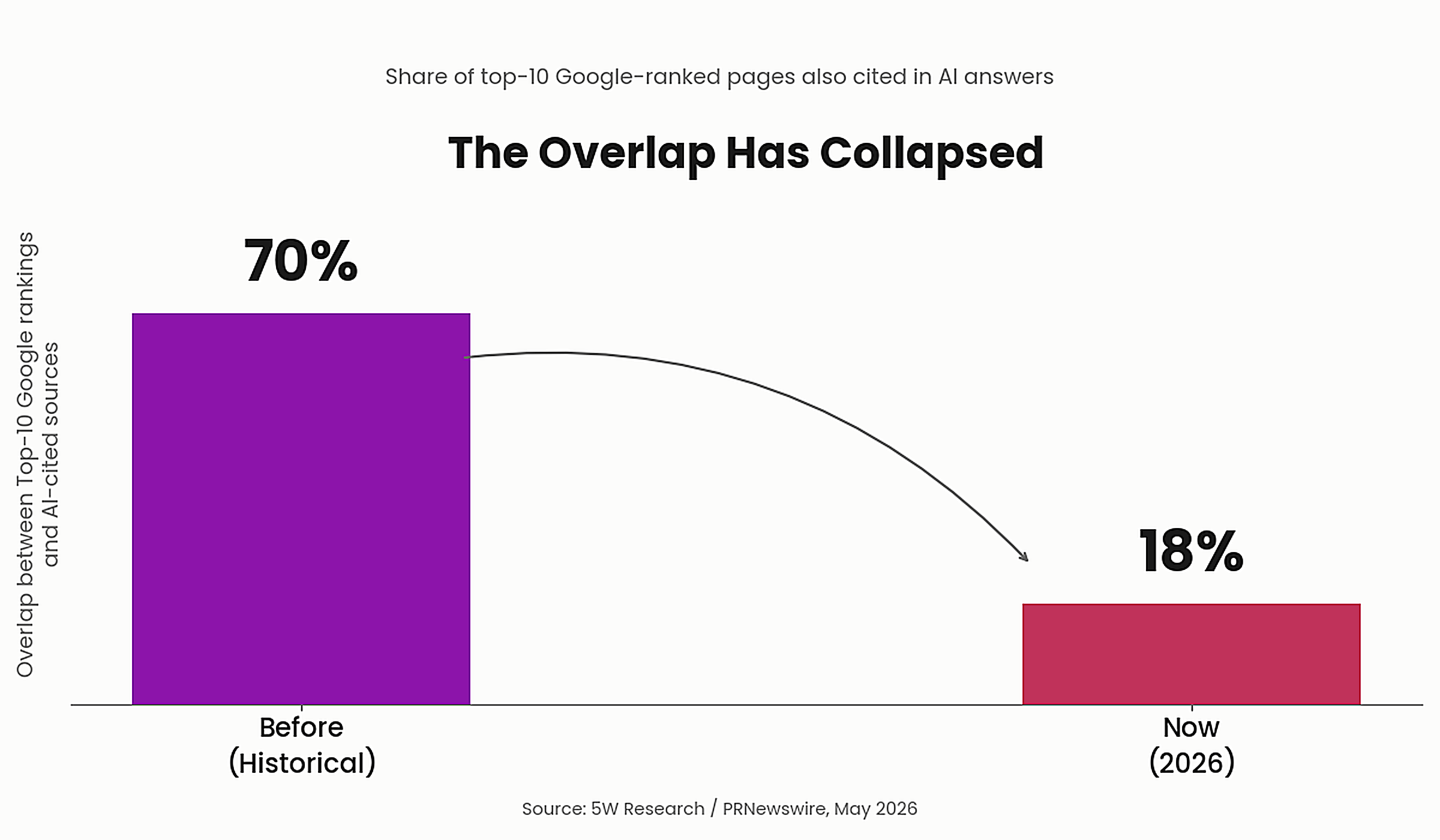
The Divergence Is Bigger Than One Report: What 2026 Research Confirms
If the 70%-to-20% figure stood alone, it would be worth a skeptical eyebrow. It doesn’t stand alone. 5W’s own GEO vs. SEO research breaks down why the overlap is disappearing: while both channels still reward site speed, schema markup, and genuine expertise, they diverge hard on tone (SEO favors persuasive copy; AI engines prefer neutral, reference-style writing), format (GEO rewards listicles, comparison tables, and FAQ blocks over long-form essays), and authority signals (GEO values unlinked brand mentions in third-party content, where classic SEO is built almost entirely around backlinks).
A second, independent data point makes the same case from a different angle. An analysis of 680 million AI citations by Averi found only 11% domain overlap between ChatGPT and Perplexity citations — meaning the AI engines don’t even agree with each other about which sources deserve credit, let alone agree with Google’s ranking algorithm. A companion Slate HQ study tracking 300,000+ citations across six B2B SaaS brands over 90 days found citation volume for identical brands varying by up to 615x between platforms. The takeaway compounds the original finding: it’s not just “Google vs. AI” that has diverged — every AI answer engine is running its own, largely independent citation logic.
Why This Matters for AI and Digital Marketing
For any team still measuring success purely by SERP position, this data is a warning shot. A page can hold the #1 Google spot and be functionally absent from the answers ChatGPT, Gemini, Perplexity, or Google’s own AI Overviews give to the exact same question. That has real consequences:
- Rank tracking alone is now an incomplete KPI. A “win” in traditional rank trackers can mask a loss in AI visibility, and vice versa — teams reporting only on SERP position are flying half-blind.
- Brand-mention monitoring becomes mandatory, not optional. Since AI engines weight unlinked mentions in third-party content, a brand’s presence across review sites, forums, comparison articles, and Reddit threads now directly affects whether it gets recommended — independent of backlink profile.
- Content decay hits differently. A page that stopped earning search traffic gains six months ago might still be losing AI citation share right now, on a much faster 13-week clock.
- Multi-engine visibility replaces single-engine visibility. With only ~11% citation overlap between ChatGPT and Perplexity, “optimizing for AI” isn’t a single target — it’s a portfolio of targets, each with its own source preferences (Wikipedia and editorial content for ChatGPT, Reddit and G2 for Perplexity, YouTube for a large share of Google AI Mode’s social citations).
- Budget and headcount decisions are affected. If ranking and citation are genuinely separate disciplines, treating GEO as a bolt-on task inside an existing SEO retainer under-resources it. It increasingly needs its own strategy, its own tracking, and its own content requirements.
How to Adapt: A 5-Step Playbook for Ranking AND Getting Cited
Treating SEO and GEO as parallel disciplines doesn’t mean starting over — it means adding a second, deliberate workstream alongside your existing ranking strategy. Here’s a practical way to structure it.
1. Audit your current AI citation rate — don’t assume rankings equal citations
Before changing anything, find out where you actually stand. Run your priority queries through ChatGPT, Perplexity, Gemini, and Google’s AI Overviews, and log whether your pages are cited, paraphrased without attribution, or absent entirely. Compare that list against your current Google rankings for the same queries. The gap between the two lists is your real GEO opportunity — and for most sites, following this research, it will be larger than expected.
2. Restructure content for machine extraction, not just human persuasion
AI engines pull passages, not pages. Add direct-answer summaries near the top of key content, use genuine FAQ sections with question-formatted headers, break comparisons into tables, and state facts in clear, quotable sentences rather than burying them in narrative copy. This doesn’t mean abandoning persuasive writing for human readers — it means giving AI engines an easy, unambiguous passage to lift.
3. Build unlinked brand authority, not just backlinks
Since GEO models weight mentions even without a hyperlink, invest in getting your brand, product, and named experts discussed on the platforms each AI engine actually pulls from — review sites and G2-style comparison pages for Perplexity, Wikipedia-adjacent and editorial coverage for ChatGPT, and video content for Google AI Mode. PR, digital PR, and structured outreach matter here as much as traditional link building.
4. Shorten your content refresh cycle to match the AI clock, not the Google clock
With citation decay showing up around the 13-week mark — far faster than typical Google ranking movement — high-value pages need a refresh cadence built for GEO, not legacy SEO. Prioritize your highest-traffic and highest-intent pages for quarterly fact and data updates, even if their Google ranking hasn’t slipped.
5. Track AI citation performance separately from rank tracking
Stand up dedicated monitoring for citation frequency and share of voice across each major AI engine, and report it alongside — not folded into — your traditional rank-tracking dashboard. Because engine-to-engine citation overlap is as low as 11%, track performance per platform, not as a single blended “AI visibility” number, so you can see exactly where the gaps are. 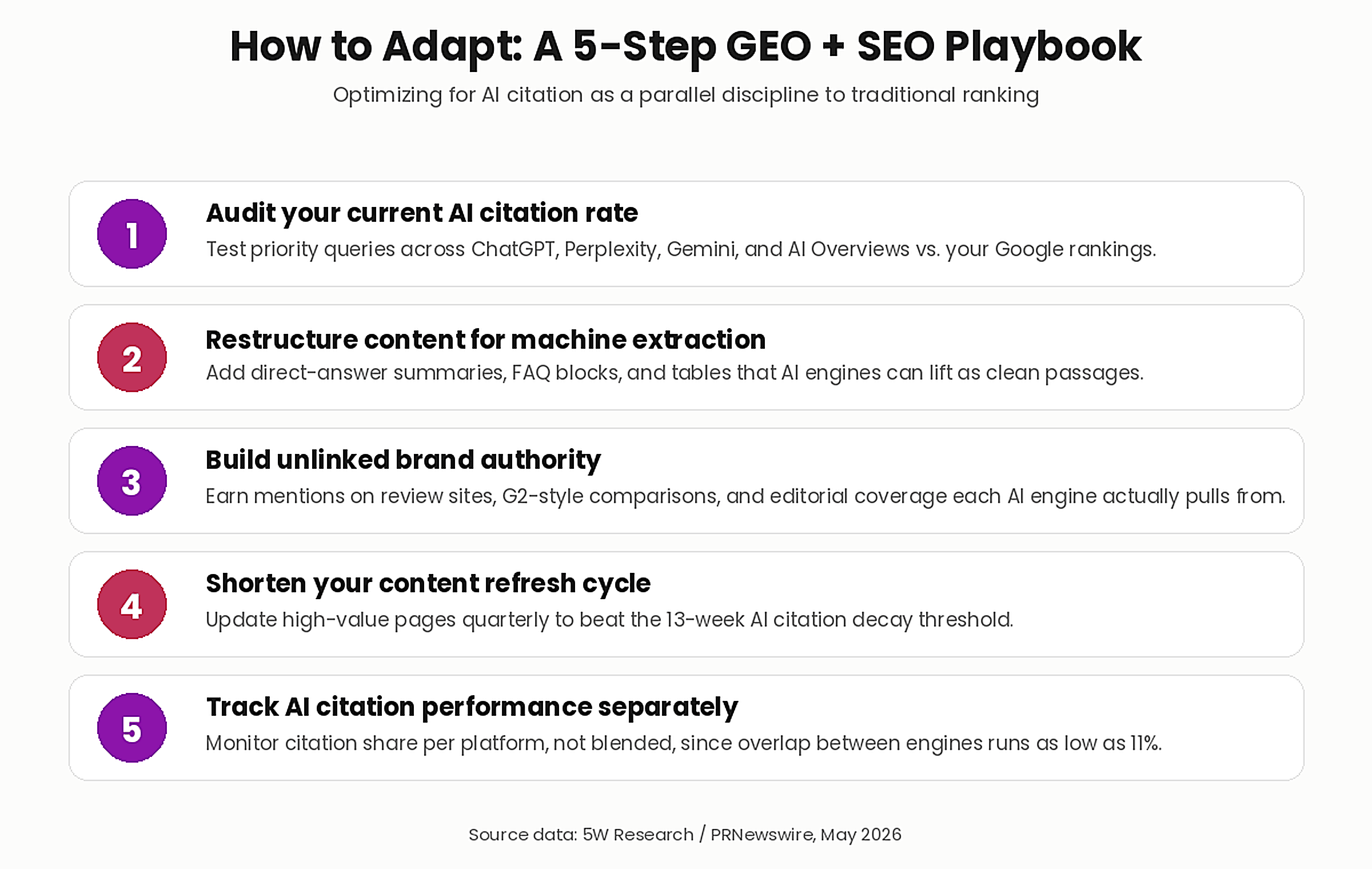
FAQ
Does this mean traditional SEO no longer matters?
No. Site speed, technical health, schema markup, and topical authority still matter to both Google and AI engines — they’re the shared foundation. What’s changed is that ranking well is no longer sufficient to guarantee AI citation; it now has to be paired with GEO-specific work.
What is the difference between SEO and GEO?
SEO (search engine optimization) is built around ranking in traditional search results, largely through backlinks, keyword targeting, and page authority. GEO (generative engine optimization) is built around being cited or referenced inside AI-generated answers, which weighs factors like extractable formatting, unlinked brand mentions, and content freshness more heavily.
How is AI citation different across ChatGPT, Perplexity, and Gemini?
Significantly. Research analyzing hundreds of millions of AI citations found only about 11% domain overlap between ChatGPT and Perplexity, with each engine favoring different source types — meaning a brand cited heavily by one AI platform may be nearly invisible on another.
How often should we refresh content to stay AI-citable?
Data suggests AI citation frequency starts declining after roughly 13 weeks without a meaningful content update — much faster than typical Google ranking decay. High-priority pages should be reviewed and refreshed on a quarterly basis at minimum.
How can a business start measuring its AI citation performance?
Start by manually testing your priority queries across the major AI engines and logging whether your brand is cited, and pair that with dedicated AI-visibility monitoring tools tracking citation share over time, separate from your standard rank tracker.
Contact Us
Ranking and being recommended by AI are no longer the same win. If your SEO strategy hasn’t evolved to cover both, you’re likely leaving visibility — and revenue — on the table with every AI-generated answer that skips your brand. SEO Outsourcing helps businesses build the parallel playbook this data demands: strong traditional rankings backed by a dedicated AI citation strategy. Call 813-397-3665 to get an AI visibility audit and find out exactly where your brand stands with both Google and the AI engines your customers are asking.