How Often Should You Blog? Why AI Changes the Math
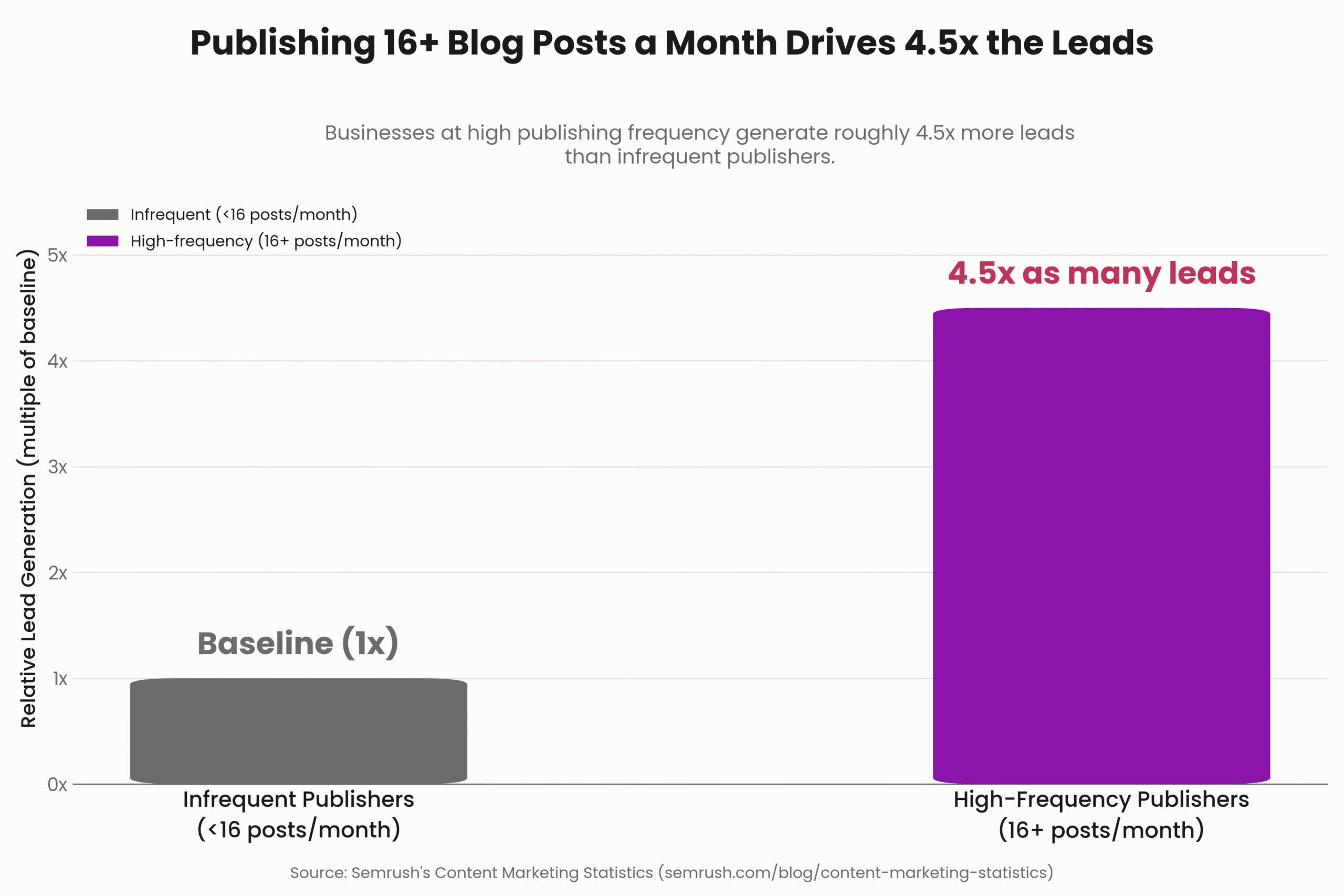
If you’re still publishing one blog post a week and wondering why leads have plateaued, the data has an answer: you’re not publishing enough. Businesses that publish 16 or more blog posts a month generate roughly 4.5 times as many leads as businesses that publish less often. That’s not a rounding error — it’s the difference between a content program that drives pipeline and one that quietly gathers dust in the CMS. For years, hitting that 16-post threshold was reserved for brands with deep in-house editorial teams or six-figure agency retainers. That’s no longer true, and the reason is AI.
The Data: Frequency Is a Lead-Generation Lever, Not Just a Vanity Metric
According to Semrush’s content marketing statistics, businesses that publish 16+ blog posts a month are likely to generate 4.5x as many leads compared to companies that publish less frequently. The same research notes that 76% of content marketers already rely on blog posts as a primary lead-generation channel, and 89% call blog content a top marketing priority. In other words, nearly every marketer agrees blogging matters — but only a fraction of them are publishing at the volume the data says actually moves the needle.
Why does frequency correlate so strongly with leads? Every published post is a new ranking opportunity: a new set of keywords to target, a new page that can earn backlinks, and a new entry point for prospects who land on your site through search rather than a paid ad. Publish once a week and you get roughly four shots a month. Publish 16+ times and you quadruple your surface area for organic discovery — and, per the data, more than quadruple your lead output. Volume compounds because search visibility is cumulative: each indexed page keeps working long after it’s published, so a higher publishing cadence builds a growing, self-reinforcing asset rather than a one-time campaign.
The 2026 Trend: Frequency Still Predicts “Strong Results” — and AI Is Closing the Gap
The Semrush stat isn’t an outlier. Orbit Media’s 2025 Blogging Statistics report, based on its long-running annual survey of bloggers and marketers, found that marketers who publish multiple times per week are the most likely to report “strong results” from their content — 37%, compared to a 21% benchmark for the broader survey population. Publishing less than weekly consistently underperforms that benchmark. The report also flags a real-world tension worth naming: average publishing frequency has actually declined over the past decade as teams stayed lean, even though the data keeps showing that more frequent publishers win.
That tension is exactly what AI is resolving. According to Averi’s State of AI in Marketing 2026 benchmarks report, companies using AI in their content workflows now publish a median of 17 articles per month, versus 12 without AI — a 42% increase that lands them squarely inside the 16+ threshold tied to the 4.5x lead multiplier. The same report found content output volume rises 77% within six months of AI adoption, and teams using structured AI content workflows can produce three articles a week in roughly 5 hours of total human effort, versus 25–36 hours through fully manual processes. The publishing-frequency ceiling that used to require a large editorial staff has effectively been lifted.
Why This Matters for AI and Digital Marketing
For most of the last decade, publishing 16+ posts a month meant one of two things: a large in-house content team, or an agency retainer big enough to fund one. That cost structure is precisely why so few businesses ever hit the frequency threshold associated with the biggest lead gains — it wasn’t that marketers doubted the data, it’s that the production math didn’t pencil out. A single well-researched, SEO-structured post could easily consume 4-6 hours of writer time before editing, formatting, and publishing. Multiply that by 16 and you’re looking at a near-full-time role just to keep the calendar full.
AI restructures that math. Modern AI-assisted workflows compress research, drafting, and on-page optimization into a fraction of the time a fully manual process requires, without requiring a proportional increase in headcount. That’s the real unlock: it’s not that AI makes any single post better than a skilled human writer working alone — it’s that it removes the production bottleneck that made high-frequency publishing financially and operationally unrealistic for all but the largest teams. A lean marketing team, or a small business with no dedicated writer at all, can now sustain a publishing cadence that used to require a five-person editorial desk. 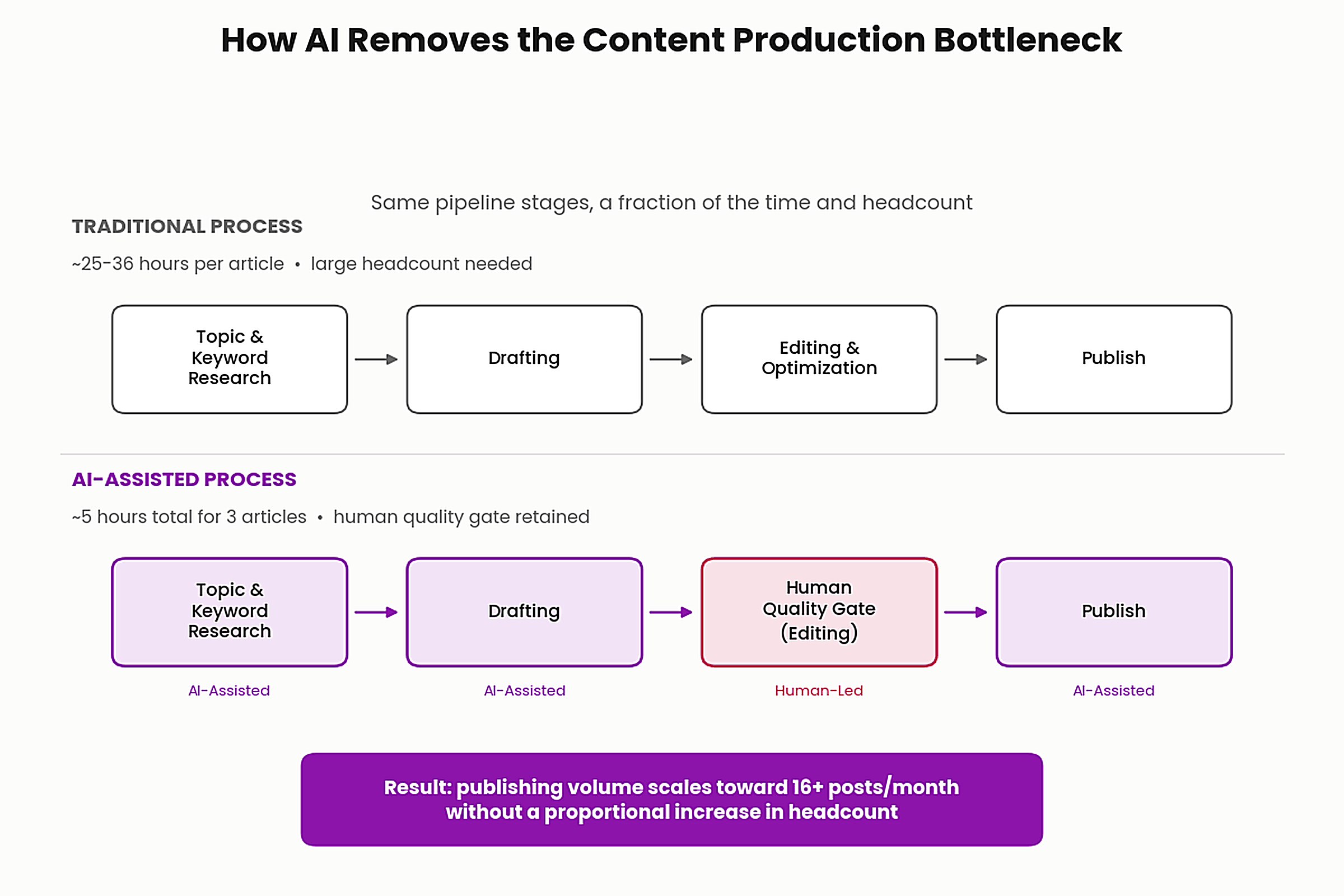
The caveat that matters: frequency without quality doesn’t compound — it just adds noise. Google’s helpful content systems and human readers alike can tell the difference between a strategically researched post and a thin, AI-generated filler article. The businesses seeing 4.5x lead gains at 16+ posts a month are pairing volume with real keyword research, original insight, and editorial review — AI accelerates the production, but a strategy and a quality bar still have to sit on top of it. Done right, though, volume and quality aren’t a trade-off; AI is what makes both achievable at the same time.
How to Adapt: A 5-Step Playbook
1. Audit Your Current Publishing Cadence
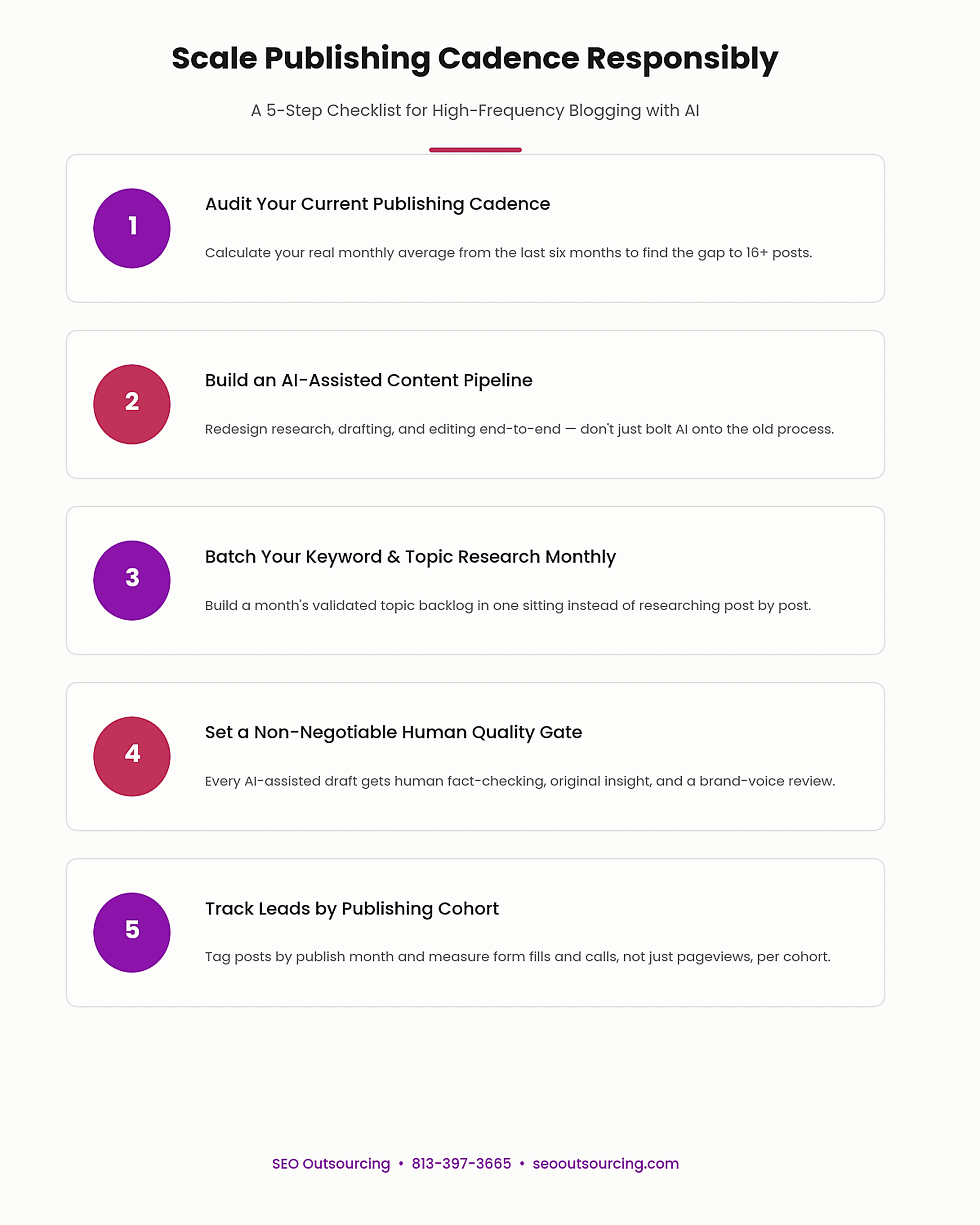
Before scaling up, know your baseline. Pull your last six months of published posts and calculate your actual monthly average — most teams are surprised to find they’re publishing far below the 16-post threshold. This number becomes the gap you need AI-assisted workflows to close.
2. Build an AI-Assisted Content Pipeline, Not Just an AI Writer
Don’t bolt a single AI tool onto your existing process and expect 4x output. Redesign the workflow end-to-end: AI-assisted topic and keyword research, AI-drafted first passes, and a human editor who fact-checks, adds original expertise, and enforces brand voice before anything publishes.
3. Batch Your Keyword and Topic Research Monthly
High-frequency publishing collapses without a deep topic backlog. Use keyword and search-volume data to build a month’s worth of validated topics in one sitting, rather than researching one post at a time — this is one of the biggest time sinks AI-assisted research tools can compress from hours to minutes.
4. Set a Non-Negotiable Human Quality Gate
Every AI-assisted draft should pass through a human reviewer who checks accuracy, adds a genuine point of view, and confirms it serves the reader — not just the algorithm. This single step protects the “quality at volume” balance that separates 4.5x lead gains from a thin-content penalty.
5. Track Leads by Publishing Cohort, Not Just Traffic
Rising pageviews don’t automatically mean rising pipeline. Tag posts by publish month and track form fills, demo requests, or calls back to that cohort so you can see, in your own data, whether increased frequency is translating into the lead lift the research predicts — and adjust cadence or topics accordingly.
Frequently Asked Questions
How many blog posts per month should a business publish?
The data suggests 16 or more posts a month is the threshold most closely associated with a substantial lead-generation lift — businesses at or above that cadence generate roughly 4.5x the leads of less-frequent publishers. Smaller or newer sites can build toward that number gradually, but it’s a meaningful target to plan around rather than an arbitrary one.
Is publishing more blog posts always better for SEO and leads?
Only if quality holds. Publishing frequency correlates strongly with results, but thin or repetitive content can dilute your site’s overall quality signals. The businesses seeing the biggest lead gains at high volume are combining frequency with genuine keyword research and editorial review, not just cranking out word count.
How does AI make high-frequency blogging possible for small teams?
AI compresses the most time-consuming parts of content production — research, outlining, and first drafts — so a lean team or even a solo marketer can sustain a publishing cadence that once required a full editorial staff. Structured AI workflows can cut per-article production time by 75–85% compared to fully manual processes, while a human editor still reviews and refines every piece before it goes live.
How long does it take to see results from increased publishing frequency?
Most businesses should expect a ramp-up period of three to six months before newly published content reaches its full ranking potential, since search engines need time to crawl, index, and rank new pages against competitors. Consistency matters more than any single month’s output — a sustained higher cadence compounds over time.
Ready to Scale Your Publishing Without Sacrificing Quality?
Hitting 16+ posts a month sounds daunting until you have the right AI-assisted process and editorial oversight behind it. SEO Outsourcing builds high-cadence content programs that pair AI-accelerated production with real keyword strategy and human quality control, so you can publish at the frequency the data rewards — without publishing noise. Call 813-397-3665 to talk about scaling your publishing cadence the right way.