If you’ve ever wondered how often you should blog, the honest answer is “more than you probably are” — and the honest reason you’re not is time. New survey data confirms what most business owners already feel in their gut: publishing frequently correlates strongly with better marketing results, but the average blog post now takes almost three and a half hours to produce. Multiply that by two or three posts a week, and you can see why so many small business blogs go quiet after a promising start. The gap between “what works” and “what’s feasible” isn’t a motivation problem — it’s a math problem. And it’s one that a smarter production process, not more hustle, is what actually solves.
The Data: Frequent Publishers Win, But Pay for It in Hours
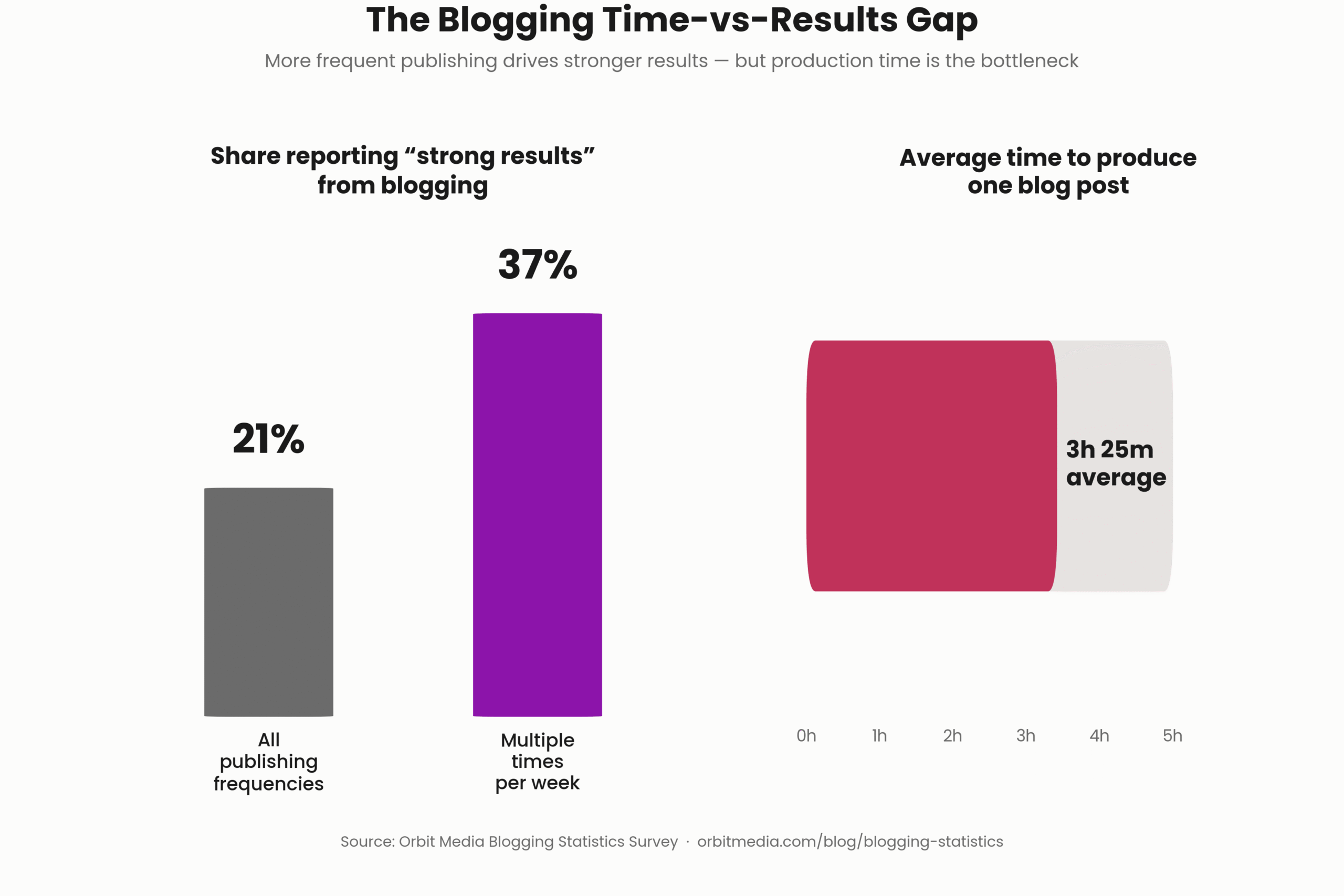
According to Orbit Media’s blogging statistics survey — one of the longest-running annual surveys of professional bloggers — marketers who publish multiple times per week are far more likely to report “strong results” from their blogging efforts: 37%, compared to just 21% across all publishing frequencies. That’s a 76% higher success rate simply tied to showing up more often. Search engines reward fresh, frequent content with more indexed pages and more chances to rank; readers and prospects reward consistency with more trust and more return visits.
But here’s the catch buried in the same dataset: the average blog post now takes roughly 3 hours and 25 minutes to write — creeping ever closer to the psychologically loaded “3.5-hour” mark that gives this trend its name. That figure covers research, drafting, editing, formatting, and sourcing images, and it has been trending upward for years as expectations around post length, depth, and originality have climbed. Do the arithmetic: publishing three times a week at 3.5 hours per post is over 10 hours of pure production time, before you’ve touched distribution, promotion, or anything else on your plate. For a solo founder or a lean marketing team, that’s not a stretch goal — it’s often simply not going to happen without a change in approach. This is precisely why, per Orbit Media’s same research, roughly half of marketers have quietly settled for publishing just 2-4 times per month: not because less-frequent publishing works better, but because the math of manual production doesn’t support anything faster.
The 2026 Trend: AI Is Rewriting the Time Equation
The good news is that the 3.5-hour benchmark is a snapshot of how blog posts have traditionally been made — and that process is changing fast. Two recent, independently sourced data points show exactly how much AI-assisted workflows are compressing production time:
First, Semrush’s content marketing research found a striking split by tooling: 38% of marketers who do not use AI say a long-form article takes them 2-3 hours to write, while 36% of marketers who do use AI say they spend less than one hour writing a comparable long-form post. That’s not a marginal efficiency gain — it’s a fundamentally different production curve for the exact same deliverable.
Second, the Content Marketing Institute’s B2B content marketing trends research, published in late 2025, reports that 89% of B2B marketers now use AI tools to generate or optimize written content, and among those adopters, 87% report improved productivity as a direct result. The CMI researchers are careful to note that “AI helps marketers type faster, not think better” — meaning the tools compress the mechanical bottlenecks (drafting, editing, formatting) without automatically fixing strategy, originality, or quality. That distinction matters enormously for how a business should actually use AI in its content operation.
Put together, these two 2025-2026 data points tell a consistent story: the 3.5-hour average is a lagging indicator of yesterday’s process, and businesses that pair AI-assisted drafting with human strategic and editorial oversight are already producing at a meaningfully faster pace than the survey average. 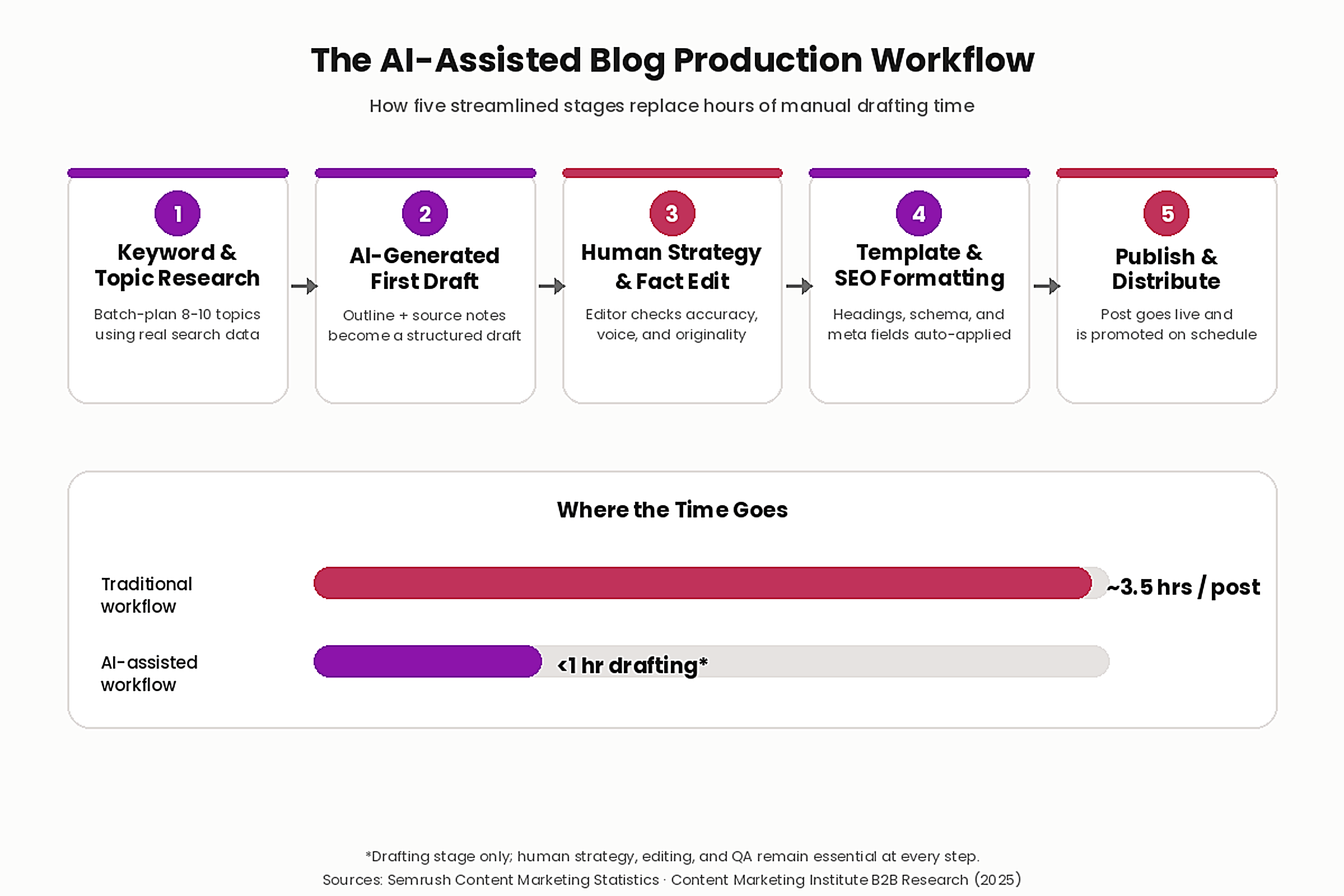
Why This Matters for AI and Digital Marketing
The 3.5-hour bottleneck isn’t just a productivity annoyance — it’s the single biggest structural reason most small and mid-sized businesses under-publish relative to what actually drives results. If strong results require multiple posts per week, and each post costs 3.5 hours of skilled labor, then consistent high-frequency blogging is effectively a “hire a full-time content person or don’t do it” decision for most owners. That math has kept a lot of good businesses on the sidelines of content marketing, publishing sporadically and then wondering why organic traffic never compounds.
AI-assisted production changes the equation on both sides of the ledger. On the cost side, tools that handle research synthesis, outlining, first-draft generation, and formatting can take a large chunk of that 3.5 hours off the table — the Semrush data above suggests a reduction from hours to under sixty minutes for the drafting-heavy portion of the work. On the quality side, the CMI finding is the important caveat: AI speeds up typing, not thinking. The businesses winning with this shift are the ones who use AI to eliminate the mechanical time sink (blank-page drafting, reformatting, basic research legwork) while keeping human judgment squarely in charge of strategy, keyword targeting, expertise, and final editorial quality control. Skip that human layer and you get content that’s fast but forgettable; skip the AI layer and you’re back to 3.5 hours per post and an unsustainable publishing cadence. The winning formula is both — AI-accelerated production with expert human oversight — which is exactly the model that closes the gap between the 21% average and the 37% enjoyed by frequent publishers.
How to Adapt: A 5-Step Playbook
1. Batch Your Research and Topic Planning
Instead of researching one post at a time, set aside a single block each month to research and outline 8-10 topics using keyword and competitor data. Batching eliminates the repeated “cold start” tax — the 20-30 minutes most writers burn just figuring out what to write before they’ve written a word.
2. Use AI for First Drafts, Not Final Copy
Let AI tools generate a structured first draft from your outline, keyword targets, and source notes — this is where the Semrush-documented time savings live. Treat that draft as raw material, not a finished asset, and always run it through human review before it goes anywhere near “publish.”
3. Build a Reusable Post Template
Standardize your H2/H3 structure, intro formula, FAQ block, and CTA across every post so your team (or your AI assistant) isn’t reinventing the format each time. A consistent template can shave 20-40 minutes off editing and formatting for every single article.
4. Assign Human Editing to Strategy, Not Grammar
Focus your most valuable (and most limited) resource — an experienced editor’s time — on the things AI genuinely struggles with: accuracy, brand voice, original insight, and E-E-A-T signals like real examples and credible sourcing. Let tools or checklists handle grammar and basic formatting so human attention goes where it counts.
5. Outsource the Bottleneck Instead of Absorbing It
If your team still can’t hit a sustainable multiple-times-per-week cadence even with a leaner process, the fastest fix isn’t working more hours — it’s handing the production pipeline to a partner who already has the AI-plus-editor workflow built and running. This converts a variable, painful time cost into a predictable line item, without sacrificing quality. 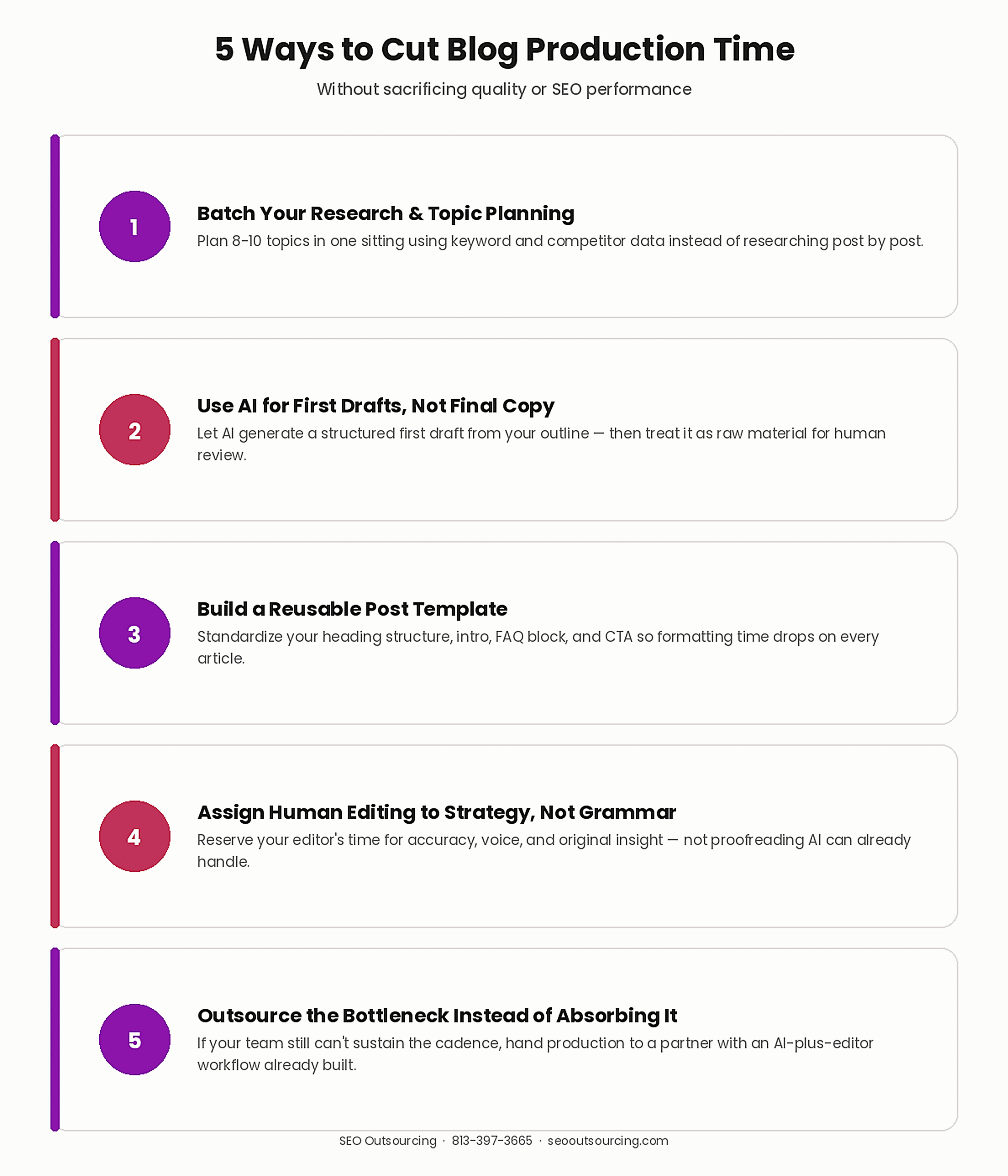
Frequently Asked Questions
How long does it actually take to write a good blog post?
Industry survey data puts the average at roughly 3 hours and 25 minutes for a full-length, well-researched post, according to Orbit Media’s annual blogging survey. That figure includes research, drafting, editing, and formatting, and it has increased over time as expectations for depth and originality have risen. AI-assisted workflows can meaningfully compress this, especially the drafting stage.
How often should you blog for the best SEO and marketing results?
Marketers who publish multiple times per week report strong results 37% of the time, compared to a 21% average across all publishing frequencies, per Orbit Media’s research. That said, consistency matters more than raw frequency — a sustainable weekly cadence you can maintain for a year outperforms a burst of daily posts that fizzles out after a month.
Does using AI to write blog posts hurt SEO or content quality?
Not inherently — the risk comes from skipping human review, not from using AI itself. Research from the Content Marketing Institute shows 87% of B2B marketers using AI report improved productivity, but the same research cautions that AI improves speed, not strategic thinking. Quality depends on keeping experienced editors in the loop for accuracy, originality, and expertise signals.
What’s the fastest way for a small business to publish more often without sacrificing quality?
Combine three things: a repeatable post template, AI-assisted first drafts to eliminate blank-page time, and a human editor focused on strategy and accuracy rather than typing speed. If internal bandwidth still can’t support the cadence needed for strong results, outsourcing production to a specialized content team is typically faster and more consistent than trying to build that capability in-house from scratch.
Ready to Publish More Without the Time Sink?
If the math of 3.5 hours per post is keeping your business stuck at one blog a month instead of two or three a week, SEO Outsourcing can help you close that gap. We combine AI-accelerated drafting with experienced human strategists and editors, so you get the publishing frequency that drives real results — without your team burning entire days on production. Call us at 813-397-3665 to talk about building a content engine that actually keeps up with your goals.