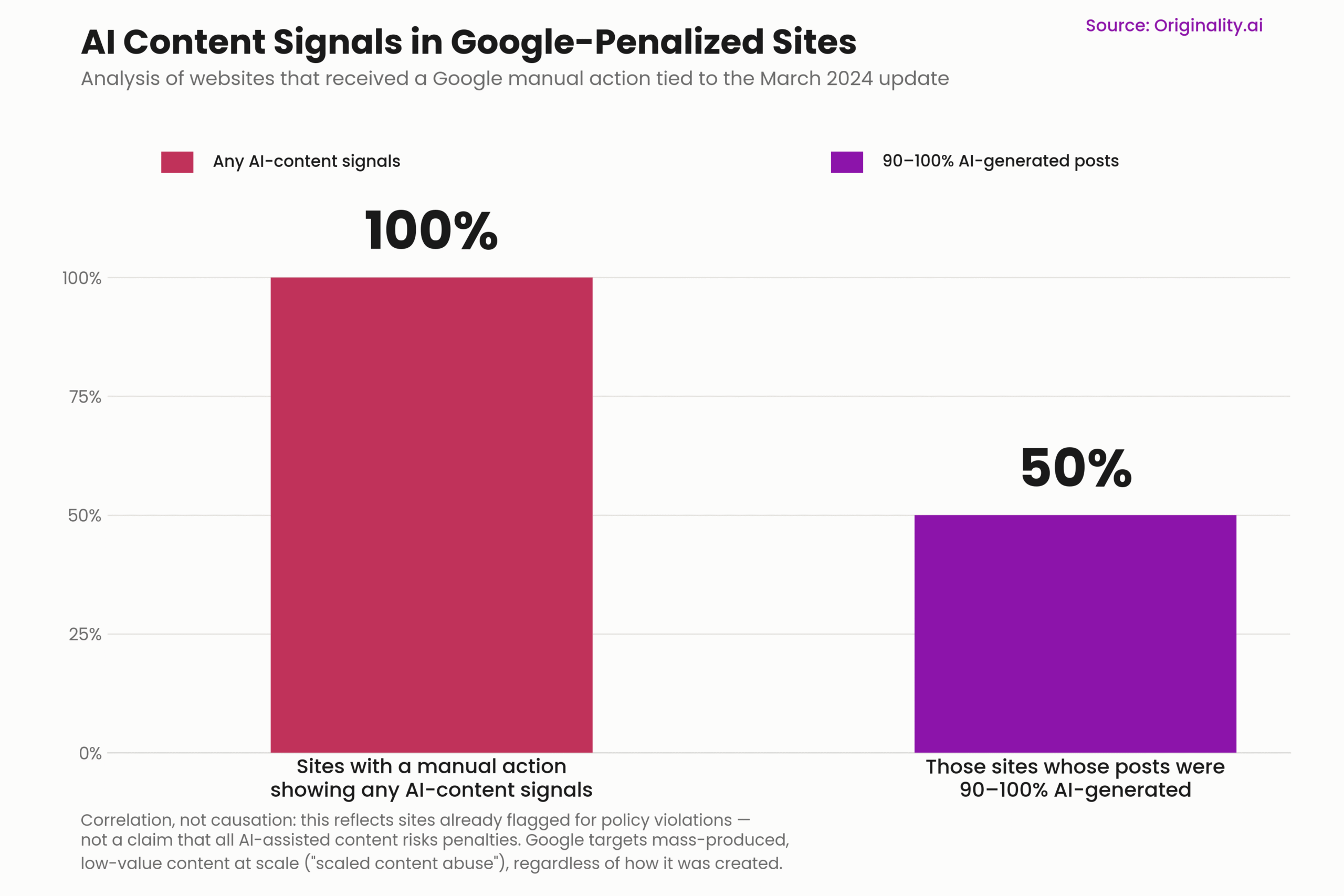
If you’re publishing AI-written blog posts without a second look before they go live, one statistic should stop you: in an analysis of websites that received a Google manual action tied to the March 2024 update, 100% showed signs of AI-generated content, and roughly half were running posts that were 90-100% AI-generated. That doesn’t mean AI writing tools are the enemy — it means the way most businesses are using them is the problem. DIY, unedited, mass-produced AI content is a fast track to a manual action, and understanding exactly why is the first step to using AI safely instead of recklessly.
The Data: What the Originality.ai Study Actually Found
Originality.ai’s analysis looked at sites that were hit with manual actions coinciding with Google’s March 2024 core update and spam policy overhaul — the update that specifically introduced “scaled content abuse” as an enforceable spam violation. The findings were stark: every single penalized site in the study showed measurable AI-content signals, and about half of those sites had gone all-in, publishing content that was 90% to 100% AI-generated with little to no human input.
Here’s the nuance that gets lost in the panic, though: Google has never said “AI-written content will be penalized.” What Google’s spam policies actually target is content that is mass-produced, unoriginal, or low-value at scale — regardless of how it was created. The March 2024 update’s “scaled content abuse” policy is explicit about this. It applies to “using generative AI tools or other similar tools” to generate large amounts of unoriginal content whose primary purpose is manipulating search rankings, not helping users. A single well-researched, AI-assisted, human-edited article isn’t scaled content abuse. Five hundred templated, unedited pages published in a week almost always is.
That distinction matters because it reframes the risk correctly. The Originality.ai data isn’t proof that “AI equals penalty” — it’s strong evidence that unedited, high-volume AI publishing correlates heavily with the exact behavior Google’s policies are built to catch. The sites that got hit weren’t using AI as a drafting tool; in the majority of cases, they were using it as a replacement for editorial judgment altogether.
The 2026 Trend: Google’s Enforcement Keeps Tightening
This isn’t a 2024-only story. Google has continued to sharpen both its guidance and its enforcement well into 2025 and 2026.
In April 2025, Search Engine Land reported that Google updated its Search Quality Rater Guidelines to explicitly direct human raters to assign a “Lowest” quality rating to pages where the main content is “auto or AI generated… with little to no effort, little to no originality, and little to no added value.” Critically, Google’s own guidance draws the same line the Originality.ai data implies: AI content with genuine effort, originality, and added value can still rate well. The failure mode is low-effort automation at scale, not AI assistance itself.
More recently, in July 2026, Search Engine Journal documented a real-world case of a long-established forum — ranking successfully for nearly two decades — that received a manual action for thin content after an AI chatbot had been auto-generating over 100,000 forum responses since 2023. The site’s genuinely stale, years-old archived content wasn’t touched; the AI-driven, mass-produced replies were. It’s a live example of the same pattern the original study found: volume plus automation minus oversight equals risk. Google itself also confirms “scaled content abuse” as an active manual-action category in its official Search Console Help documentation on major spam violations, alongside cloaking and repeated policy abuse — this is not a fringe concern, it’s a standing enforcement category.
Why This Matters for AI and Digital Marketing
For marketing teams and business owners, the takeaway isn’t “stop using AI.” Used correctly, AI is one of the most valuable productivity tools in modern SEO and content marketing — it accelerates research, drafting, and ideation. The takeaway is that how you use AI now determines whether it helps or hurts your search visibility.
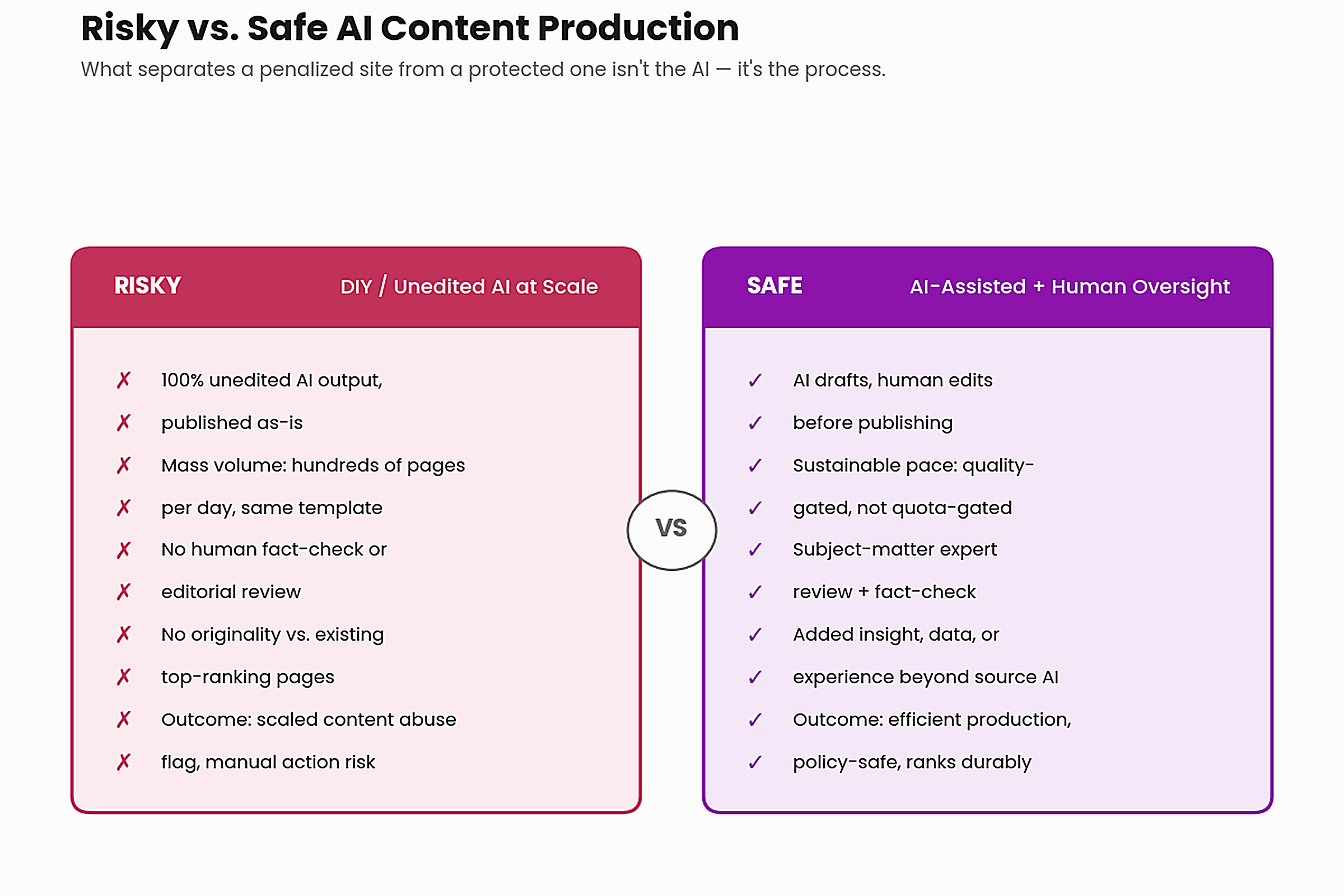
The line Google is drawing, consistently, across its rater guidelines, its spam policies, and its enforcement actions, is between AI as a tool with human oversight and AI as a replacement for human judgment. Content that’s drafted with AI assistance, then fact-checked, edited, and enriched with real expertise or original data by a human, looks nothing like the scaled, templated, unedited output that trips Google’s spam filters. Content that’s generated and published on autopilot, at volume, with no review, looks exactly like it.
This also has downstream business implications beyond rankings. A manual action doesn’t just cost traffic — it costs time (reconsideration requests can take weeks), trust (with clients or stakeholders who see a traffic cliff), and often revenue that’s difficult to recover even after the site is cleared. Treating AI content oversight as a compliance function, not an afterthought, is now a core part of responsible digital marketing.
How to Adapt: A 5-Step Playbook
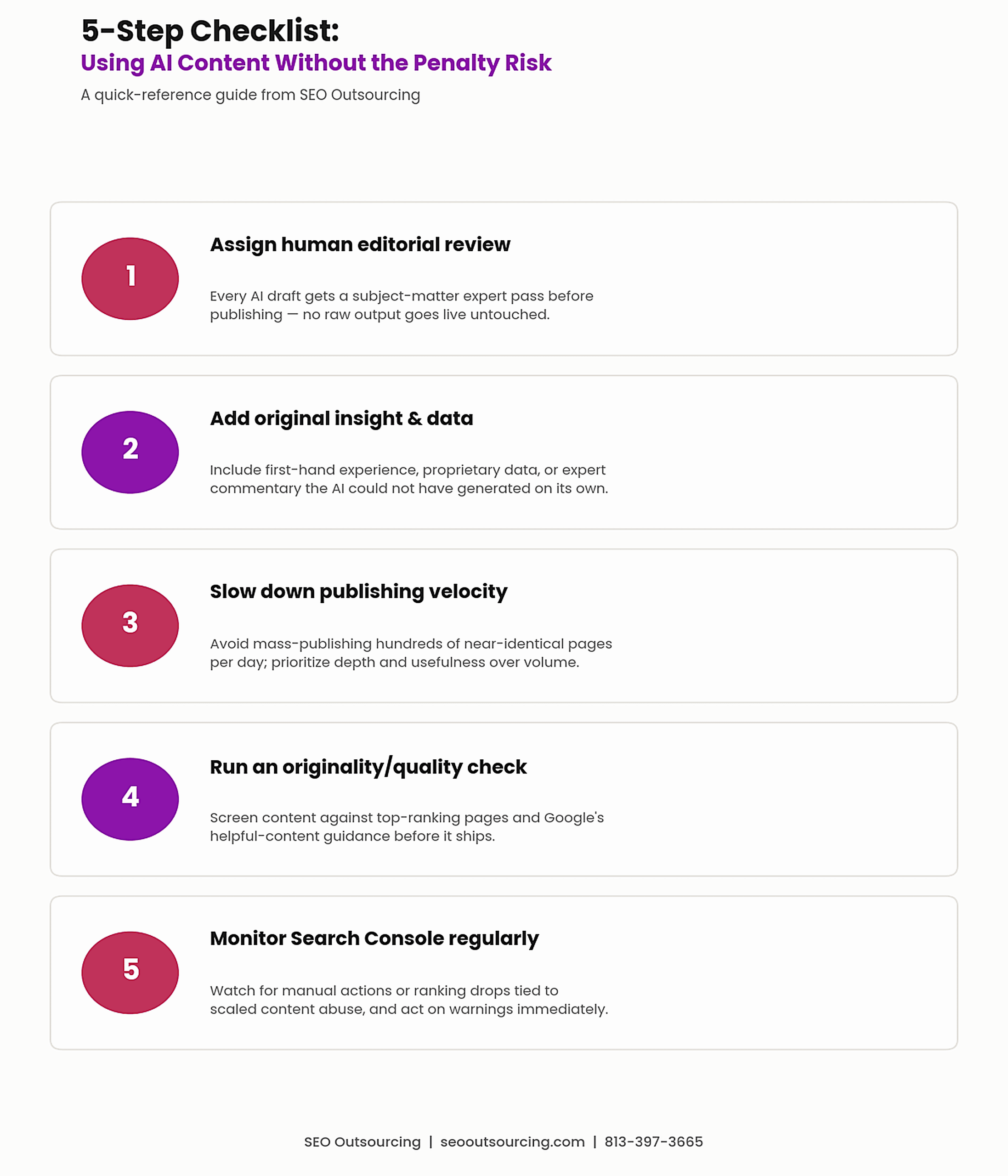
1. Never publish AI drafts unedited
Every piece of AI-assisted content should go through a human editorial pass before publication — checking facts, tone, accuracy, and whether it actually says something useful. This single habit does more to reduce penalty risk than any tool or plugin.
2. Add what the AI can’t: real expertise and original data
Layer in first-hand experience, proprietary research, case studies, or expert commentary that didn’t come from the model. This is what separates content that demonstrates genuine E-E-A-T (experience, expertise, authoritativeness, trustworthiness) from a rehash of what’s already ranking.
3. Control your publishing velocity
If your content calendar suddenly jumps from a few posts a month to dozens per day, that volume spike is itself a red flag pattern Google’s systems are built to catch. Scale output gradually and proportionally to your editorial and review capacity, not your AI tool’s output speed.
4. Screen for originality before you hit publish
Run new content through an originality or AI-detection check and compare it against what’s already ranking for the same query. If your draft reads like a generic summary of the top five results, it needs more original value before it ships, not just a publish button.
5. Monitor Google Search Console for early warning signs
Watch your Manual Actions report and Search Performance data closely, especially after a large content push. Sudden indexing drops, impression declines, or a manual action notice tied to “scaled content abuse” should trigger an immediate content audit, not a wait-and-see approach.
Frequently Asked Questions
Does Google penalize all AI-generated content?
No. Google has repeatedly clarified that it does not blanket-penalize content simply because AI tools were involved in creating it. Its spam policies target mass-produced, unoriginal, low-value content published at scale to manipulate rankings — a pattern often (but not exclusively) seen in unedited AI content, regardless of the tool used to produce it.
What is “scaled content abuse” exactly?
Scaled content abuse is a Google spam policy, formalized in the March 2024 update, that covers generating large volumes of pages — using AI, automation, or even human templates — primarily to manipulate search rankings rather than to help users. Google’s own Search Console Help documentation lists it as a major spam violation that can trigger a manual action.
How do I know if my content will trigger a manual action?
Watch for the pattern the data reveals: high publishing volume, minimal human editing, templated or repetitive structure, and little original value compared to already-ranking pages. If your AI content checks several of those boxes, it’s at elevated risk regardless of quality scores from any single tool.
Can I recover if I already have a manual action for AI content?
Yes, but it requires real remediation, not a quick fix. You’ll typically need to significantly rewrite or remove the offending content, add genuine editorial value and expertise, and submit a reconsideration request through Search Console. Recovery can take several weeks, which is why prevention is far cheaper than the cure.
Ready to Use AI Content Without the Penalty Risk?
AI content isn’t the risk — unsupervised, unedited, mass-produced AI content is. At SEO Outsourcing, we build AI-assisted content workflows with expert human review, originality checks, and E-E-A-T-focused editing baked into every step, so you get the speed of AI without gambling your rankings on it. Call us at 813-397-3665 to get a policy-safe content strategy that scales your traffic instead of your penalty risk.