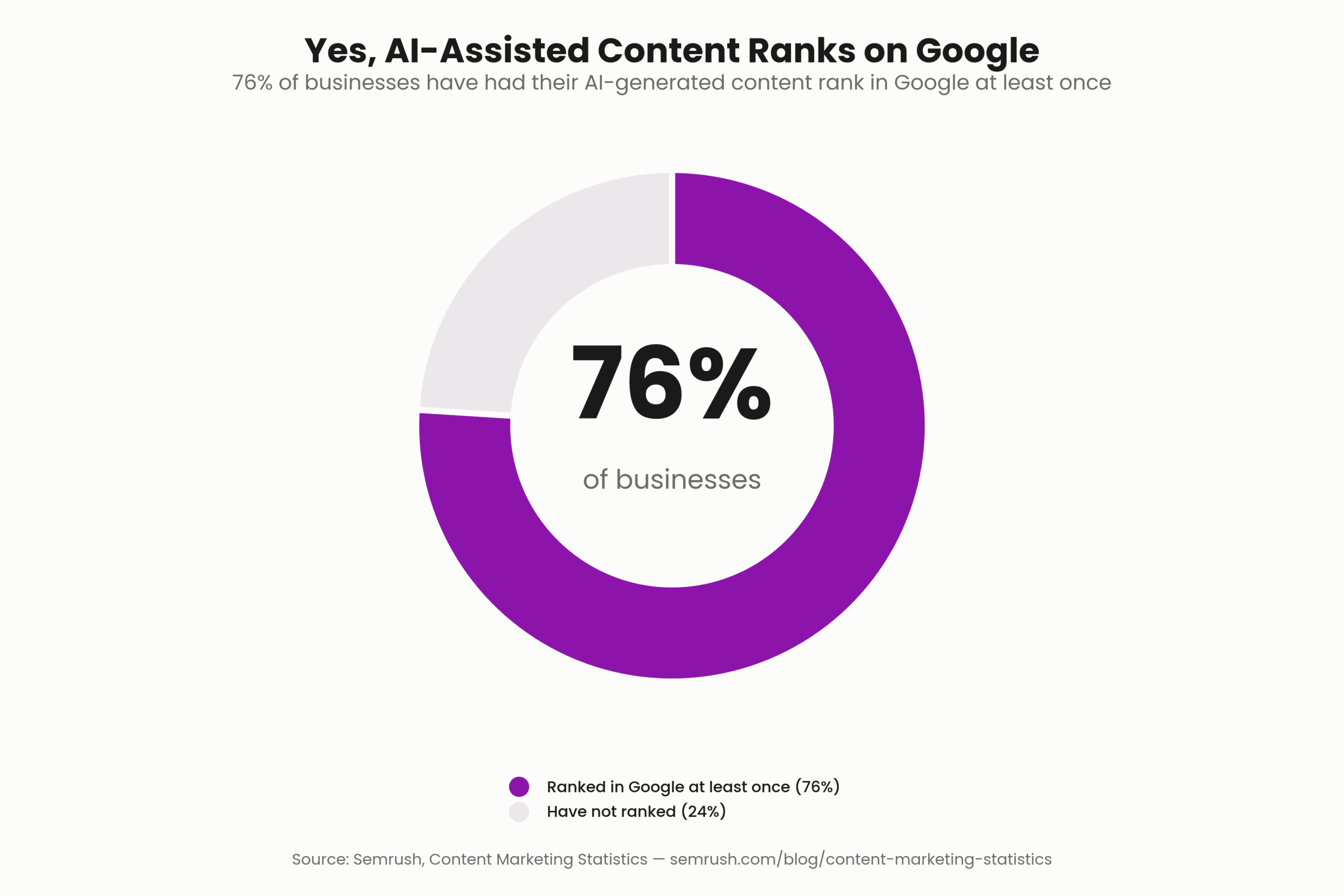
If you’ve held off on AI-assisted content because you’re afraid Google will bury it, the data says you’re leaving rankings on the table. According to Semrush’s content marketing statistics, 76% of businesses have had their AI-generated content rank in Google at least once. That is not a fringe result — it is the clear majority experience. The fear that “Google won’t rank AI content” is one of the most persistent myths in SEO right now, and it doesn’t hold up against either the data or Google’s own public policy. This post breaks down the 76% stat, what Google has actually said about AI content, the corroborating research from 2025 and 2026, and the exact playbook to get your AI-assisted content ranking instead of ignored.
The Data: 76% of Businesses Have Already Ranked AI Content
The number is worth sitting with: roughly three out of every four businesses using AI to help produce content have watched that content earn a ranking position in Google Search. Per Semrush’s content marketing statistics, this places AI-assisted content squarely inside the mainstream of what actually performs in organic search today, not on the fringe of some risky experiment.
This lines up directly with what Google itself has said publicly. In its Search Central guidance on AI-generated content, Google has been explicit that the production method is not the deciding factor in rankings. The company’s own language draws the line at intent, not tooling: using automation — including AI — “to generate content with the primary purpose of manipulating ranking in search results” is treated as a violation of Google’s spam policies. Notably, that statement is about manipulative intent, not about AI as a technology. Google’s broader helpful-content guidance reinforces the same idea — content is evaluated on whether it is “created for people” and demonstrates real expertise, experience, authority, and trust (E-E-A-T), regardless of whether a human, an AI system, or some combination of both produced the words on the page.
Put simply: Google never built an “AI detector” into ranking. It built a helpfulness detector. The 76% figure is the real-world proof that businesses following that principle — using AI to assist rather than to mass-produce manipulative filler — are getting rewarded with visibility.
The 2026 Trend: Independent Research Backs Up the Same Story
Two independent 2025–2026 studies add texture to the Semrush number and confirm the same underlying conclusion from different angles.
First, Originality.ai’s ongoing tracking study of AI content in Google’s top 20 search results found that AI-generated or AI-assisted material made up roughly 17–19% of top-ranking informational content through 2025, up from under 3% back in 2019. AI content isn’t a rare anomaly appearing in the search results — it is now a normal, persistent part of what shows up on page one, at a scale that has climbed steadily for years.
Second, and more instructive, is Search Engine Land’s 16-month experiment publishing 2,000 purely AI-generated articles across 20 brand-new, zero-authority domains. The early results looked promising — the majority of pages indexed quickly and even generated meaningful impressions and clicks within the first few months. But by months three through six, visibility collapsed to a fraction of its peak and largely stayed there. The researchers’ conclusion was blunt: without authority, unique insight, or trust signals, AI content’s rankings collapse over time, no matter how fast it gets indexed.
Read together, these two studies tell a consistent story that matches the Semrush number perfectly: AI content ranks, and ranks often, but only durably when it’s paired with the same fundamentals that have always mattered — expertise, originality, and trust. AI content produced in a vacuum, with no authority behind it, is the exception that struggles. AI-assisted content built on a foundation of real experience and editorial oversight is the majority case that succeeds.
Why This Matters for AI and Digital Marketing
The practical takeaway for marketers is that the “AI vs. human” framing is the wrong question. The right question is “does this page demonstrate genuine expertise and actually help the searcher?” Google’s ranking systems were never built to detect the software used to draft a paragraph; they were built to detect thin, redundant, unoriginal content — the kind AI can produce just as easily as a rushed human writer can.
This reframing has three concrete implications for any business investing in content right now:
- Quality control is the actual ranking factor, not authorship. The businesses in that 76% aren’t succeeding because they used AI — they’re succeeding because they used AI without sacrificing the editorial standards that make content worth ranking.
- Fear of AI content is often a fear of bad process, not AI itself. The failure mode in the Search Engine Land experiment wasn’t “AI wrote it” — it was zero authority, zero unique insight, and zero trust signals stacked on top of automation. Any content produced that way, AI or not, would have struggled.
- E-E-A-T is now a production requirement, not a nice-to-have. As more AI content enters the search results (per Originality.ai’s data), the pages that keep winning will be the ones layering real experience and expertise on top of AI-assisted drafting — not the ones treating AI as a substitute for it.
For digital marketing teams, that’s good news: it means AI can legitimately speed up production without being a rankings liability, as long as the workflow keeps humans in the loop for expertise, fact-checking, and original perspective. 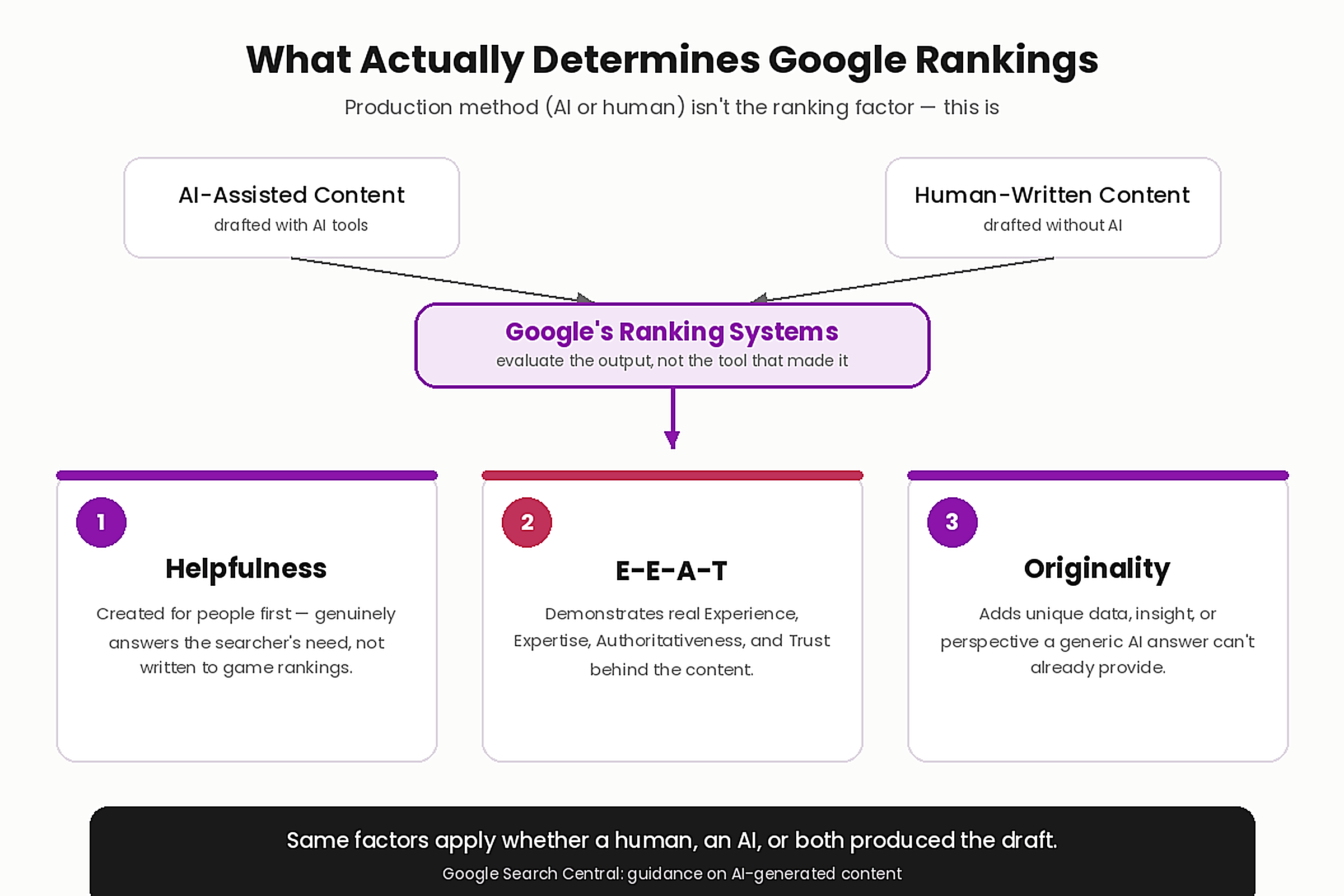
How to Adapt: A 5-Step Playbook for AI Content That Ranks
1. Anchor every draft in real experience, not just AI output
Before AI touches a topic, gather first-hand input: a subject-matter expert’s notes, proprietary data, customer questions from sales or support, or original examples from your own work. AI should draft around this material, not invent it from scratch. This is the single biggest lever for satisfying Google’s experience signal.
2. Always run a human editorial pass
Never publish raw AI output. Have a knowledgeable editor check facts, tighten claims, remove generic filler, and inject specificity — names, numbers, dates, and examples that a generic model wouldn’t know. This is also where you catch the repetitive phrasing and hedge-y language that make AI content read as thin.
3. Build topical authority instead of one-off pages
The Search Engine Land experiment failed largely because it tested brand-new domains with zero authority. Publish AI-assisted content inside an established site with a track record on the topic, and support each new piece with internal links to related, well-performing content you already own.
4. Add original data, quotes, or analysis AI can’t fabricate
Differentiate every piece with something a generic AI response cannot produce on its own: a proprietary statistic, a client case study, an expert quote, or a genuinely fresh take on a debated question. This is what separates content that merely restates the consensus from content Google treats as worth ranking above it.
5. Disclose your process and keep intent transparent
Google explicitly cares about intent, not tooling. Keep your use of AI aligned with genuinely helping readers, not gaming rankings — avoid mass-publishing near-duplicate pages targeting keyword variants with no added value. Where relevant, be transparent about your editorial and AI-assisted process; it builds trust with readers and aligns cleanly with how Google evaluates helpful content. 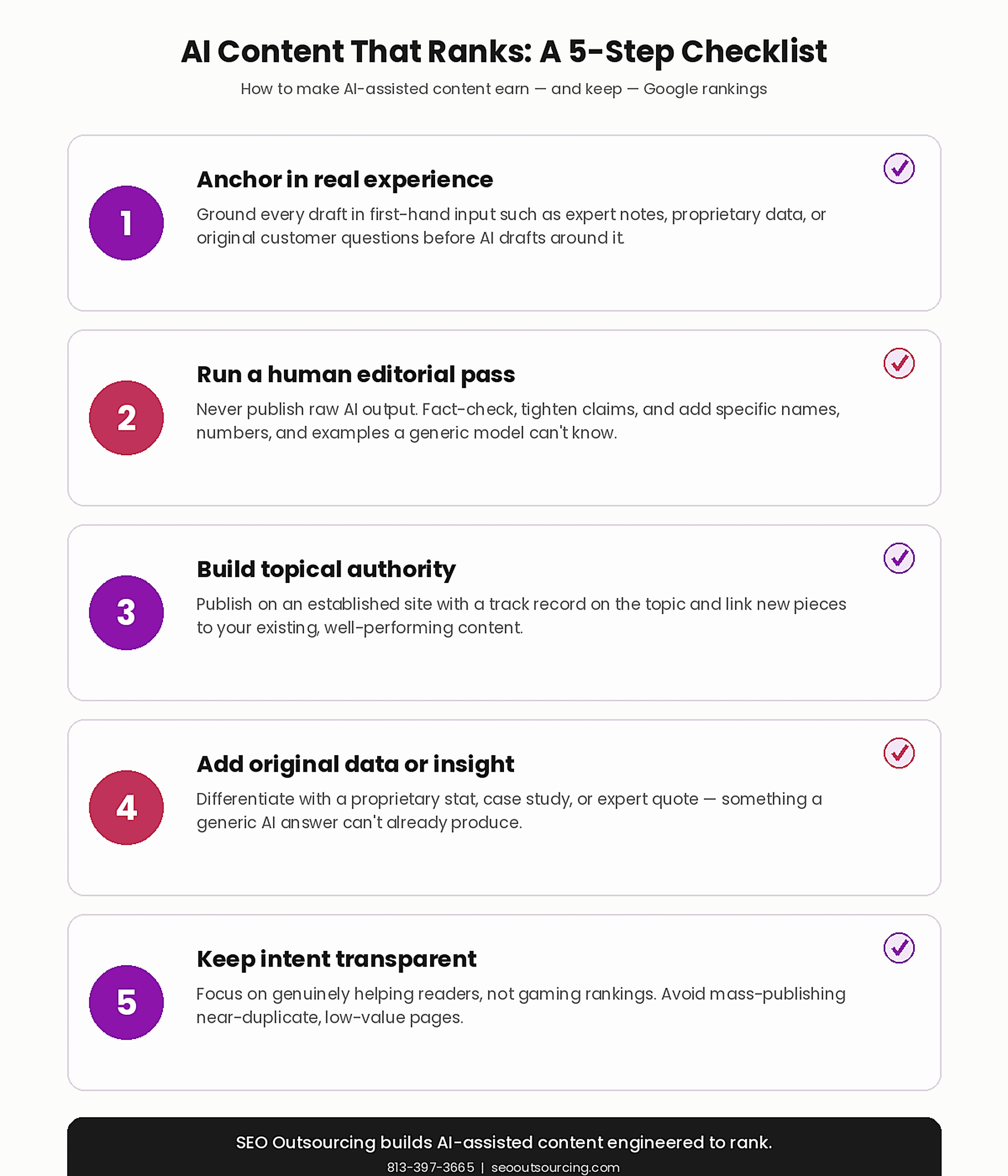
Frequently Asked Questions
Does Google penalize content just because it was written with AI?
No. Google has stated publicly that using automation, including AI, is not itself a violation of its guidelines. The violation is using automation with “the primary purpose of manipulating ranking in search results.” Well-edited, genuinely helpful AI-assisted content is treated the same as any other content.
What percentage of businesses have gotten AI content to rank on Google?
According to Semrush’s content marketing statistics, 76% of businesses have had their AI-generated content rank in Google search results at least once, making it the majority outcome rather than a rare exception.
Why did some AI content fail in the Search Engine Land experiment if AI content generally ranks?
That experiment specifically tested purely AI-generated content on brand-new domains with zero prior authority, links, or trust signals. Its early gains collapsed because the content had no expertise or authority behind it — not because AI was used. Content that pairs AI drafting with real experience and site authority performs very differently.
What matters more for rankings: AI or human writing?
Neither, directly. Google’s ranking systems are built around helpfulness and E-E-A-T signals — expertise, experience, authoritativeness, and trust — regardless of production method. The deciding factor is whether the finished content is genuinely useful and original, not whether a human or an AI drafted the first version.
Ready to Publish AI Content That Ranks?
The data is clear: AI-assisted content can rank on Google, but only when it’s built the right way — grounded in real expertise, edited by knowledgeable humans, and backed by site authority. SEO Outsourcing builds AI-assisted content programs specifically engineered around Google’s helpful-content standards, not around cutting corners, so every piece is designed to earn and keep its ranking. Call us at 813-397-3665 to build a content process that turns AI into a ranking asset instead of a risk.