Why Consumers Now Trust ChatGPT’s Recommendations as Much as Online Reviews
For twenty years, the star rating was the ultimate trust signal. Consumers checked review counts, scanned recent comments, and made decisions based on what strangers said about a business. That era isn’t over, but it now has company. According to BrightLocal’s Local Consumer Review Survey on AI Trust, 64% of consumers who use AI say they trust ChatGPT’s business recommendations as much as online reviews.
That single number is a signal flare for anyone who manages a brand’s online reputation. It means a meaningful share of your prospective customers are no longer only reading your Google reviews — they’re asking ChatGPT which plumber, dentist, or law firm to call, and they’re trusting the answer with the same confidence they’d give a five-star rating from a neighbor.
This shift doesn’t replace traditional reputation management. It raises the stakes on it. If AI recommendations now carry review-level credibility, then what feeds those recommendations — your reviews, your citations, your website content — has become more important, not less. Below, we break down the data, what more recent research adds to the picture, and a practical playbook for making sure AI tells your story accurately.
The Data: What BrightLocal Found
BrightLocal surveyed 1,002 U.S. adult consumers in early 2026, including 455 respondents identified as “AI users” — people who had used AI tools like ChatGPT for local business recommendations in the past 12 months. The full study surfaced several figures that matter for reputation strategy:
- 64% of AI users say they trust ChatGPT’s business recommendations as much as online reviews.
- 63% of AI users say they trust AI tools’ recommendations generally, while only 10% express outright distrust.
- 42% of AI users say they trust AI exactly as much as traditional reviews — a smaller but meaningful subset who treat the two as functionally interchangeable.
- 50% of all consumers (AI users and non-users combined) trust AI to accurately summarize existing reviews; that trust jumps to 71% among active AI users.
- Among people who don’t yet use AI for local recommendations, 53% say they don’t trust AI-generated business recommendations — a real credibility gap that separates adopters from skeptics.
- Despite that trust, consumers aren’t blind followers: 88% of AI users say they fact-check sources or verify legitimacy, 97% sometimes double-check AI recommendations against real reviews, and 42% say they always verify on native review platforms before deciding.
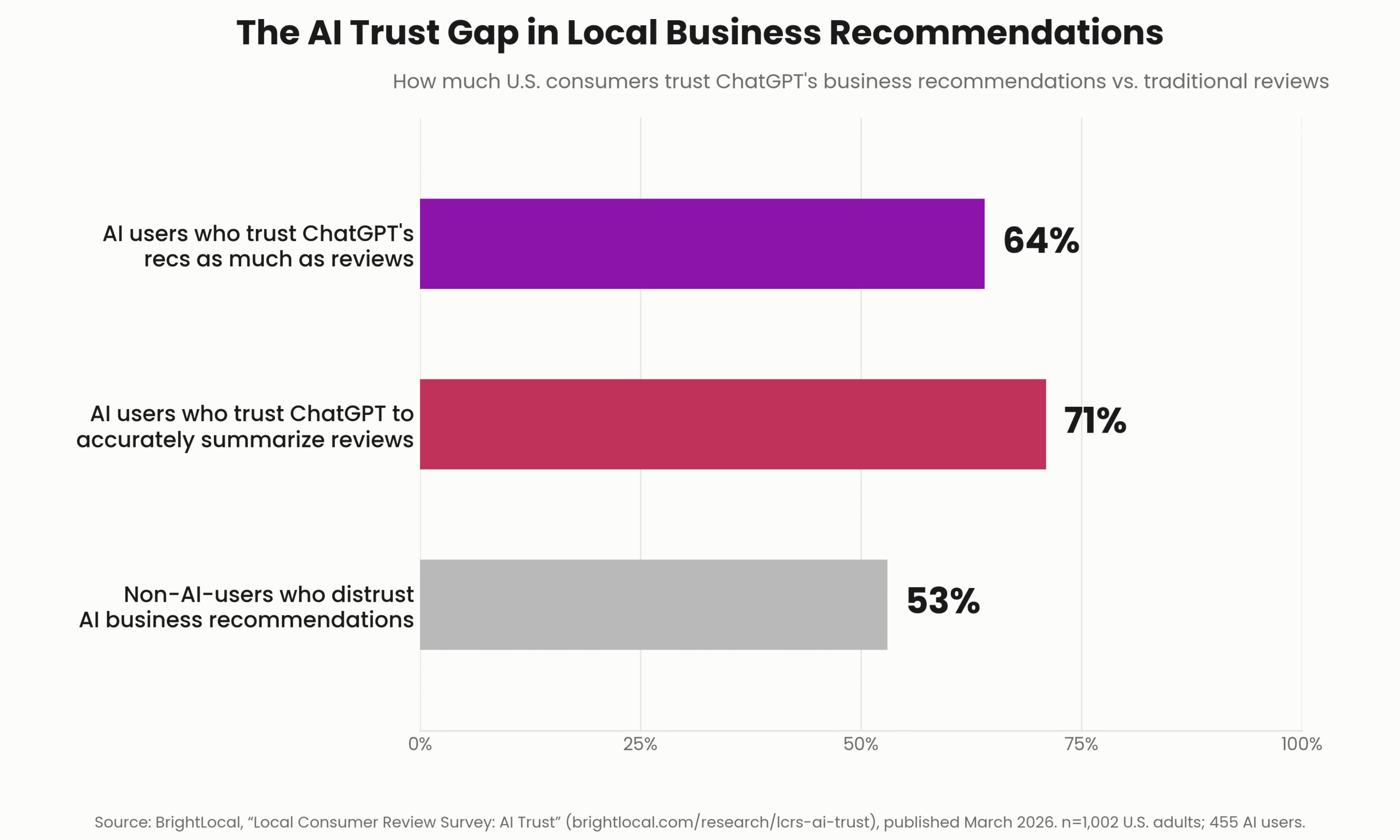
Two things stand out. First, trust in AI recommendations isn’t fringe — it’s approaching parity with the trust consumers place in reviews they’ve relied on for two decades. Second, consumers aren’t turning off their critical thinking. They’re using AI as a first filter and reviews as a verification layer, which means both channels now need to tell the same accurate story about your business.
The 2026 Trust Gap: What Newer Research Adds
BrightLocal isn’t the only data point here. A 2026 analysis on Human Reviews vs. AI Recommendations pulls together additional research that sharpens the picture. Citing Gartner’s 2026 consumer survey, the piece notes that shoppers are far more comfortable letting AI narrow down their options — filtering ten competitors to three, say — than letting it make the final purchase decision for them, especially for high-stakes categories like healthcare, legal services, or anything involving safety or significant money. Boston Consulting Group’s research adds that generative-AI use for shopping-related tasks grew 35% between February and November of 2025, meaning the pool of people forming first impressions through AI is expanding quickly, not plateauing.
That same coverage highlights a countervailing pressure: Trustpilot detected and removed 4.5 million fake reviews in 2024 alone, with roughly 90% caught by automated detection. As AI-generated content and review fraud both increase, the businesses that maintain a clean, verifiable, well-documented reputation trail are the ones AI models are more likely to surface — and trust — with confidence.
Put together, the 2026 research suggests a “trust hierarchy” rather than a trust replacement: AI is winning the early, low-stakes research and discovery phase, while reviews retain authority as evidence for higher-stakes final decisions. For most local and service businesses, that means you need to win both moments.
Why This Matters for AI and Digital Marketing
If 64% of AI users treat a ChatGPT answer like a review, then a chatbot’s summary of your business is functionally a new front door — and most businesses have never audited what’s behind it. AI recommendation engines don’t invent opinions out of thin air. They synthesize signals: your review volume and sentiment, the consistency of your name, address, and phone number across the web, the content and structured data on your website, and how authoritative sources describe your services.
This has two direct implications for digital marketing and reputation management:
- Reputation management is now AI input, not just a customer-facing display. A stale Google Business Profile, inconsistent citations, or a thin review base doesn’t just look bad to a human visitor — it gives AI models less (or worse) material to work with when someone asks, “Who’s the best HVAC company near me?”
- Answer engine optimization (AEO) and traditional reputation management have merged into one discipline. The tactics that used to live in separate departments — review generation, citation cleanup, schema markup, and content marketing — now all feed the same output: what an AI says about you when a customer asks.
The businesses that treat this as an SEO afterthought will find themselves misrepresented, under-recommended, or invisible in AI answers, while competitors who actively manage their AI-visible trust signals get recommended by name. 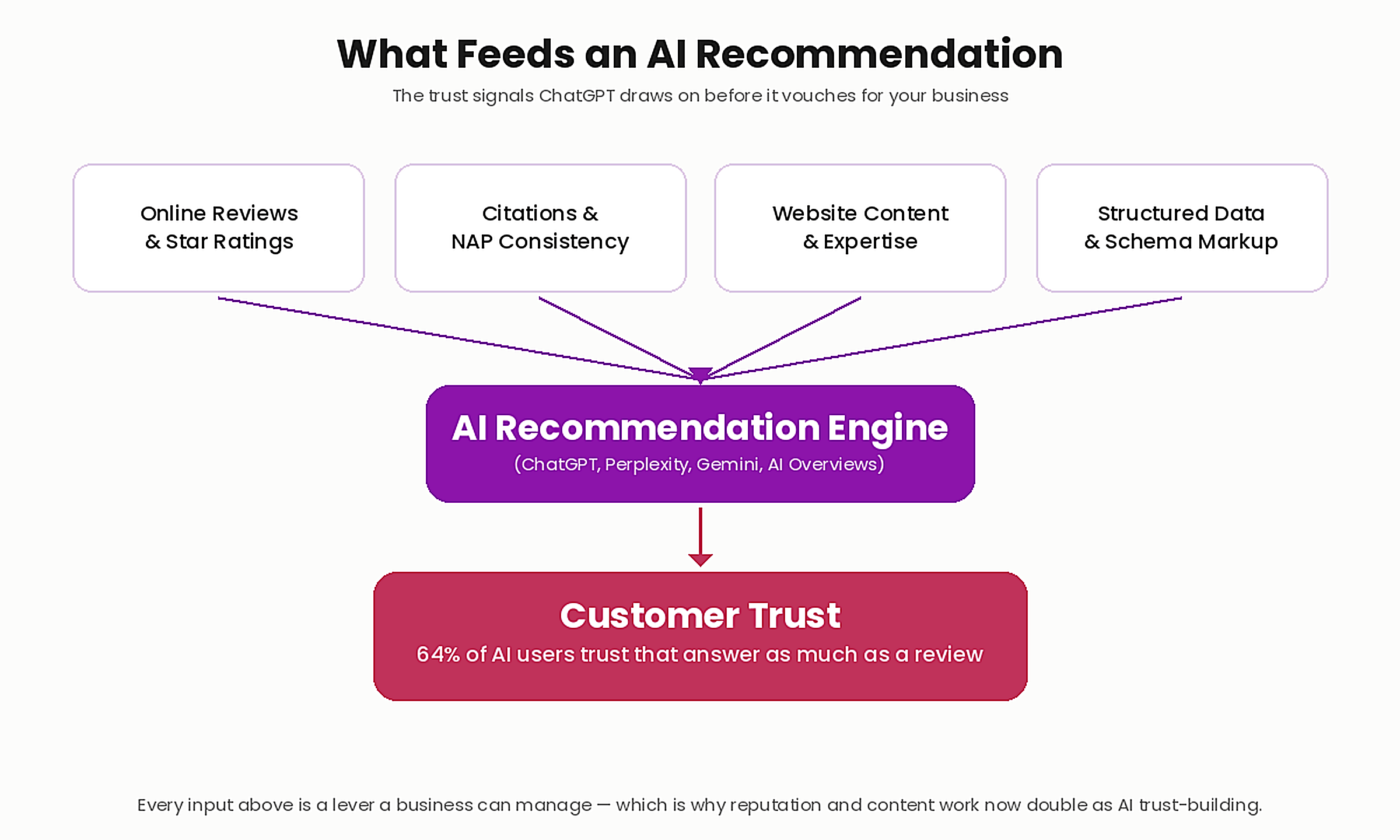
How to Adapt: A 5-Step AI Trust Playbook
Winning traditional SEO rankings is no longer enough on its own. Here’s a practical playbook for making sure that when ChatGPT (or Perplexity, or Google’s AI Overviews) vouches for your business, it says the right thing.
1. Audit Your Review Footprint Across Platforms
Start by finding out where your reviews actually live: Google, Yelp, Facebook, industry-specific directories, and the Better Business Bureau all feed different AI training and retrieval pipelines. Pull a full inventory, note your average rating and volume on each, and flag any glaring gaps — a business with 400 Google reviews but zero on an industry-specific site can look thin to a model pulling from that second source.
2. Lock Down Citations and Structured Data
Inconsistent name, address, and phone (NAP) information across directories confuses both search engines and AI models trying to confirm you’re a legitimate, single entity. Clean up duplicate or outdated listings, and add LocalBusiness, Review, and FAQ schema markup to your website so AI systems can parse exactly who you are, what you do, and what customers say about you — in a structured, machine-readable format.
3. Keep Reviews Fresh and Specific
A pile of five-star reviews from three years ago is less useful to an AI summarizer than a steady, recent stream of detailed feedback. Build a simple, consistent process for requesting reviews after every completed job or sale, and encourage customers to mention specifics — the service performed, the outcome, the timeline — since specific language is exactly what AI systems pull into their summaries and recommendations.
4. Publish Content AI Can Cite
AI recommendation engines favor sources that answer questions directly and authoritatively. Build out FAQ pages, service-specific expertise content, and case studies that state clearly who you serve, what makes you different, and what outcomes you deliver. Structure this content so a model can extract a clean, quotable answer rather than having to infer one from marketing copy.
5. Monitor What AI Actually Says About You
Reputation monitoring can no longer stop at review alerts. Regularly query ChatGPT, Perplexity, and Google’s AI Overviews with the questions your customers are likely asking — “best [service] near me,” “is [business] reliable,” “compare [you] vs. [competitor]” — and track how you’re described. When you spot outdated, incomplete, or inaccurate information, correct it at the source (your website, your listings, your reviews) rather than trying to argue with the model directly. 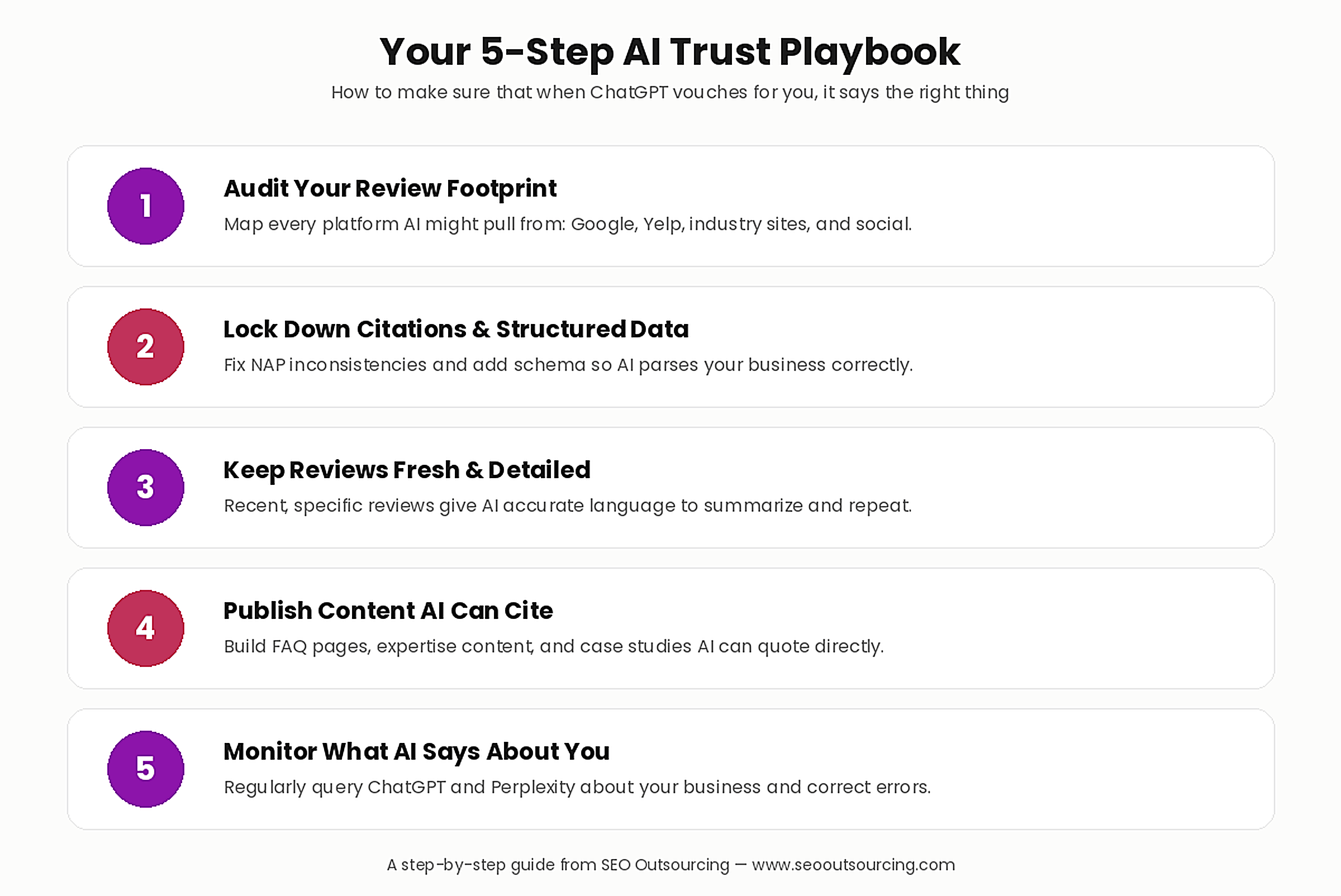
FAQ
Why do consumers trust ChatGPT’s recommendations almost as much as online reviews?
BrightLocal’s 2026 research found that AI users largely see ChatGPT as a fast, convenient synthesis of the same information reviews provide. Because AI recommendations are built from real review data, citations, and business content, many consumers treat a confident AI answer as functionally equivalent to a well-reviewed listing — while still verifying it before making a final decision.
How many people were surveyed in the BrightLocal AI trust study?
BrightLocal surveyed 1,002 U.S. adult consumers, including 455 who qualified as “AI users” — people who had used AI tools for local business recommendations within the past 12 months. The study was published in March 2026.
Does trusting AI recommendations mean people are reading fewer reviews?
Not necessarily. The same study found that 97% of AI users sometimes double-check AI recommendations against real reviews, and 42% always verify on native review platforms. AI is increasingly the discovery layer, while reviews remain the verification layer — especially for higher-stakes decisions.
How can a business influence what ChatGPT recommends about it?
By actively managing the signals AI models draw from: review volume and recency, citation consistency (NAP), structured data and schema markup, and authoritative, specific website content. This combined practice is often called answer engine optimization (AEO), and it works alongside traditional SEO and reputation management rather than replacing it.
What is answer engine optimization, and how does it relate to review trust?
Answer engine optimization is the practice of structuring your online presence — reviews, citations, content, and schema — so that AI systems like ChatGPT, Perplexity, and AI Overviews can accurately find, understand, and recommend your business. Because 64% of AI users trust those recommendations at review-level, AEO has effectively become an extension of reputation management.
Contact Us
AI is now part of how customers decide who to trust — which means your reputation management strategy needs to work for both human readers and AI models. SEO Outsourcing helps local and service businesses audit their review footprint, clean up citations and schema, and build the kind of authoritative content that gets recommended by name, whether the question comes from Google or ChatGPT. Call (813) 397-3665 or visit www.seooutsourcing.com to get a free AI visibility and reputation audit today.