Marketing leaders have spent the better part of two years asking whether answer engine optimization (AEO) is worth the budget line. New data says the debate is over: 97% of CMOs and digital leaders who invested in AEO in 2025 reported it had a positive impact on their marketing funnel, and the visitors AI search sends convert at twice the rate of other traffic, in a third of the sessions. That is not a visibility metric. It is a performance metric, and it is the kind that gets a CMO’s spend approved for another year.
For an SEO agency working alongside marketing teams every day, this is the number we have been waiting for. It moves AEO out of the “emerging channel, watch and see” bucket and into the “prove it, then scale it” bucket. Below, we break down what the data actually shows, what corroborating research says about why AI-sourced traffic behaves this way, and a five-step playbook for capturing the funnel advantage before your competitors do.
The Data: 97% Positive Impact, 2x Conversion, One-Third the Sessions
The headline figure comes from Conductor’s State of AEO/GEO report, which surveyed CMOs and digital marketing leaders at enterprise organizations about their AEO and GEO (generative engine optimization) investments. The result: 97% of respondents who had invested in AEO said it had a positive impact on their marketing funnel in 2025. That is about as close to consensus as enterprise marketing data gets.
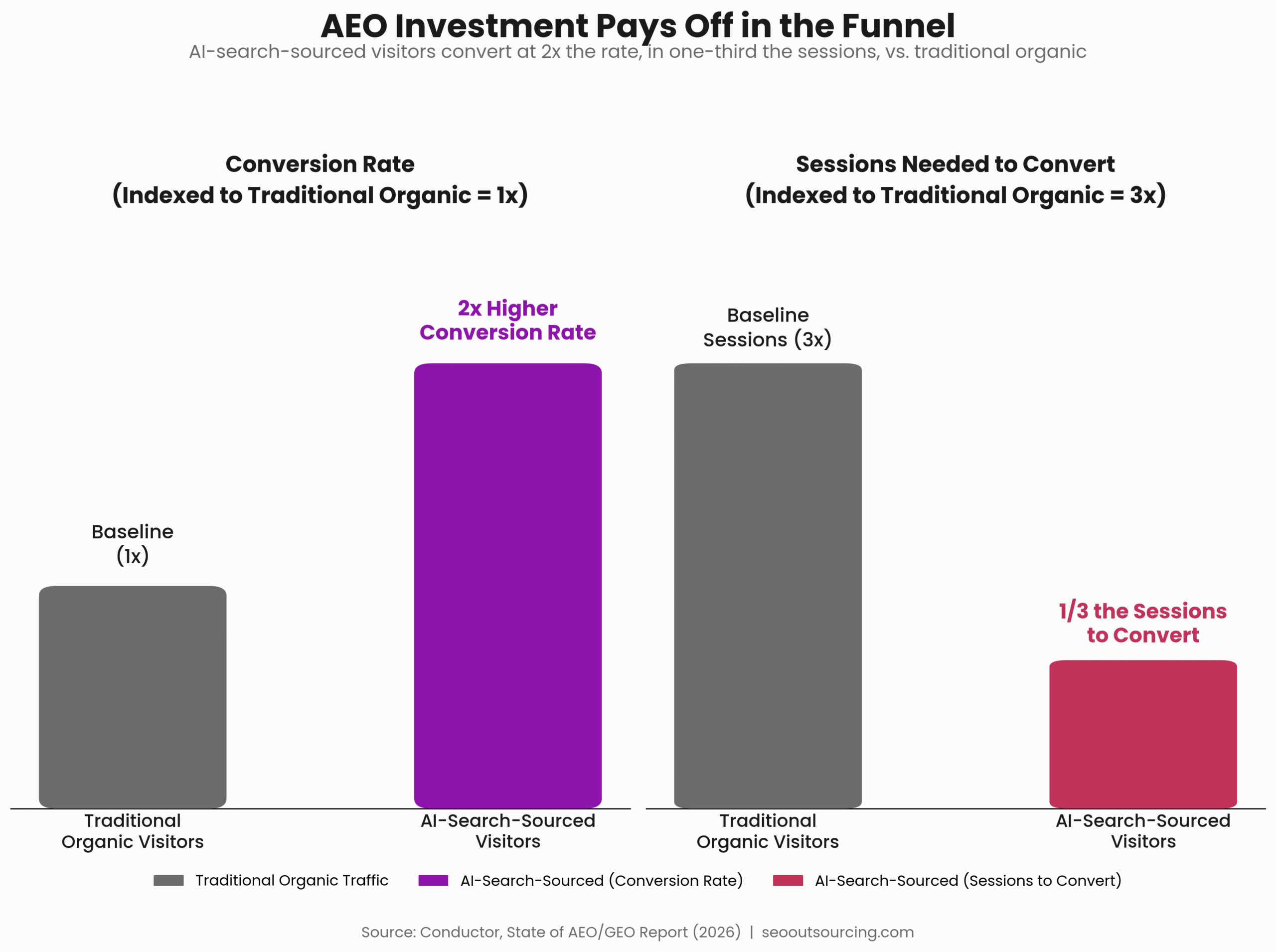
The report goes further than sentiment. It quantifies the funnel effect directly: traffic sourced from AI answer engines “tends to have higher intent than traditional organic traffic, converting at twice the rate and in one-third the number of sessions compared to other site traffic sources.” Read that carefully, because both halves matter.
- Twice the conversion rate means AI-referred visitors are simply more likely to take the action you want, whether that’s a form fill, a demo request, or a purchase.
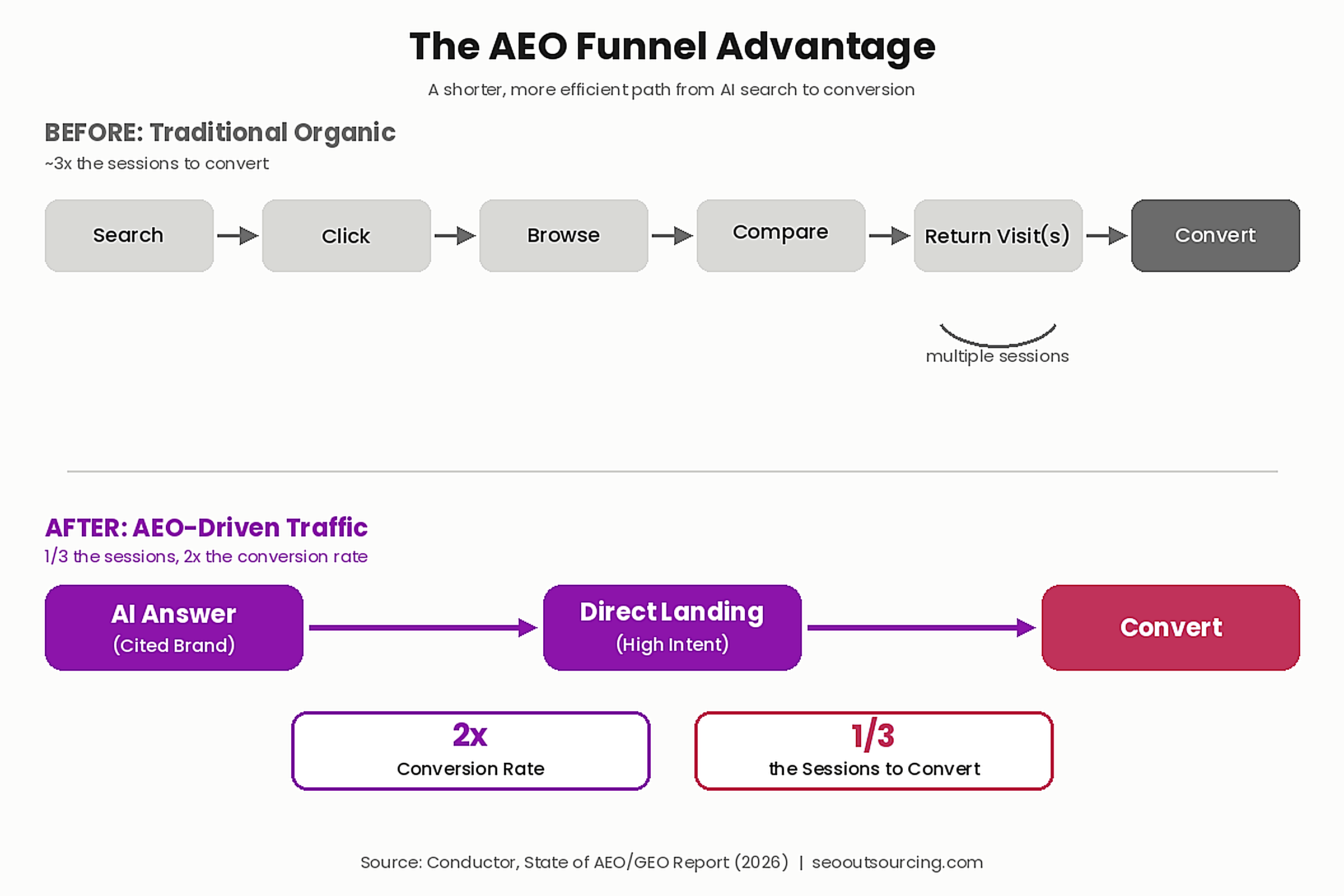
- One-third the sessions means those visitors need far less nurturing to get there. A traditional organic visitor might search, click, browse, leave, and come back two or three more times before converting. An AI-search visitor, by contrast, often arrives already educated, having had their questions answered inside the AI conversation, and converts closer to the first visit.
Put together, this is a compounding efficiency story: AEO-driven traffic converts more often, and it converts faster, which means every dollar spent optimizing for AI citations works harder across the entire funnel, not just at the top.
The 2026 Trend: Independent Research Confirms the Pattern
Conductor’s finding is not an outlier. A growing body of 2025 and 2026 research from other analytics providers points to the same conclusion: traffic from AI search engines and chatbots converts meaningfully better than traffic from traditional organic search.
Ahrefs published its own analysis in June 2025 after reviewing 12 months of its own web analytics data. The finding: AI search represented just 0.5% of Ahrefs’ total traffic, yet those visitors accounted for 12.1% of all signups, a 23x higher conversion rate than traditional organic search visitors. Ahrefs also found AI search visitors viewed 50% more pages per visit, a sign of the same high-intent, ready-to-act behavior Conductor describes.
Adobe’s Digital Insights team reported similar momentum in its January 2026 analysis of holiday shopping data: AI-referred traffic converted 31% more than other traffic sources overall, with conversions running 54% higher on Thanksgiving and 38% higher on Black Friday compared to non-AI traffic. Revenue per visit from AI-driven traffic climbed 254% year-to-date during the 2025 holiday season, and AI-referred shoppers were 33% less likely to bounce and spent 45% more time on-site than shoppers arriving through other channels.
Three independent data sets, three different methodologies, one consistent signal: AI search doesn’t just send interested visitors, it sends visitors who are further along in their decision and ready to act. It’s little wonder that, according to the same Conductor report, 94% of enterprise CMOs now plan to increase their AEO investment in 2026 after 56% already made a significant investment in 2025. The performance data is what’s justifying the budget.
Why This Matters for AI and Digital Marketing
For years, SEO and content teams have been measured primarily on traffic and rankings. The AEO performance data forces a shift toward funnel and revenue metrics, and that shift has real implications.
First, efficiency changes the ROI math on content investment. If AEO-sourced visitors need a third of the sessions to convert, the lifetime cost of acquiring a customer through AI search visibility drops even if your absolute traffic volume from AI engines stays modest. A smaller number of highly qualified visitors can out-perform a much larger number of low-intent organic clicks.
Second, attribution models need to catch up. Many analytics setups still lump AI referral traffic into “direct” or “other,” making it invisible in funnel reports. Marketing leaders who can’t see AI-sourced sessions separately can’t measure the 2x/one-third-sessions effect internally, which means they can’t make the budget case Conductor’s survey respondents are already making.
Third, the funnel itself needs to be redesigned around answer-stage intent. Traditional organic visitors typically land on a page still forming their opinion. AEO-driven visitors have often already had their core question answered inside the AI conversation and are evaluating specific brands, not general options. That means landing pages, calls to action, and even sales scripts built for a “top of funnel” visitor may under-serve a visitor who is functionally mid- or bottom-funnel the moment they click through.
How to Adapt: A 5-Step Playbook
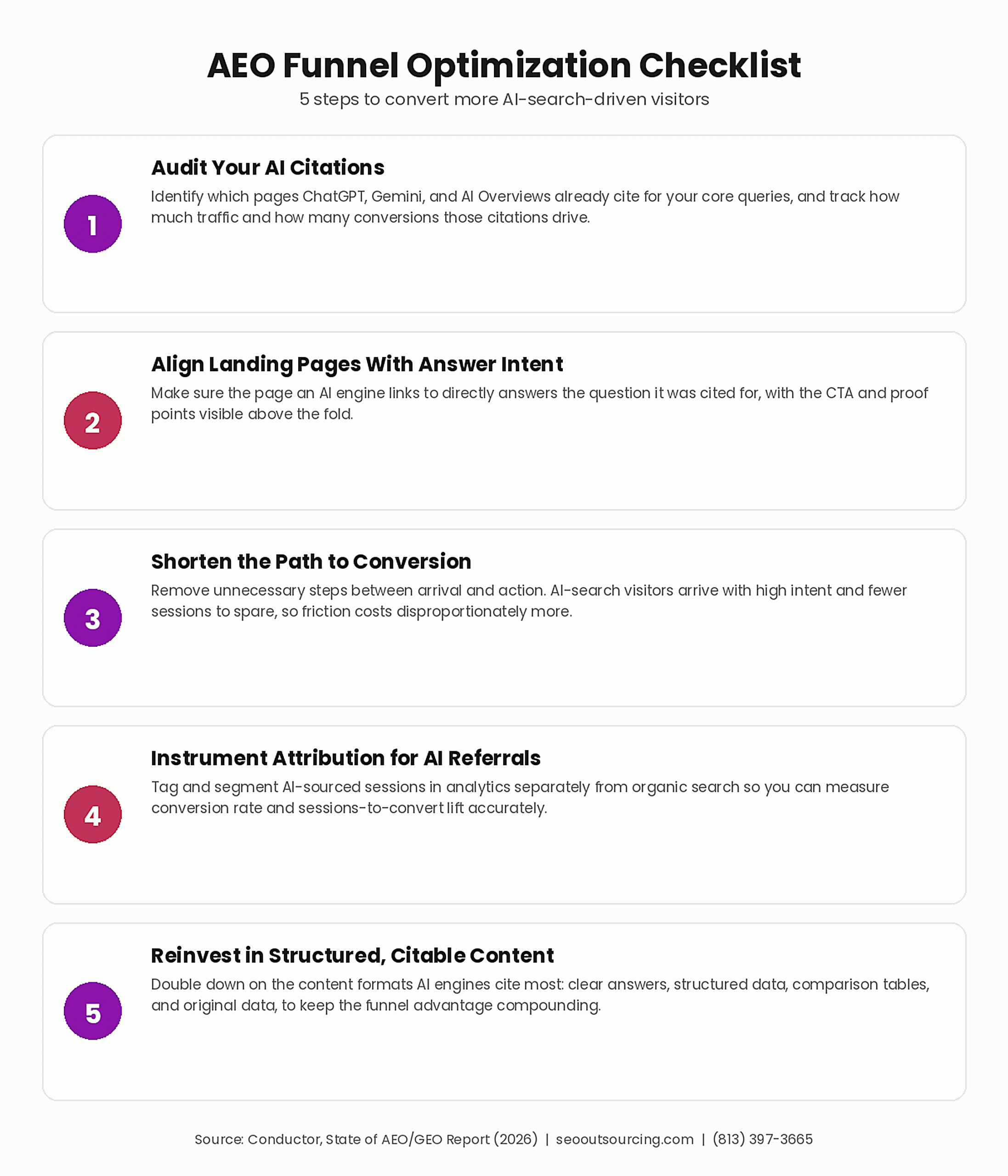
1. Audit your AI citations
Before you can improve funnel performance from AEO, you need to know where you already show up. Use tools that track AI Overview and chatbot citations, or manually query ChatGPT, Gemini, and Perplexity with your core commercial questions, to see which of your pages are already being cited. Cross-reference those pages against your analytics to see how much traffic and how many conversions they’re already driving.
2. Align landing pages with answer intent
When an AI engine cites your page and a user clicks through, that page needs to deliver on the exact question that earned the citation, not a generic overview. Put the direct answer, proof points, and a clear call to action above the fold, since AEO visitors have less patience for scrolling to confirm they landed in the right place.
3. Shorten the path to conversion
Given that AI-search visitors convert in a third of the sessions, every extra click, form field, or navigation step between arrival and action costs you disproportionately more of this traffic. Audit your conversion paths for AI-referred landing pages specifically and remove friction wherever the data allows it.
4. Instrument attribution for AI referrals
Set up dedicated tracking segments or UTM conventions to isolate AI-sourced sessions from general organic traffic in your analytics platform. Without this, you cannot measure your own version of the 2x conversion rate and one-third sessions statistic, and you cannot make an internal case for further AEO investment.
5. Reinvest in structured, citable content
The content formats AI engines cite most, direct answers, well-labeled FAQs, comparison tables, and original data, are the same formats that keep this funnel advantage compounding. Treat AEO content production as a continuous investment tied to measured funnel results, not a one-time project.
Frequently Asked Questions
What does “AEO” mean in this context?
AEO stands for answer engine optimization: the practice of optimizing content so it gets cited and surfaced inside AI-generated answers from tools like ChatGPT, Google’s AI Overviews, Gemini, and Perplexity, rather than only ranking in traditional blue-link search results.
Why do AI-search visitors convert at 2x the rate of other traffic?
According to Conductor’s research, AI-search visitors tend to arrive with higher intent because much of their research and question-answering has already happened inside the AI conversation. By the time they click through to a website, they are often evaluating a specific option rather than starting from scratch, which naturally produces higher conversion rates and shorter paths to purchase.
Is this conversion advantage specific to Conductor’s data, or is it a broader trend?
It’s a broader trend. Independent analyses from Ahrefs (June 2025) and Adobe (January 2026) both found significantly higher conversion performance from AI-referred traffic compared to traditional organic or non-AI traffic, using entirely different data sets and methodologies. See the sources cited above for details.
How can I measure my own AEO conversion performance?
Start by segmenting AI-referral traffic in your analytics platform, either through referrer-based rules or dedicated tagging, then compare conversion rate and average sessions-to-convert for that segment against your traditional organic segment. If your analytics can’t cleanly isolate AI referrals yet, that gap is itself a sign your attribution setup needs an update.
Does this mean we should stop investing in traditional SEO?
No. Traditional organic search still drives the largest share of most brands’ traffic and remains an important discovery channel, and strong traditional SEO fundamentals (technical health, authority, content quality) are often prerequisites for being cited by AI engines in the first place. The data argues for adding AEO-focused funnel work alongside SEO, not replacing it.
Ready to Turn AI Search Visitors Into Customers?
Knowing that AEO-driven traffic converts at twice the rate in a third of the sessions is only useful if your funnel is built to capture it. SEO Outsourcing helps marketing teams audit their AI citations, rebuild landing pages around answer intent, and instrument the attribution needed to prove the ROI to leadership. If you’re ready to turn AI search visibility into measurable pipeline, call us at 813-397-3665 to get started.