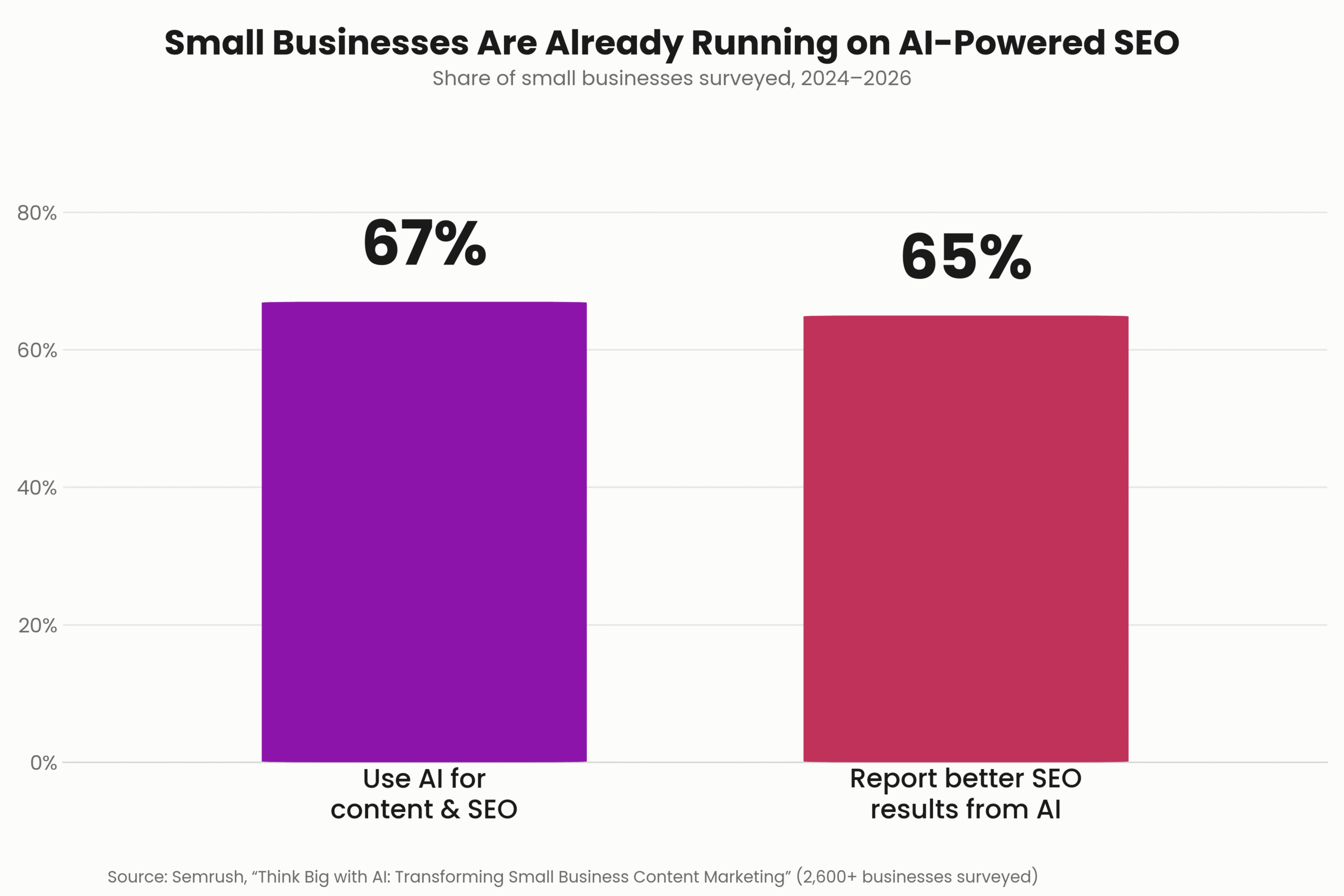
If you run a small business and you haven’t touched AI in your marketing yet, you’re now in the minority. New research shows that 67% of small businesses are already using AI for content and SEO — and 65% of them say it’s actually working, delivering measurably better search results. That’s not a fringe trend anymore. It’s the new baseline. In 2026, the small businesses still debating whether to “try AI someday” are quietly falling behind competitors who made the switch months ago and are now ranking, publishing, and converting faster on a fraction of the budget.
This shift matters most for small and local businesses, because AI is one of the few tools that genuinely levels the playing field against bigger competitors with bigger marketing teams. Here’s what the data actually says, what it means for your business, and exactly how to catch up.
The Data: Small Businesses Have Already Voted With Their Workflows
The headline numbers come from Semrush’s AI content marketing report, “Think Big with AI: Transforming Small Business Content Marketing,” which surveyed more than 2,600 businesses worldwide, incorporated insights from eight industry experts, and gathered feedback from 700 consumers. The topline findings:
- 67% of small businesses are already using AI for content creation and SEO tasks — everything from drafting blog posts and product descriptions to researching keywords and structuring pages.
- 65% of those businesses report improved SEO results as a direct outcome of using AI in their content and optimization process.
Two-thirds adoption with two-thirds of adopters seeing real results is a rare combination in marketing research. It tells us this isn’t hype or a shiny-object trend — small business owners are using AI tools, and most of them are getting a measurable return in the form of better rankings, more organic traffic, or both. The businesses in that 65% aren’t necessarily using more sophisticated tools than everyone else. They’re using AI consistently, treating it as part of their normal content workflow rather than a one-off experiment.
The 2026 Trend: Adoption Is Accelerating, Not Leveling Off
If the Semrush numbers made you think AI adoption might already be near its ceiling, more recent data says otherwise. According to Forbes’ coverage of Constant Contact’s Q1 2026 Small Business Now report, which surveyed more than 1,500 small business owners across five countries, 54% of small businesses currently use AI marketing tools and another 27% plan to adopt AI this year — pushing total adoption to a projected 81% by the end of 2026. The same study found small businesses are using AI to analyze trend data (45%), compose content (44%), and create images and visuals (40%), while also planning to increase both marketing budgets (68%) and time invested in marketing (74%).
That trend lines up with HubSpot’s 2026 State of Marketing report, which found that 80% of marketers now use AI for content creation and 61% believe marketing is experiencing its biggest disruption in two decades because of AI. Put the three reports together and the pattern is unmistakable: small business AI adoption isn’t a 2024 blip, it’s a multi-year curve that’s still climbing in 2026, with content and SEO as the leading use case.
Why This Matters for AI and Digital Marketing
For years, small and local businesses have been at a structural disadvantage in SEO. Larger competitors could afford full-time content teams, dedicated SEO managers, and enterprise tools that made it possible to publish more, optimize faster, and outrank smaller players almost by sheer volume. AI is one of the first genuine equalizers in that fight.
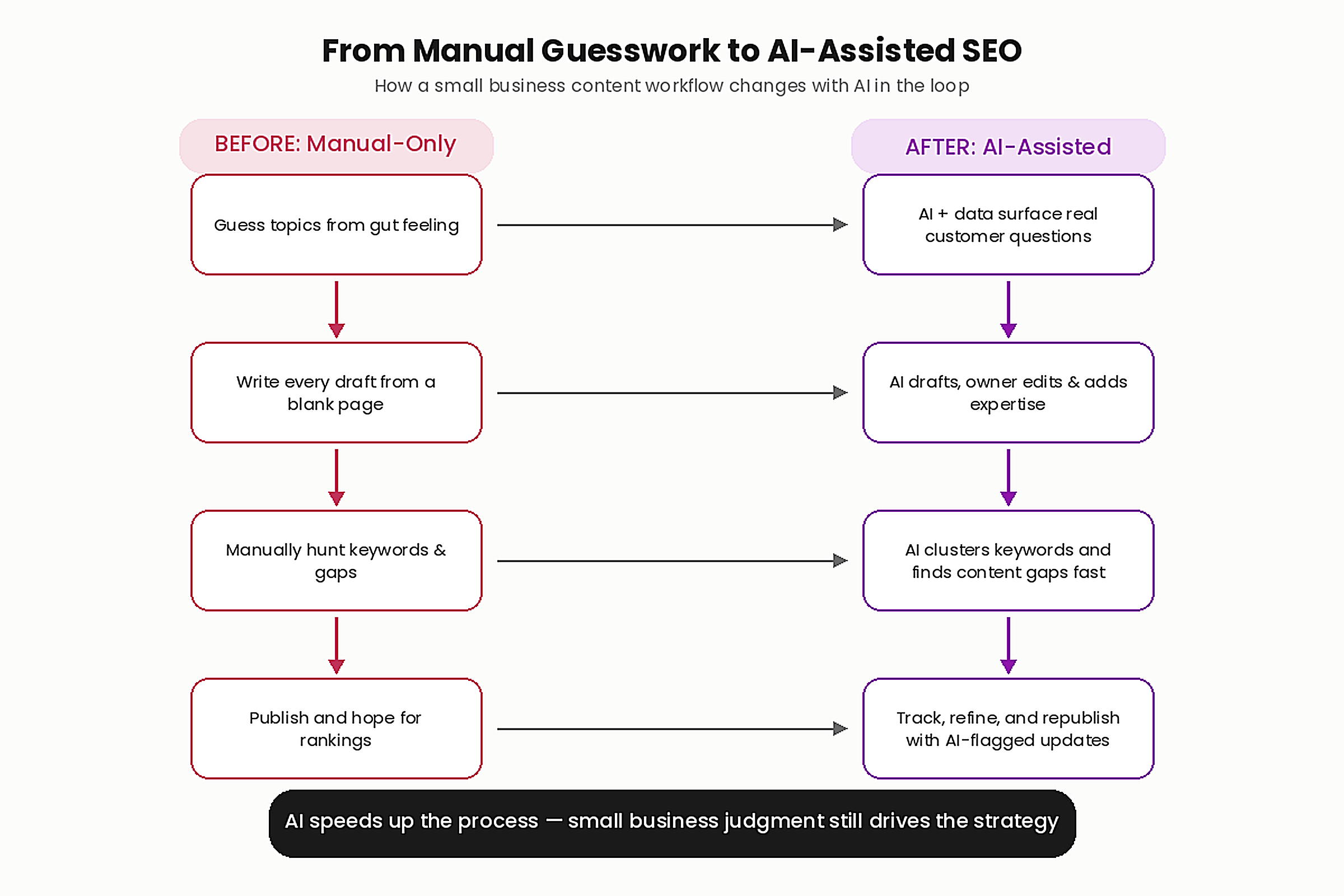
A solo business owner or a two-person marketing team can now use AI to do in an afternoon what used to take a week: draft a first pass of a service page, generate a batch of FAQ answers pulled from real customer questions, cluster keywords into a content plan, or spot gaps in a competitor’s site. That doesn’t replace expertise or judgment — it removes the blank-page and grunt-work bottlenecks that used to keep small businesses from publishing consistently.
The flip side is real too. As adoption climbs toward that 81% figure, AI-generated content is about to get a lot more common in every industry and every local market. Search engines and AI answer engines are getting better at rewarding content with genuine expertise, original data, and local specificity — and penalizing generic, interchangeable AI output. Businesses that use AI as an accelerant for real expertise will pull ahead. Businesses that use AI as a replacement for expertise will blend into the noise. For small businesses competing against bigger budgets, that distinction is the entire game in 2026.
How to Adapt: A 5-Step Playbook
1. Audit what you already have before you generate anything new
Pull a list of your most important pages — service pages, location pages, top blog posts — and evaluate each one honestly. Is it outdated, thin, or missing answers to questions customers actually ask you? AI is far more useful for fixing and expanding existing content with real gaps than for generating pages from nothing.
2. Standardize on one AI tool and actually learn its prompts
Small business owners often bounce between five different AI tools without mastering any of them. Pick one general-purpose AI assistant plus, if budget allows, one SEO-specific AI tool, and invest a few hours learning how to prompt it well for outlines, meta descriptions, and FAQ drafts. Depth with one tool beats a shallow trial of many.
3. Use AI for research and structure, not final copy
The highest-value use of AI in SEO right now is research: surfacing keyword clusters, summarizing competitor content, drafting outlines, and identifying content gaps. Let AI do that heavy lifting, then have a human — ideally the business owner or someone with real subject-matter expertise — rewrite the final draft in your own voice with your own examples.
4. Layer in proof that AI cannot fabricate
Original photos of your team, project, or storefront; specific customer stories; exact numbers from your own results; and local details tied to your actual service area are what separate content that ranks from content that reads like everyone else’s. AI can help you organize and phrase this proof, but it can’t manufacture it — that has to come from your business.
5. Track results monthly and adjust your process
Adoption alone doesn’t guarantee the 65% result — measurement does. Check keyword rankings, organic traffic, and lead volume for AI-assisted pages every month, and compare them to your pre-AI baseline. If a particular type of content or prompt isn’t moving the needle, change your approach rather than assuming AI itself isn’t working. 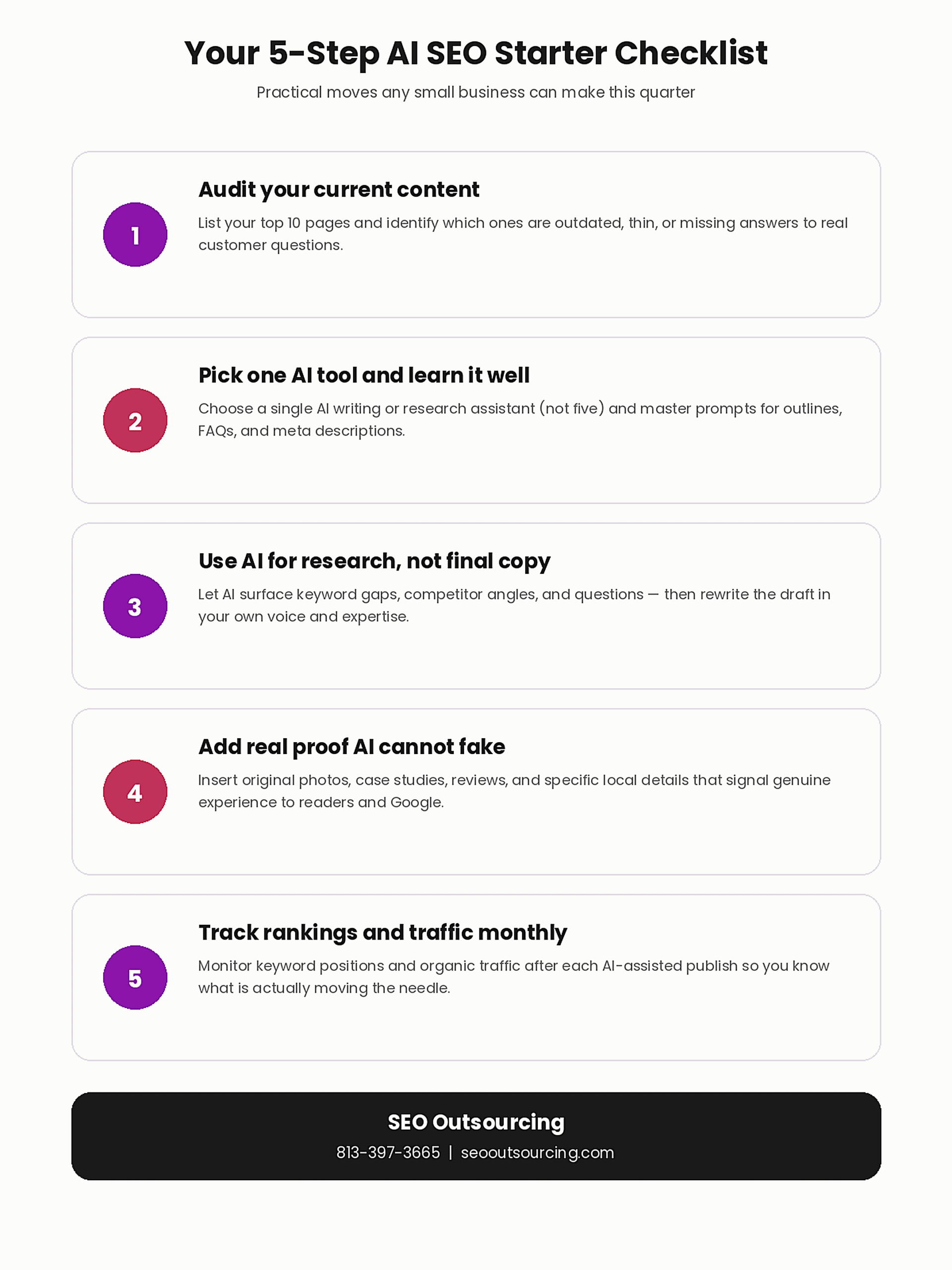
Frequently Asked Questions
Is it true that 67% of small businesses use AI for SEO?
Yes. According to Semrush’s AI content marketing report, which surveyed more than 2,600 businesses worldwide, 67% of small businesses are already using AI for content creation and SEO tasks, and 65% of those businesses report improved SEO results as a result.
Will AI-generated content hurt my SEO rankings?
Not inherently. Search engines don’t penalize content simply for being AI-assisted — they penalize thin, generic, or unhelpful content, whether a human or an AI wrote it. Content that combines AI-assisted research and drafting with real expertise, original data, and genuine local detail performs well. Content that is purely AI output with no human oversight or added value tends to underperform.
What’s the easiest way for a small business to start using AI for SEO?
Start small: use an AI tool to audit your existing top pages for gaps, generate a first-draft outline or FAQ section based on real customer questions, and cluster your target keywords into topics. Then have a human edit and add specific proof points before publishing. This approach gets you most of the time savings without sacrificing quality.
How fast is AI adoption growing among small businesses?
Quickly. Constant Contact’s Q1 2026 Small Business Now report found 54% of small businesses already use AI marketing tools with an additional 27% planning to adopt this year, projecting 81% total adoption by the end of 2026 — up sharply from prior years, as covered by Forbes.
Ready to Put AI-Powered SEO to Work for Your Business?
Knowing the data is one thing — turning it into rankings, traffic, and leads is another. SEO Outsourcing helps small businesses build AI-powered content and SEO workflows the right way: research and structure accelerated by AI, backed by real strategy, real expertise, and measurable results. If you’re ready to stop guessing and start competing with businesses twice your size, call us at 813-397-3665 to get started.