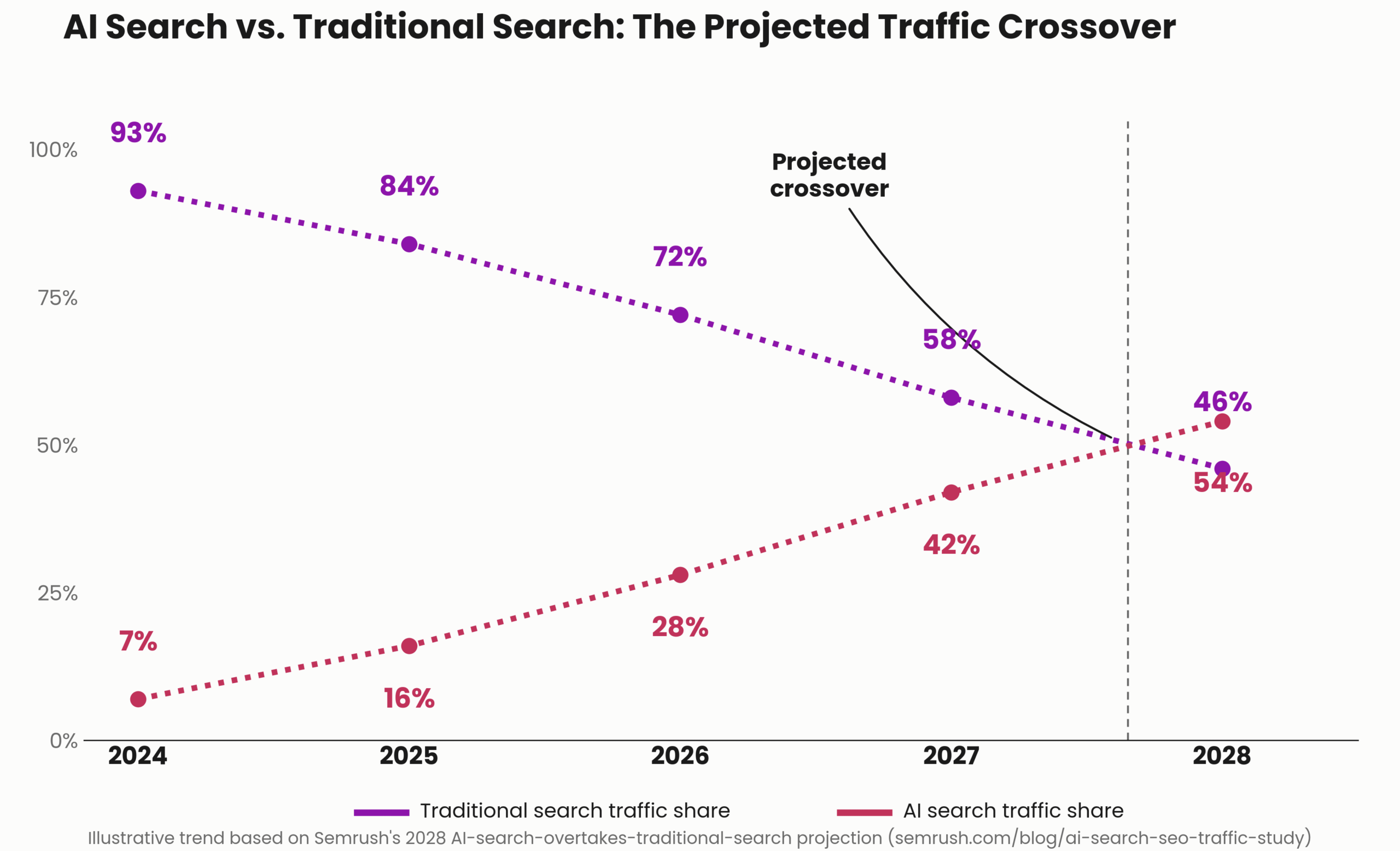
Mark your calendar: according to Semrush’s 2028 AI search traffic study, AI search visitors are projected to surpass traditional search visitors within the next two years. That’s not a distant, theoretical shift — it’s a planning horizon that fits inside a single marketing budget cycle or two.
For years, “SEO” meant optimizing for Google’s blue links. That world is ending. Chatbots, AI Overviews, and answer engines are increasingly the first (and sometimes only) stop for the questions your customers used to type into a search box. Semrush’s research suggests the tipping point — where more visitors arrive via AI search than traditional search — could land as soon as 2028, and possibly sooner if Google pushes its AI Mode experience to become the default for all users.
The businesses that treat this as a distant curiosity will spend 2028 scrambling to catch up. The ones that start adapting their content, budgets, and measurement systems today will own the visibility that AI systems hand out to the sources they trust most. This article breaks down the data behind the projection, what corroborating 2026 research shows, and a concrete five-step plan for getting ahead of the curve.
The Data: What Semrush’s Projection Actually Says
Semrush’s study, published July 21, 2025 by Rachel Handley, is one of the most-cited attempts to put a date on the AI-search crossover. Here’s what the research is actually built on:
- The core projection: AI search visitors are forecast to overtake traditional search visitors for digital-marketing and SEO-related topics by 2028 — and that timeline “could happen much sooner” if Google makes AI Mode the default search experience. (Semrush)
- Methodology: The study analyzed more than 500 high-value digital marketing and SEO-related topics and subtopics, translated into the specific search terms and prompts people actually use across both traditional search and AI assistants.
- The forecasting basis: Semrush is explicit that its “traffic and value projections are extrapolations of historical data and user adoption rates” — a methodology caveat worth remembering. This is a directional projection, not a guaranteed date.
- Supporting adoption signal: ChatGPT’s weekly active users grew roughly 8x between October 2023 and April 2025, surpassing 800 million weekly users — the kind of adoption curve that underpins a crossover this fast.
- Conditional acceleration: The report flags one wildcard above all others — if Google shifts AI Mode from an opt-in experiment to the default search interface, the 2028 timeline compresses further.
What 2026 Data Adds to the Picture
A year of real-world data since Semrush’s study has only reinforced the trajectory, even if the exact numbers vary by source. A few data points worth watching:
- Google’s AI Mode has already reached 100 million users across the US and India and expanded to more than 200 countries and territories, according to Semrush’s own 2026 AI SEO statistics roundup — a sign the “what if AI Mode becomes default” scenario is closer than it looked in 2025.
- The same 2026 report found that traffic referred from large language models surged 527% year-over-year, and that Google’s AI Overviews now reach roughly 2 billion monthly users globally, with about 60% of searches on traditional engines now ending in no click at all.
- A separate 2026 market-share analysis from First Page Sage puts Google at roughly 57% of digital query share versus ChatGPT at about 18% as of Q2 2026 — still Google-dominant overall, but with adoption skewing heavily toward younger users (17% share among 13-24 year-olds versus 5% among users 65+), exactly the demographic replacement pattern that would accelerate a longer-term crossover.
Put together, none of this data contradicts Semrush’s 2028 projection — if anything, the AI Mode rollout and the informational-query shift toward AI-generated answers suggest the “sooner if Google makes AI Mode the default” caveat is already starting to play out.
Why This Matters for AI and Digital Marketing
A projected traffic crossover isn’t just a talking point for conference keynotes — it has direct implications for how marketing budgets, content teams, and measurement systems should be structured over the next 24 months.
Budget allocation will need to shift gradually, not overnight. Traditional SEO isn’t disappearing by 2028 — Semrush’s own numbers still show Google commanding the majority of query share today. But a growing share of new marketing spend should flow toward the disciplines that earn visibility in AI-generated answers: structured, entity-rich content; digital PR that builds the kind of third-party citations large language models pull from; and technical work that makes a site easy for AI crawlers to parse.
Content strategy needs an AI-readability layer. AI Overviews and answer engines favor content that states facts plainly, cites sources, and answers a specific question completely — not content optimized purely for keyword density or backlink volume. Brands that restructure cornerstone content now, rather than in 2028, get a multi-year head start on being the source AI models already trust when the crossover accelerates.
Measurement has to expand beyond rank tracking. If a growing share of your future traffic arrives via ChatGPT, Gemini, Perplexity, or AI Overviews rather than a ranked blue link, then rank position alone stops telling the full story. Marketing teams need visibility into AI referral traffic and brand-mention frequency inside AI answers as a standing KPI, not an occasional curiosity check.
Risk gets distributed, not eliminated, by diversifying channels. Companies that depend entirely on classic organic rankings are the most exposed to a fast-moving AI Mode rollout. Companies that have already built presence across AI search, owned audiences, and traditional SEO absorb the transition instead of being blindsided. 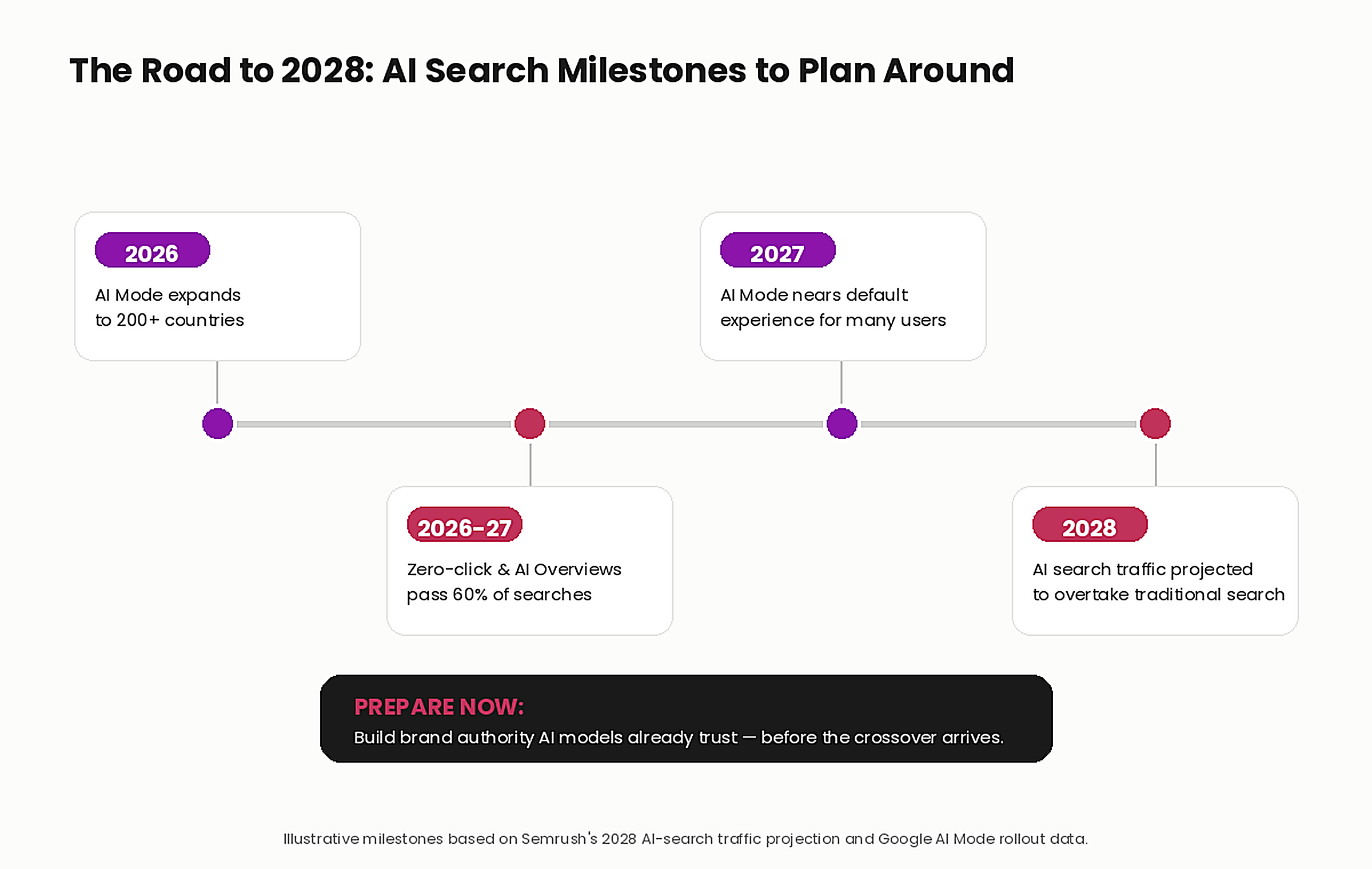
How to Adapt: A 5-Step Playbook for the AI-Search-Dominant Era
Preparing for a 2028 crossover doesn’t mean abandoning what already works. It means building the muscles that will matter more with each passing year. Here’s a practical, five-step approach.
1. Audit your current AI visibility
Before changing strategy, find out where you actually stand. Run your brand and top service topics through ChatGPT, Google’s AI Mode, and Gemini to see whether — and how accurately — you’re being mentioned. This baseline tells you whether you’re already earning AI citations or starting from zero, and it should be repeated quarterly as the landscape shifts.
2. Build an entity-first content foundation
AI systems reward content that clearly defines who you are, what you do, and why you’re credible — structured facts, consistent terminology, and clear expertise signals, not just keyword-stuffed pages. Rebuild cornerstone pages around clear entities (your services, your locations, your differentiators) so AI models have unambiguous, citable facts to draw from.
3. Diversify beyond Google rankings
Treat AI Mode, answer engines, and owned channels (email, communities, direct traffic) as core acquisition channels — not experiments. The goal isn’t to abandon traditional SEO; it’s to make sure no single algorithm or interface change can sink your entire traffic base once AI search claims a larger share of the pie.
4. Reallocate budget toward AEO and GEO incrementally
Start shifting a defined percentage of your SEO budget — even 10-15% — toward answer engine optimization (AEO) and generative engine optimization (GEO) work now. Waiting until AI search visibly dominates your analytics means starting from behind competitors who built this expertise early.
5. Track AI referral traffic as a core KPI
Add AI-driven sessions, brand mentions inside AI answers, and citation frequency to your standing reporting dashboard alongside rankings and organic sessions. If your analytics platform can’t yet segment AI referral traffic cleanly, flag it as a priority fix — you’ll need clean historical data to prove ROI as this channel grows. 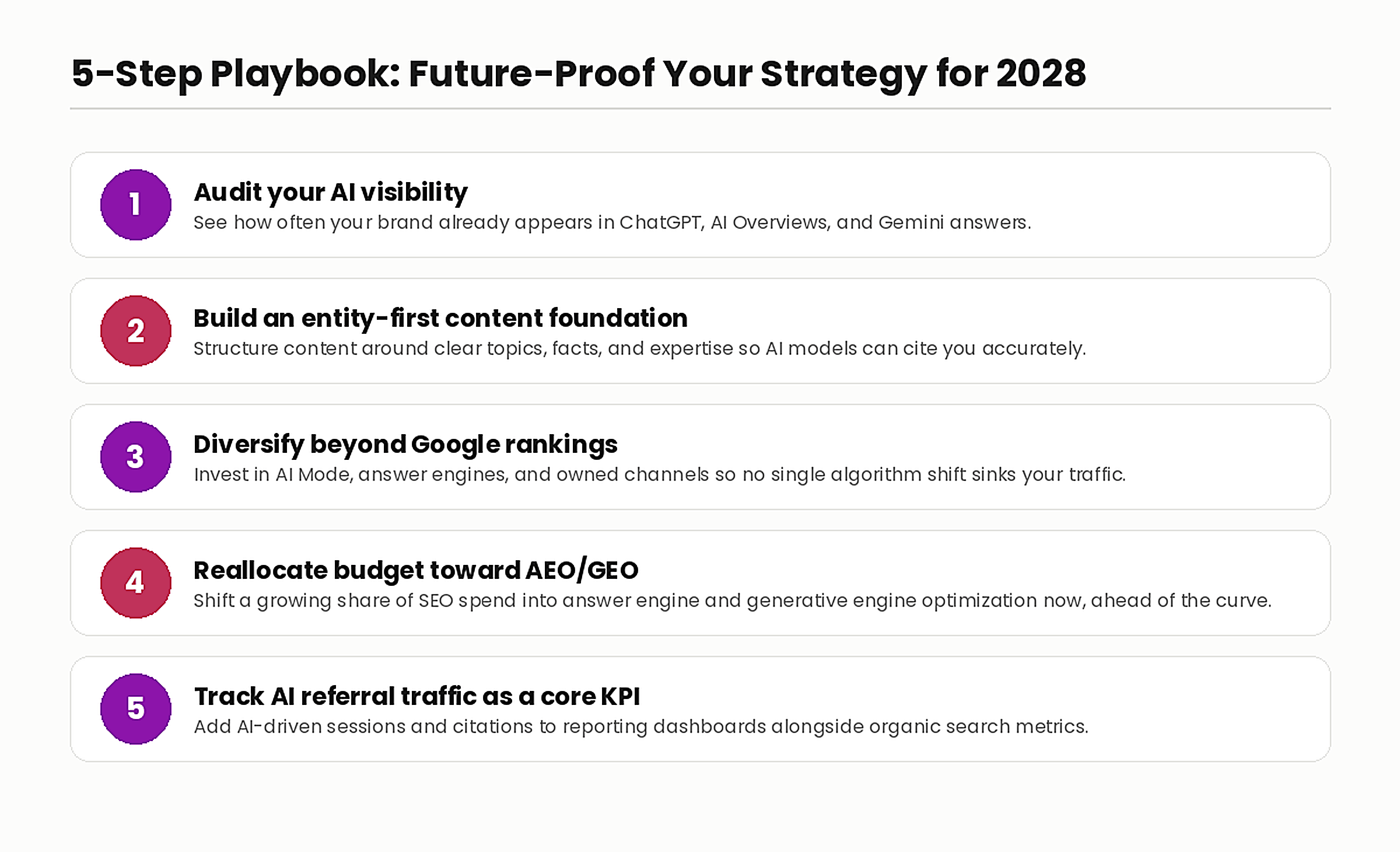
FAQ
Is it certain that AI search traffic will overtake Google by 2028?
No projection about the future is certain. Semrush is explicit that its 2028 timeline is “an extrapolation of historical data and user adoption rates,” not a guarantee. It’s a well-researched directional estimate based on real adoption trends, and current 2026 data on AI Mode rollout and AI Overview usage supports the trajectory — but the exact date could move earlier or later depending on how quickly Google and other platforms change default behaviors.
What could make the crossover happen sooner than 2028?
Semrush’s own research flags one major accelerant: if Google makes AI Mode the default search experience rather than an opt-in feature, adoption of AI-generated answers would jump immediately across its entire user base, compressing the timeline.
Does this mean traditional SEO is becoming obsolete?
Not yet, and not entirely. Google still commands the majority of search query share as of 2026. Traditional SEO fundamentals — technical health, quality content, authoritative backlinks — remain the foundation that AI systems also draw from. The shift is about adding AI-search readiness on top of that foundation, not replacing it.
How can a business start measuring its AI search visibility today?
Start by manually testing branded and service-related queries in ChatGPT, Google AI Mode, and Gemini to see if and how your business is mentioned. From there, look for analytics tools or agency partners that can track AI referral traffic and citation frequency over time as a standing metric.
What’s the single most important first step for a small or mid-sized business?
Get a baseline AI visibility audit done now. You can’t build a strategy to close a gap you haven’t measured, and the businesses that start tracking this in 2026 will have two full years of data and iteration before the projected 2028 crossover arrives.
Contact Us
The 2028 crossover isn’t a reason to panic — it’s a two-year head start for the businesses smart enough to use it. SEO Outsourcing helps companies audit their current AI search visibility, rebuild content for the answer-engine era, and build a measurement system that tracks AI referral traffic alongside traditional rankings — so you’re ready well before AI search traffic overtakes Google, not scrambling after it does.
Call 813-397-3665 to start future-proofing your search strategy today.