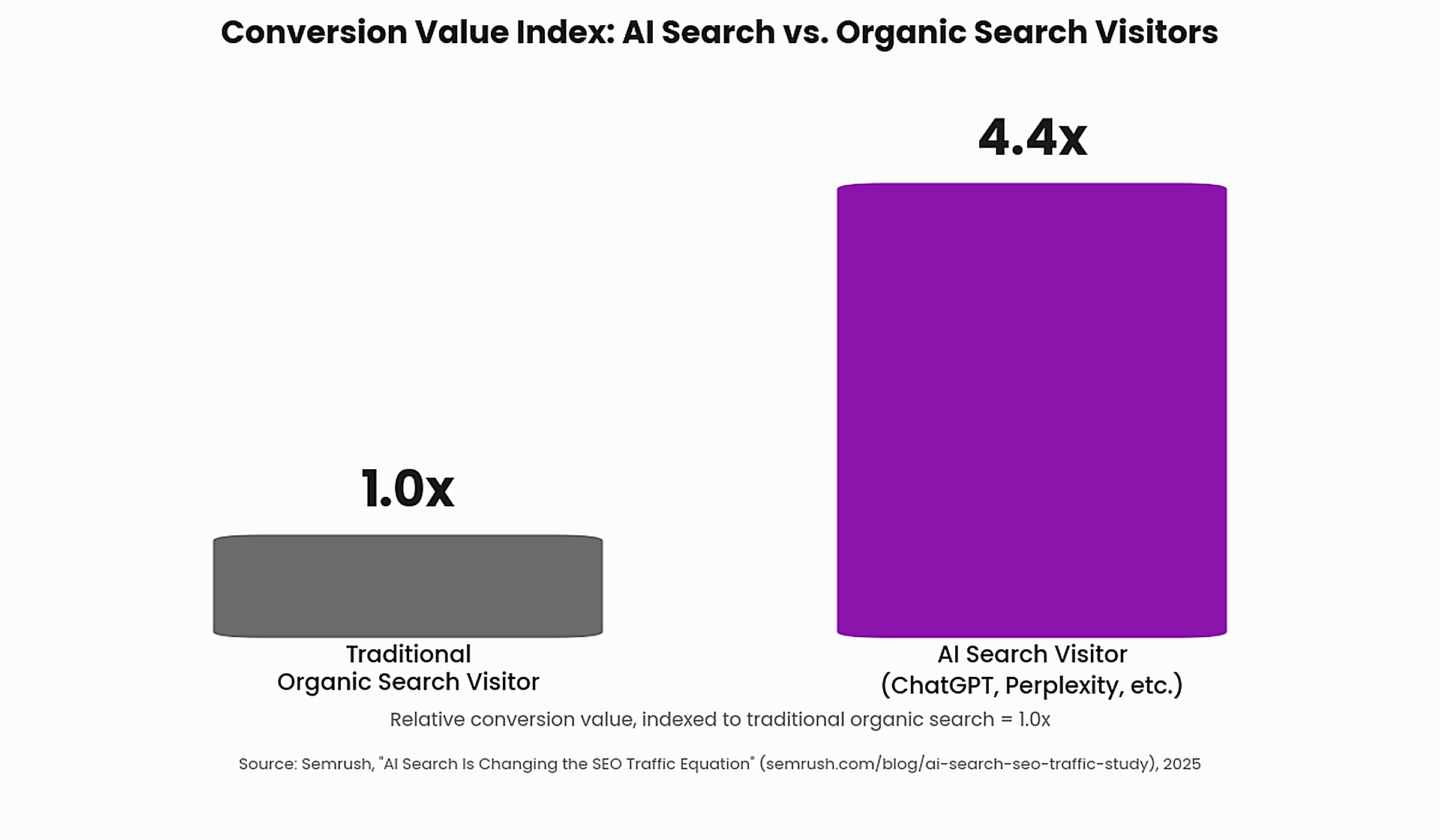
Not every visitor is created equal. According to Semrush’s 2025 AI search traffic study, the average visitor who arrives at your site from an AI search tool like ChatGPT or Perplexity converts at a rate that makes them 4.4 times more valuable than a visitor who arrives through traditional organic search. Same website, same offer, dramatically different outcome depending on how the person got there.
That number matters more than most marketers realize, because it flips the usual traffic conversation on its head. For most businesses today, AI-referred traffic is still a small slice of total visits compared to Google organic. It’s tempting to file it under “not worth the effort yet.” But value isn’t the same as volume — and a small stream of visitors who convert 4.4x better can already be moving the revenue needle more than the size of that stream suggests.
Fresh 2026 data backs this up with even sharper numbers. This isn’t a one-off finding — it’s an early signal of a real shift in how people search, decide, and buy, and it means the businesses that adapt now have a window to capture disproportionate value before the rest of the market catches up.
The Data: What Semrush Found
Semrush’s research, published July 21, 2025, was built on an analysis of over 500 high-value digital marketing and SEO-related topics and subtopics, translated into real search terms and prompts across AI platforms and traditional search. Here’s what stood out:
- The average AI search visitor — tracked to a non-Google source such as ChatGPT — is 4.4x as valuable as the average organic search visitor, based on conversion rate.
- AI-driven search visits are on pace to surpass traditional organic search visits by early 2028, and that timeline could accelerate if Google’s own AI Mode becomes the default search experience.
- AI-referred channels are projected to drive economic value equivalent to traditional search by the end of 2027 — meaning the value gap is closing even faster than the volume gap.
- The study spans platforms including ChatGPT, Perplexity, Google AI Overviews, and Claude, treating them collectively as a distinct, higher-intent traffic category rather than a single-vendor phenomenon.
2026 Data Confirms the Trend Is Accelerating
Skeptics could reasonably ask whether a single study from mid-2025 is enough to build a strategy around. It isn’t — which is why it’s worth pairing with more recent, independently sourced data. Adobe Analytics’ 2025 holiday shopping season report, published in January 2026 and based on more than 1 trillion visits to U.S. retail sites, found that AI-referred traffic didn’t just hold its value advantage — it grew it substantially over the course of the year.
During the November–December 2025 holiday season, Adobe found that traffic from generative AI tools converted 31% more than other traffic sources, with that conversion advantage nearly doubling year-over-year compared to the 2024 holiday season. The gap was even wider on peak shopping days: AI-referred visitors converted 54% higher than non-AI traffic on Thanksgiving and 38% higher on Black Friday. Revenue per visit from AI channels climbed 254% year-over-year during the holiday period, and AI visitors also spent 45% more time on-site and viewed 13% more pages per visit than other traffic sources.
Two independent data sets, measured almost a year apart with different methodologies, are pointing at the same underlying reality: people who arrive from an AI conversation are further along in their decision-making process, and it shows up directly in the numbers.
Why This Matters for AI and Digital Marketing
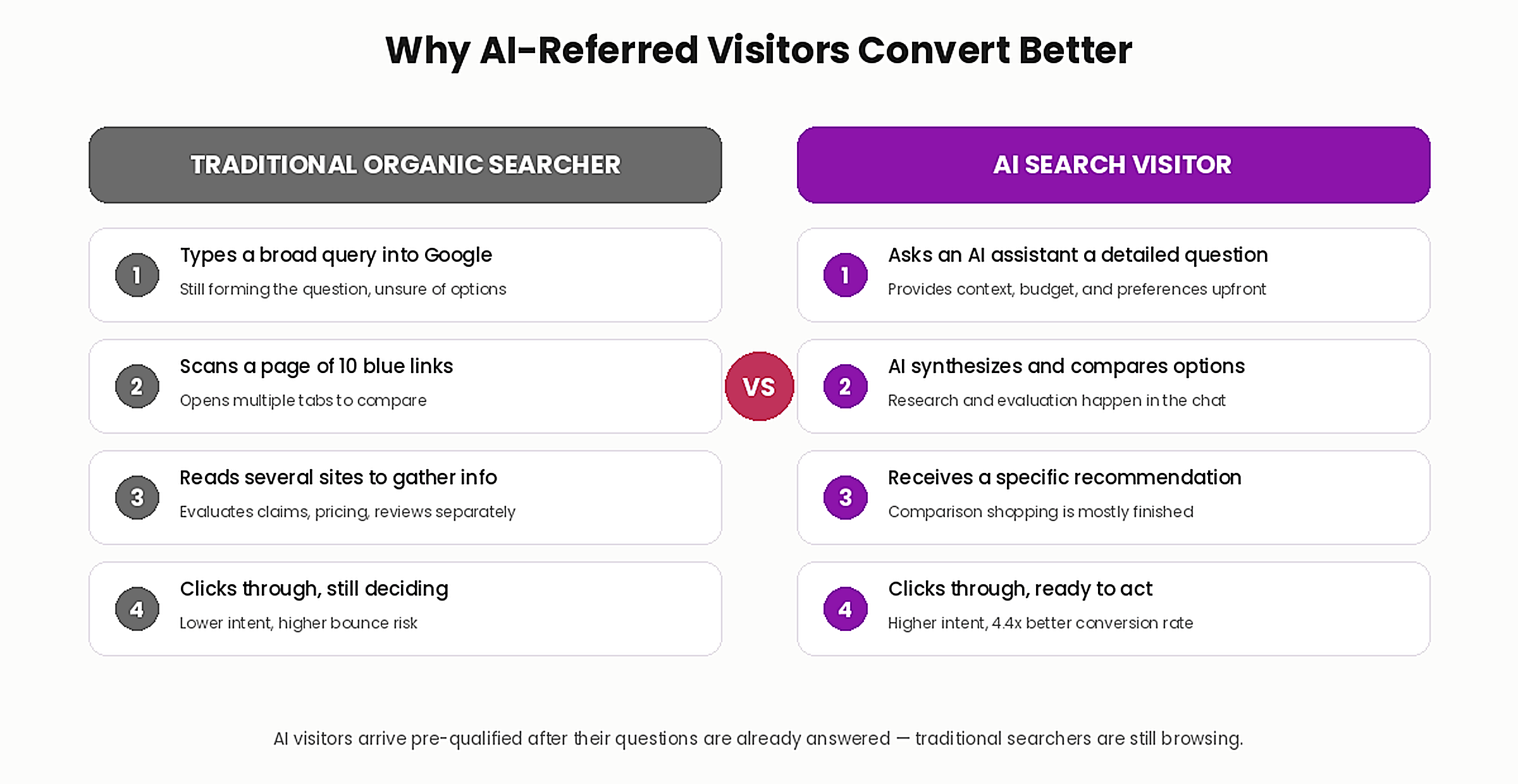
The reason AI-referred visitors convert so much better comes down to what happens before they ever land on your site. A traditional organic searcher types a query into Google, scans a page of ten blue links, and is still evaluating — they’re one click away from a competitor and may open five tabs before deciding on anything. An AI search visitor has already had a conversation. They asked a detailed question, the AI assistant synthesized an answer, compared options, and handed them a specific recommendation. By the time they click through, much of the research and comparison shopping has already happened inside the chat window.
That changes what “traffic” means for planning purposes. If your team is still valuing every visit the same way regardless of source, you’re almost certainly under-crediting AI-driven channels and over-investing in tactics that chase volume without regard to intent. A marketing plan built purely around raw session counts will overlook a channel that’s already punching well above its weight in revenue terms.
Practically, this has implications across the funnel:
- Attribution models need to weight AI-referred sessions differently, or reporting will make this channel look smaller than it actually is in dollar terms.
- Content strategy should prioritize being the source AI assistants cite and recommend, not just the page that ranks tenth on a results page.
- Budget allocation should treat AI visibility as a growth lever today, not a “wait and see” category for 2027.
How to Adapt: A 5-Step Playbook for Capturing High-Value AI Traffic
Knowing that AI-referred visitors are more valuable is only useful if you can actually attract more of them. Here’s a practical, five-step approach for doing exactly that.
1. Audit your current AI visibility
Before optimizing anything, find out where you already stand. Ask ChatGPT, Perplexity, and Google AI Overviews the exact questions your prospective customers are likely asking about your industry, products, or services. Note whether your brand shows up, how it’s described, and which competitors get cited instead. This baseline tells you whether you’re starting from zero or building on existing traction.
2. Structure content for direct, extractable answers
AI systems favor content that answers a specific question clearly and completely near the top of the page, rather than content that buries the answer under long preambles. Use clear headers that mirror real questions, put the direct answer in the first one to two sentences after each header, and back it up with specifics — numbers, dates, named sources — that an AI model can confidently quote or paraphrase.
3. Build topical authority, not just isolated pages
AI assistants tend to trust and cite sources that demonstrate depth across a topic, not a single well-optimized page floating in isolation. Group related content into clusters — pillar pages supported by detailed subtopic articles, all internally linked — so that both search engines and AI crawlers see your site as a comprehensive, trustworthy resource on the subject.
4. Earn citations and mentions beyond your own site
Large language models draw heavily on third-party mentions — press coverage, industry roundups, forum discussions, comparison sites, and reputable directories — when deciding what to recommend. Invest in digital PR, guest contributions, and listings on the sites your industry’s AI tools are already pulling from. Being mentioned favorably elsewhere is often as influential as your own on-page SEO.
5. Track AI referrals separately and reinvest in what works
Set up analytics segments specifically for AI-driven traffic (referral sources like chat.openai.com, perplexity.ai, and Google’s AI Overview clicks) so you can measure conversion rate, revenue per visit, and engagement for this channel on its own terms. Once you can see which content and topics are actually driving high-value AI referrals, double down on producing more of it. 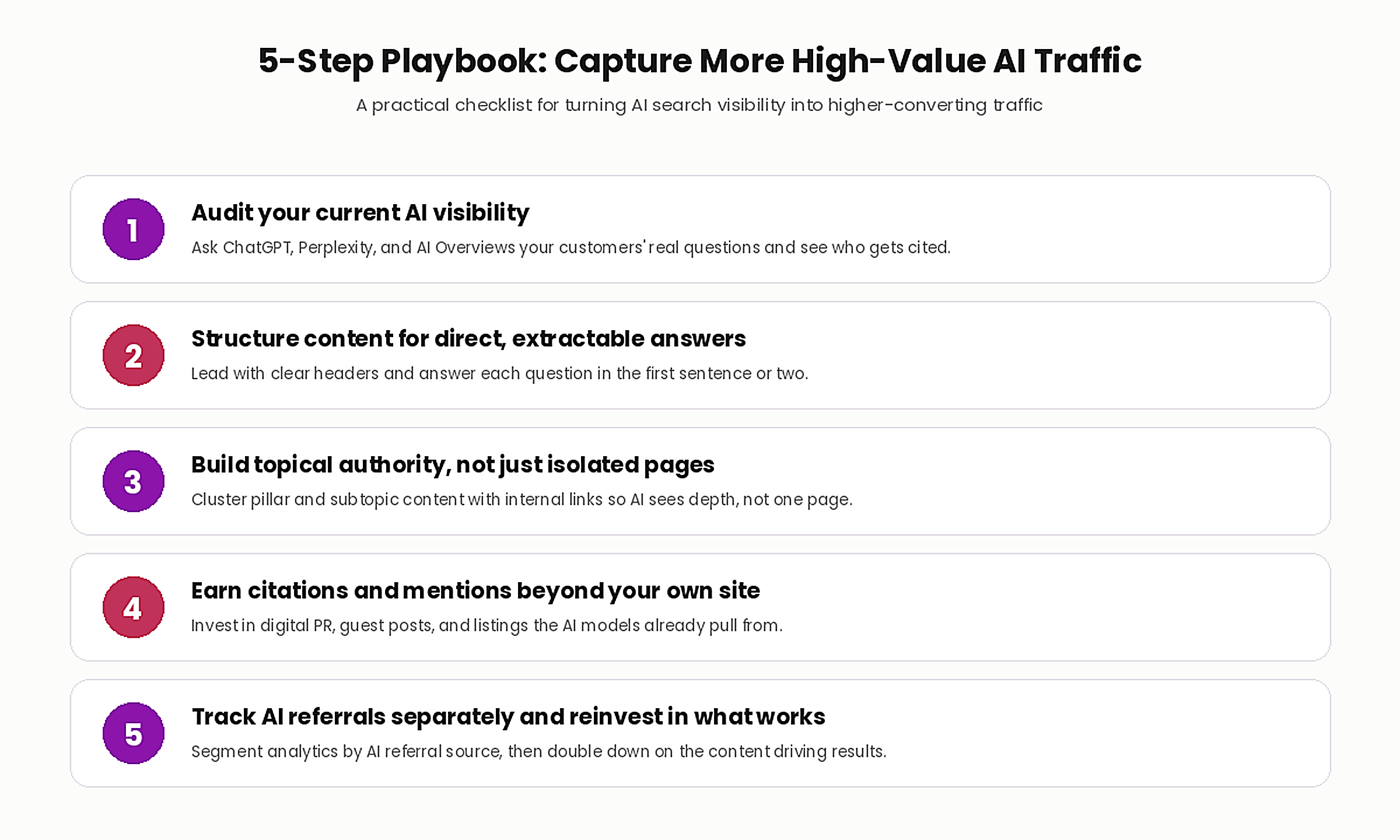
FAQ
Why does AI search traffic convert better than organic search traffic?
AI search visitors typically arrive after already asking detailed questions and receiving a synthesized, comparative answer from an AI assistant. Much of their research and evaluation happens before they click through, so they land on your site closer to a decision than a typical organic searcher who is still browsing and comparing.
Is AI search traffic really only worth pursuing once it’s larger in volume?
No. Because AI-referred visitors convert roughly 4.4x better according to Semrush, and that conversion advantage is growing according to Adobe’s 2026 holiday data, even a modest volume of AI traffic can already generate meaningful revenue. Waiting until the channel is large means competing for it against businesses that built visibility years earlier.
What platforms count as “AI search” for this kind of traffic?
The main sources are ChatGPT, Perplexity, Google AI Overviews (and Google’s broader AI Mode), and Claude. Referral traffic from these tools is typically identifiable in analytics through distinct referral domains such as chat.openai.com and perplexity.ai.
How is this different from traditional SEO?
Traditional SEO focuses on ranking a page in a list of links. Optimizing for AI search — sometimes called answer engine optimization (AEO) or generative engine optimization (GEO) — focuses on being the source an AI model chooses to cite, quote, or recommend directly inside its answer. The two disciplines overlap heavily but aren’t identical.
How quickly can a business start seeing results from AI search optimization?
Because AI models frequently pull from recently indexed and well-structured content, some businesses see their content getting cited within weeks of restructuring key pages for clarity and depth. A full visibility program — spanning content, technical structure, and off-site mentions — typically shows measurable traffic and conversion movement within one to two quarters.
Contact Us
The businesses that show up in AI search results today are building an advantage that compounds as this channel grows. If you don’t yet know how your brand appears when customers ask ChatGPT or Perplexity about your industry, that’s the first gap worth closing.
SEO Outsourcing helps businesses audit their AI search visibility, restructure content to earn citations, and track the high-value traffic this channel delivers. Call 813-397-3665 to get started.