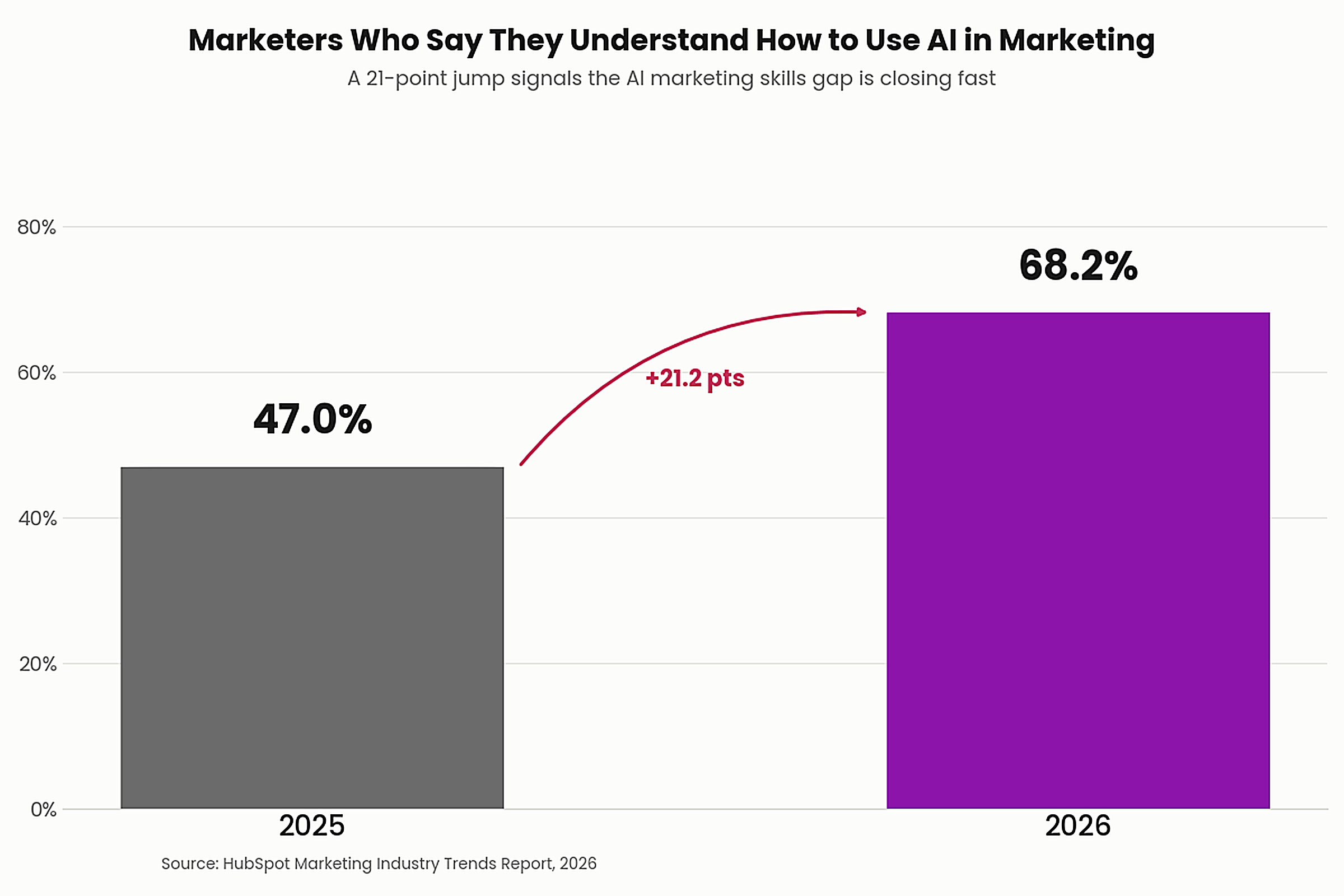
If you polled a room full of marketers last year about their top strategic priority, you’d have heard a dozen different answers — content volume, paid media efficiency, marketing automation, brand awareness. Ask that same room today, and the answer is converging fast: updating SEO for AI-driven search changes. According to HubSpot’s newest industry research, 40.6% of marketers now name it a top priority heading into 2026 — more than any other single initiative on their roadmap. Just as notably, the marketers who say they actually understand how to use AI in their work jumped from 47% in 2025 to 68.2% in 2026. Strategy and skill are rising together, and that combination is what makes this shift worth paying attention to.
This isn’t a minor tactical adjustment. It’s a signal that the marketing industry has stopped treating “AI search” as a future trend to watch and started treating it as a present-tense line item that needs budget, headcount, and a plan. Below, we break down the data, corroborate it with independent 2026 research, and lay out a five-step playbook for making AI search optimization a genuine strategic priority rather than a talking point.
The Data: What Marketers Are Actually Prioritizing in 2026
The headline number comes from HubSpot’s Marketing Industry Trends Report, which surveys marketers across industries and company sizes about where they’re placing their strategic bets for the year ahead. The report is explicit: “Updating SEO for search changes is one of the top trends brands are tackling this year,” cited by 40.6% of respondents as a top priority — the single most commonly named strategic focus in the survey.
That statistic sits alongside a second, equally important data point about capability. In 2025, only 47% of marketers said they understood how to use AI in marketing. In 2026, that number is 68.2% — a 21.2-percentage-point jump in a single year. Read together, these two figures tell a coherent story: marketers aren’t just aware that AI is reshaping search, they’re rapidly building the skills to respond to it, and “updating SEO for AI search” is where that new capability is being pointed first. Priority-setting and skill-building are moving in lockstep, which is a much stronger signal than either statistic would be on its own — a strategy without capability stalls, and capability without a clear priority gets scattered across a dozen minor projects instead of the one that matters most.
The 2026 Trend: Independent Research Confirms the Shift
HubSpot’s numbers aren’t an outlier. Two independent 2026 studies point in the same direction — treating AI-era search as a leadership-level priority backed by measurable behavioral change.
Gartner’s 2026 CMO Spend Survey, covering 401 CMOs and senior marketing leaders across North America, Europe, and the U.K., found that 70% of CMOs now identify AI as a central objective for the year, even as many acknowledge their organizations lack the infrastructure and budget to fully execute on it (Marketing Dive). That’s a leadership-level echo of the same prioritization shift HubSpot found among working marketers — the initiative is being named as a priority at every level of the org chart, from individual contributors to the C-suite.
On the search behavior side, Adobe’s 2026 analysis found that web traffic from generative-AI-driven referrals increased more than 10x in the United States between July 2024 and February 2025, and that visitors arriving via AI platforms browse 12% more pages per visit and show a 23% lower bounce rate than non-AI referrals (Adobe Business Blog). In other words, AI search isn’t just growing in volume — it’s sending higher-quality, more engaged traffic, which explains why marketers are prioritizing it over other channels rather than treating it as a side experiment.
Why This Matters for AI and Digital Marketing
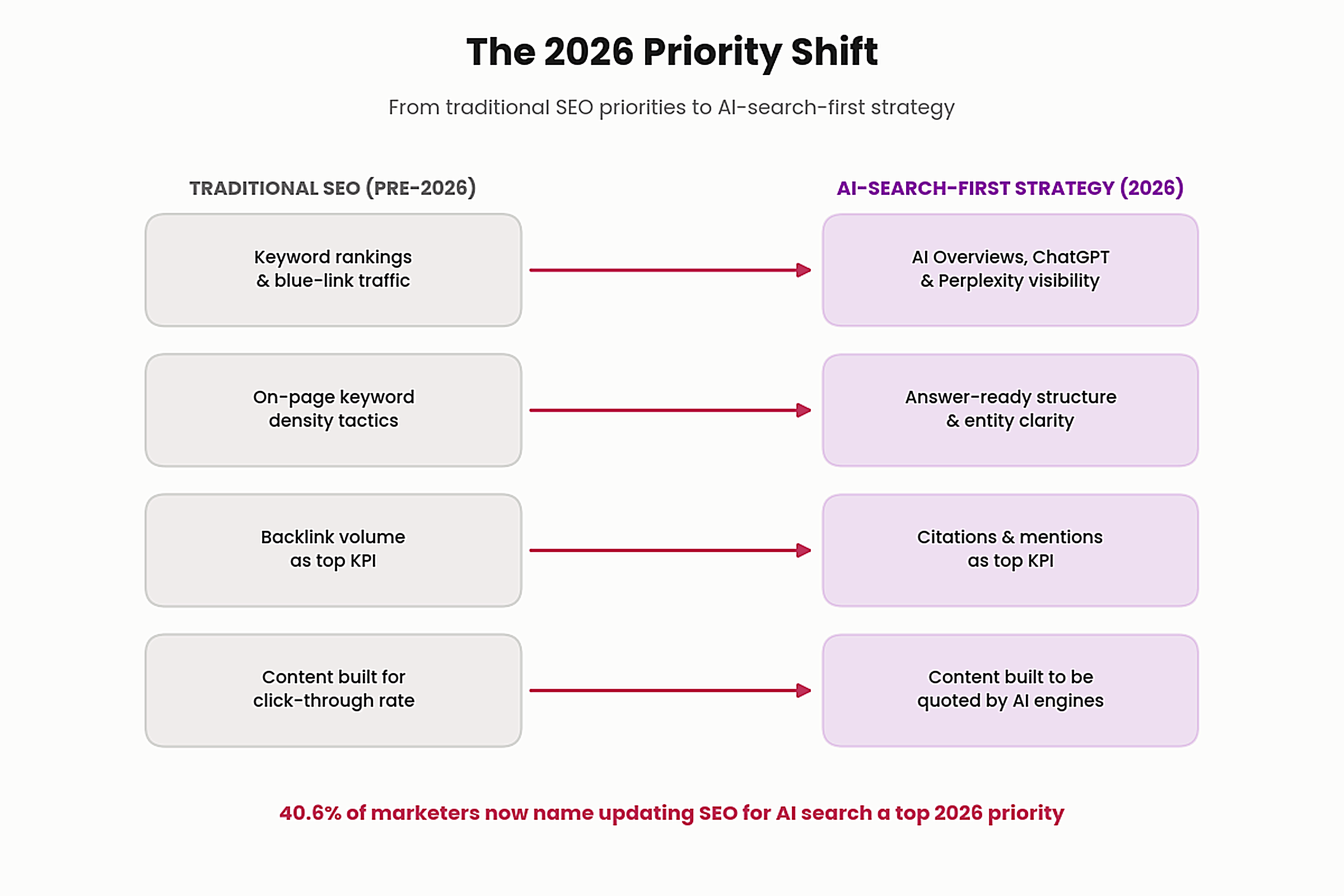
For years, “SEO for AI search” existed in a strange in-between space: everyone knew AI Overviews, ChatGPT, and Perplexity were changing how people found information, but few organizations had made it a formal, budgeted priority. That has changed. When 40.6% of marketers — the largest single bloc in the survey — name it their top priority, it stops being an emerging trend and becomes the baseline expectation for a competent 2026 marketing strategy.
The literacy jump from 47% to 68.2% matters just as much as the priority ranking itself. A strategic priority without the skills to execute it is just a wish list. What this data shows is that the marketing profession closed roughly a third of its AI knowledge gap in twelve months — a pace of upskilling rarely seen with a single technology shift. That means the marketers setting AI search as their top priority increasingly have the working knowledge to act on it: understanding how large language models retrieve, summarize, and cite content; how entity clarity and structured data influence whether a brand gets referenced in an AI answer; and how traditional ranking signals now share the field with citation and mention signals.
Combined with the Gartner and Adobe findings, the picture is unambiguous. Leadership is allocating attention and budget to AI (70% of CMOs), the traffic source is proving itself commercially (10x referral growth, better engagement), and working marketers are both prioritizing the response and building the skills to deliver it. Brands that treat this as optional in 2026 aren’t just behind a trend — they’re behind the majority of their own industry’s stated strategic plan.
How to Adapt: A 5-Step Playbook
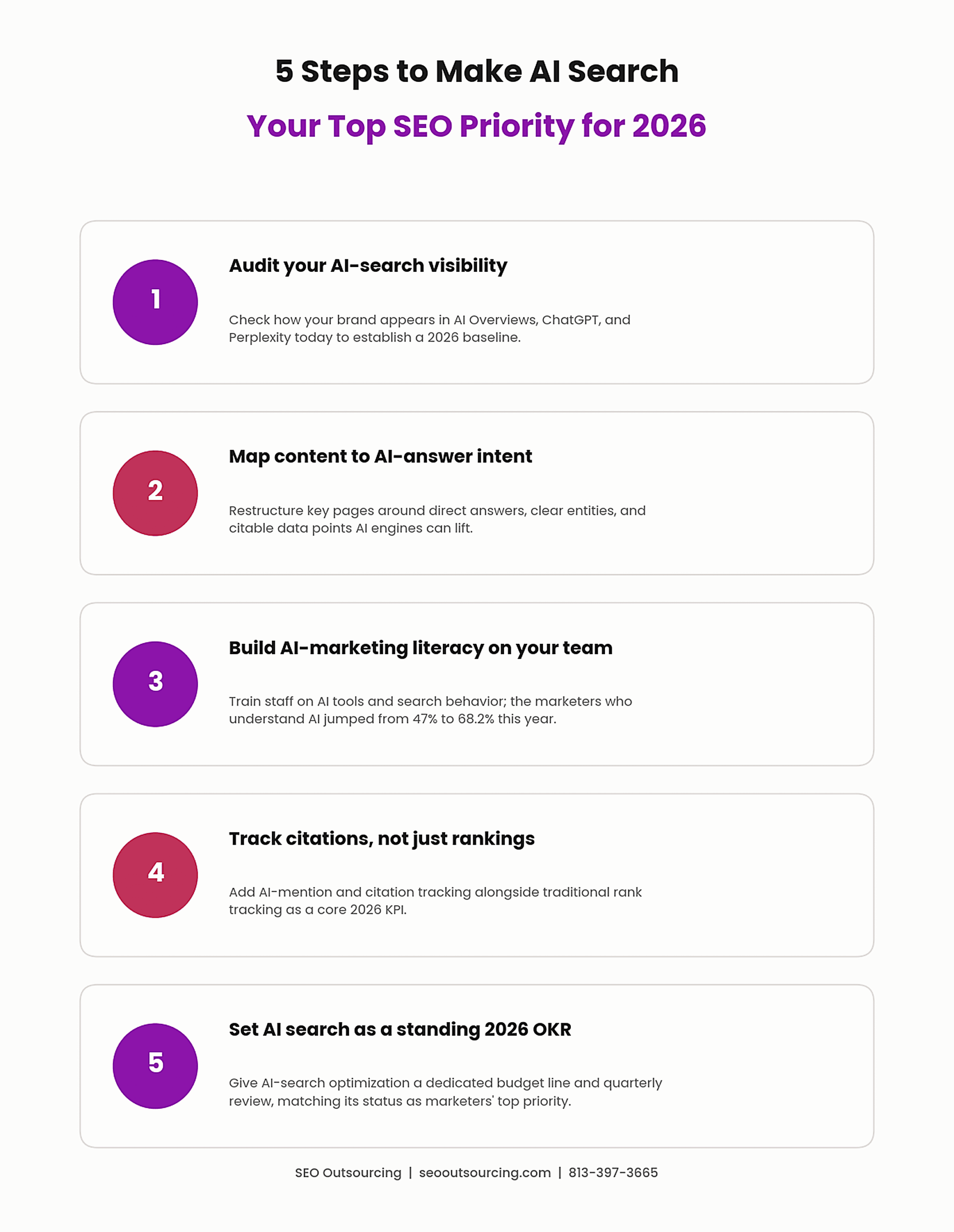
1. Audit your current AI-search visibility
Before you can prioritize AI search optimization, you need a baseline. Search your brand, products, and key topics in ChatGPT, Perplexity, and Google’s AI Overviews to see whether — and how — you’re being cited. Document gaps now so you can measure progress as you implement changes throughout 2026.
2. Restructure content around answer-readiness
Traditional SEO content is written to rank; AI-search-ready content is written to be quoted. Rework your highest-value pages with clear, direct answers near the top, explicit entity definitions, and well-organized data points that a language model can lift cleanly into a summarized response.
3. Invest in your team’s AI literacy, deliberately
The jump from 47% to 68.2% understanding didn’t happen by accident — it happened because marketers actively studied how AI systems work. Build a recurring training cadence (monthly workshops, certification tracks, internal AI-search briefings) so your team’s capability keeps pace with the priority you’re setting.
4. Add citation and mention tracking to your KPI stack
Keyword rank tracking alone no longer captures your visibility. Layer in tools and processes that monitor how often and how accurately your brand is cited inside AI-generated answers, and treat that data with the same rigor you apply to organic rankings and click-through rate.
5. Formalize AI search as a standing 2026 initiative
A priority named in a survey and a priority reflected in your budget are two different things. Give AI search optimization a dedicated line item, an owner, and a quarterly review cadence — the same structure you’d apply to any initiative your organization has decided matters most.
Frequently Asked Questions
Why are marketers prioritizing AI search over other 2026 initiatives?
Because it’s where search behavior is actually moving. HubSpot found 40.6% of marketers name updating SEO for AI-driven search changes as their top priority, and independent research from Adobe shows AI-driven referral traffic grew more than 10x with stronger engagement than traditional referrals — making it the channel with the clearest near-term upside.
What does the jump from 47% to 68.2% AI understanding actually mean?
It means the marketing industry closed a significant portion of its AI knowledge gap in a single year. More marketers now understand how AI tools work well enough to apply that knowledge strategically, which is part of why “updating SEO for AI search” could become the top-ranked priority rather than staying an abstract concern.
Is AI search optimization different from traditional SEO?
It builds on traditional SEO fundamentals — technical health, quality content, authority — but adds new priorities: structuring content for direct extraction by AI models, strengthening entity and topical clarity, and tracking citations in AI answers alongside conventional rankings.
How quickly should a business act on this shift?
Given that 40.6% of marketers already rank it a top priority and 70% of CMOs name AI a central 2026 objective, waiting risks falling behind the majority of your industry’s own stated strategy. Starting with a visibility audit this quarter is a reasonable, low-risk first step.
Ready to Make AI Search Your Top Priority for 2026?
The data is clear: the marketers pulling ahead in 2026 are the ones treating AI search optimization as a formal, budgeted strategic priority — not an afterthought. SEO Outsourcing helps brands build exactly that kind of AI-search-first strategy, from visibility audits and answer-ready content restructuring to citation tracking and team training. If you’re ready to make updating SEO for AI search your top priority instead of your biggest gap, call us at 813-397-3665 to get started.