Here’s a number that should make every marketing team stop scrolling: visitors who arrive from AI search engines like ChatGPT convert at a rate 23 times higher than visitors from traditional organic search. That statistic comes straight from Ahrefs’ own analytics, and it’s not a fluke of a single company’s data — it’s part of a pattern showing up across retail, SaaS, and B2B sites heading into the second half of 2026. If your team is still measuring AI search success by traffic volume alone, you’re looking at the wrong metric, and you’re almost certainly underinvesting in AI search optimization.
For years, the SEO playbook rewarded whoever captured the most clicks. AI search flips that logic. Fewer people click through from an AI Overview, a ChatGPT answer, or a Perplexity result — but the ones who do are further along in their decision, more qualified, and dramatically more likely to convert. Understanding why that’s happening, and what to do about it, is now a core part of any modern digital marketing strategy.
The Data: Ahrefs’ 23x Conversion Discovery
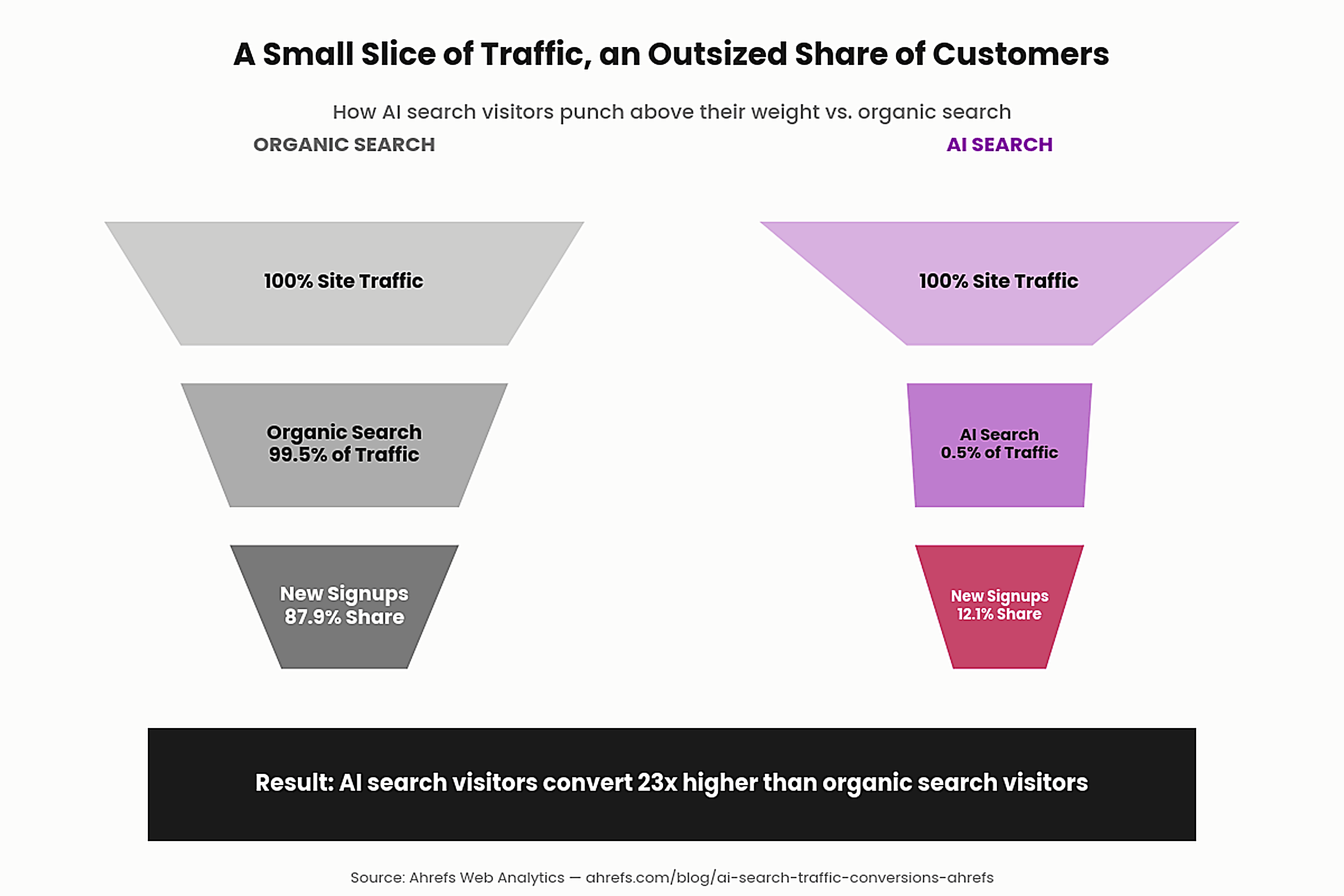
Ahrefs analyzed its own website traffic using Ahrefs Web Analytics and found that, over a recent 30-day period, visitors referred from AI search sources — dominated by ChatGPT — made up just 0.5% of total site traffic. Despite that razor-thin share, those same AI-referred visitors accounted for 12.1% of new signups. Run the math and you get a conversion rate roughly 23 times higher than the rate for visitors coming from traditional organic (Google/Bing) search.
Why would such a tiny sliver of traffic punch so far above its weight? Ahrefs’ analysis points to intent. When someone asks ChatGPT a detailed question about a tool like Ahrefs, the AI has typically already done the top-of-funnel filtering — summarizing features, comparing alternatives, and answering basic objections — before ever generating a link. The person who still clicks through isn’t casually browsing; they’re already sold on the category and are validating a near-final decision. Traditional organic search, by contrast, catches people at every stage of awareness, from “what is SEO” to “buy SEO software today,” which naturally dilutes the average conversion rate.
Ahrefs also flagged an important nuance worth taking seriously: users referred from AI search click through to external links about 75% less often than users from traditional search results. In other words, AI platforms are sending far fewer visits overall — but the visits they do send are pre-qualified in a way classic organic traffic rarely is. Low volume, extremely high value. That combination is exactly why traffic-share metrics alone can badly mislead a marketing team evaluating AI search’s importance. 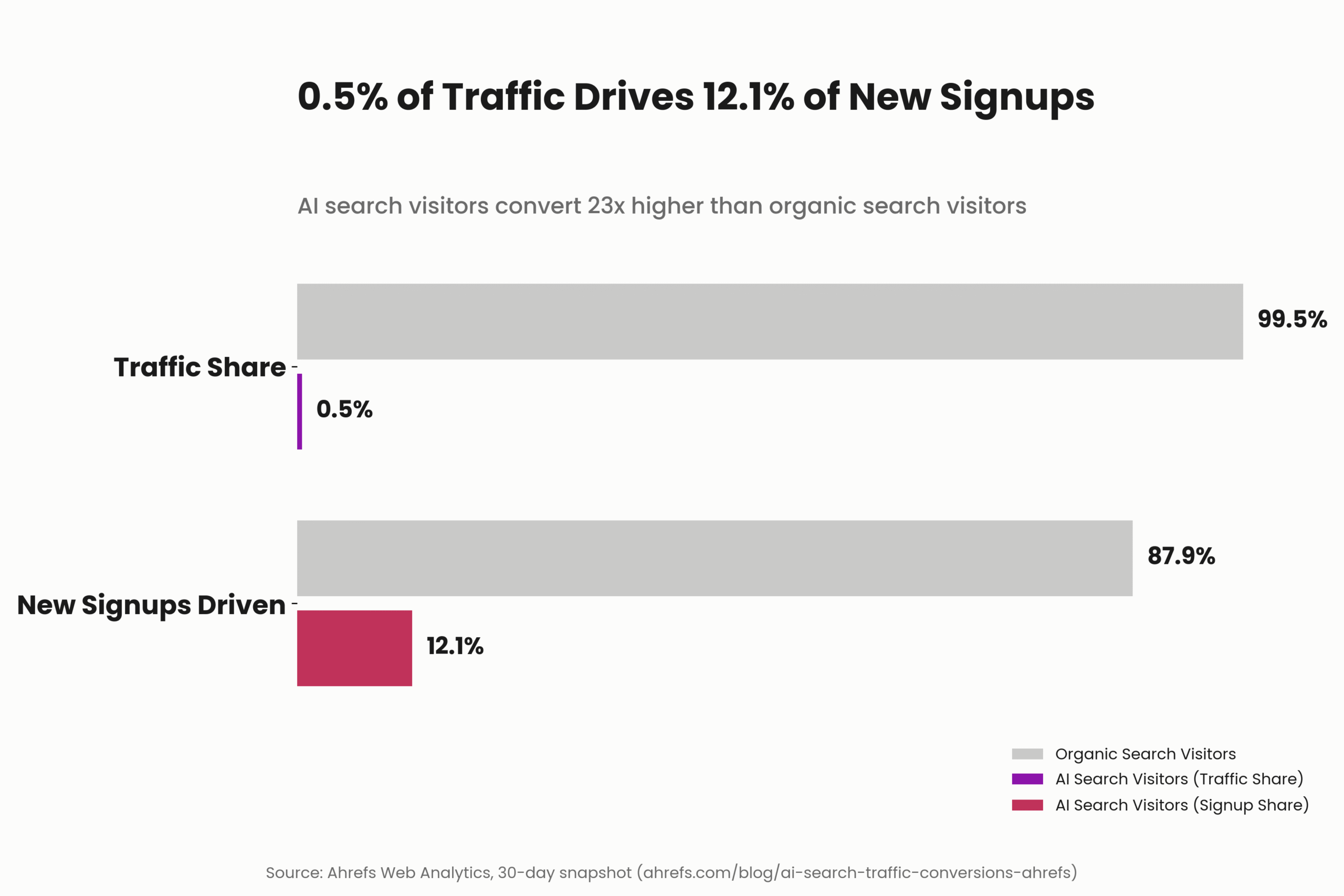
The 2026 Trend: It’s Bigger Than One Company
Ahrefs’ numbers would be a notable curiosity on their own. But they line up closely with what Adobe Analytics has been tracking at a much larger scale across the retail sector. Adobe’s ongoing AI traffic research, based on analysis of more than 1 trillion visits to U.S. retail sites, found that during the October 2024–October 2025 window, AI-referred traffic converted at a rate 31% higher than other traffic sources — with conversions “nearly doubling year-over-year” during key shopping moments, including a 54% conversion lift on Thanksgiving and a 38% lift on Black Friday (Adobe: AI traffic surges across industries).
More recent Adobe data shows the trend accelerating rather than fading. By May 2026, AI-referred traffic to retail sites was converting 54% better than traffic from non-AI sources — up sharply from the prior year, when AI-driven conversions actually lagged behind other channels. Visitors arriving via AI assistants were also spending 53% more time on-site and viewing significantly more pages per visit than the typical shopper (Digital Commerce 360, reporting on Adobe Analytics).
Put Ahrefs’ SaaS-signup data next to Adobe’s retail-transaction data and a consistent story emerges: across very different business models, AI search traffic is smaller in volume but consistently converts at a meaningfully — sometimes dramatically — higher rate than traditional organic search. This isn’t a one-off statistic to cite once and forget. It’s an emerging pattern that should be shaping how budgets get allocated for the rest of 2026 and into 2027.
Why This Matters for AI and Digital Marketing
For years, marketing teams have set KPIs almost entirely around traffic volume and click-through rate. That model breaks down when a channel sends 99.5% less traffic but drives a disproportionate share of your best customers. Judging AI search purely by session counts in Google Analytics will make it look irrelevant, when in fact it may already be one of your highest-value acquisition channels.
This has direct implications for budget allocation. Marketing leaders who wait for AI search traffic to “scale up” before investing in it risk missing the window where competitors lock in visibility inside ChatGPT, Perplexity, and Google’s AI Overviews. Because these platforms tend to cite a small number of sources per answer, being one of the two or three brands an AI model recommends compounds over time — much like ranking #1 on Google did in the 2010s, except the winner-take-most dynamics are even more pronounced.
It also changes how success gets measured. Marketers need to track AI referral traffic as its own segment (most analytics platforms now let you isolate chatgpt.com, perplexity.ai, and similar referrers), weight it by downstream conversion value rather than raw sessions, and stop discounting a channel just because its volume looks small on a dashboard. The agencies and in-house teams that adjust their reporting frameworks now will have a much clearer read on ROI than those still lumping AI referrals into “other” or ignoring them entirely.
How to Adapt: A 5-Step Playbook
1. Segment AI Referral Traffic in Your Analytics
Before you can act on this data, you need to see it. Create a dedicated segment or channel grouping in GA4 (or your analytics platform of choice) that isolates traffic from chatgpt.com, perplexity.ai, gemini.google.com, and Bing Copilot referrers. Without this visibility, AI-driven conversions get buried inside “direct” or “other,” and you’ll systematically undervalue the channel.
2. Structure Content for Extraction, Not Just Ranking
AI models pull concise, well-structured answers to cite or paraphrase. Use clear headers, direct answers in the first sentence of each section, comparison tables, and FAQ blocks so your content is easy for an LLM to lift and attribute. This is the core discipline of answer engine optimization, and it’s distinct from writing purely to satisfy traditional Google ranking factors.
3. Build Topical Authority Around High-Intent Questions
AI platforms favor sources that comprehensively and consistently answer a topic across many related questions, not just a single landing page. Map out the full set of questions your buyers ask at the decision stage and build content, comparison pages, and structured data around each one, so your brand shows up repeatedly across an AI model’s training and retrieval sources.
4. Prioritize Trust Signals and Structured Data
Because AI tools tend to cite sources they perceive as authoritative, invest in schema markup (Article, FAQPage, Organization, Product), original data, expert bylines, and consistent NAP/business information. These signals help both traditional crawlers and AI retrieval systems verify that your content is credible enough to reference by name.
5. Weight Reporting Toward Conversion Value, Not Volume
Update internal reporting so that AI search is judged on conversion rate, revenue per visit, and pipeline influence — not sessions. Set a recurring monthly review of AI-referred traffic’s conversion performance versus organic search, and use that comparison to justify continued (or increased) investment in generative engine optimization, even while raw AI traffic volume stays small. 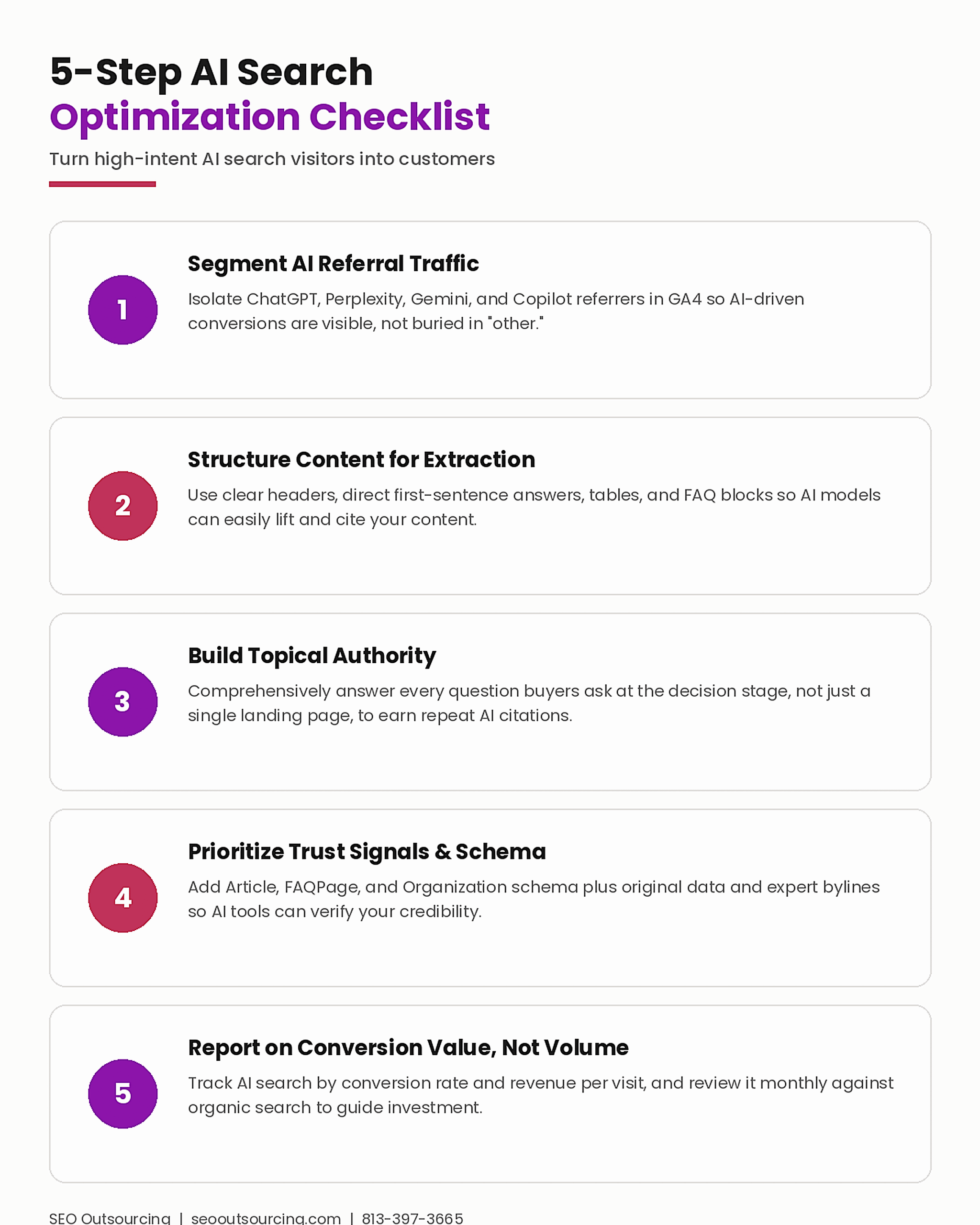
Frequently Asked Questions
What does “AI search optimization” actually mean?
AI search optimization (also called generative engine optimization or GEO) is the practice of structuring content, data, and site signals so that AI-powered search tools like ChatGPT, Perplexity, and Google AI Overviews can accurately understand, summarize, and cite your brand in their generated answers. It builds on traditional SEO fundamentals but places extra emphasis on clear structure, direct answers, and verifiable trust signals.
Why do AI search visitors convert so much higher than organic search visitors?
AI platforms typically do more of the early-stage research and comparison work for a user before generating an answer. By the time someone clicks through from an AI Overview or a ChatGPT response, they’ve often already been educated on the category and are close to a decision, whereas traditional organic search captures users across every stage of awareness, which lowers the average conversion rate.
Is AI search traffic large enough to matter for my business yet?
Volume is still small for most sites — Ahrefs measured just 0.5% of its own traffic coming from AI search — but Adobe’s retail data shows AI referral traffic growing well over 100% year-over-year with conversion rates now outperforming other channels. Given the outsized conversion value and the compounding advantage of early visibility, most businesses should start optimizing now rather than waiting for volume to catch up.
How is answer engine optimization (AEO) different from traditional SEO?
Traditional SEO optimizes primarily to rank a page in a list of blue links. Answer engine optimization optimizes content to be extracted, summarized, and cited directly inside an AI-generated answer, which means prioritizing scannable structure, direct answers, structured data, and demonstrable expertise over factors like backlink volume alone.
Ready to Capture High-Value AI Search Traffic?
The data is clear: AI search visitors may be a small slice of your traffic, but they can represent an outsized share of your best customers. Getting your brand structured, cited, and trusted inside ChatGPT, Perplexity, and Google’s AI Overviews takes a deliberate strategy — one most in-house teams don’t have the bandwidth to build alone. SEO Outsourcing specializes in answer engine optimization and generative engine optimization strategy, helping businesses turn AI search from an overlooked channel into a measurable growth driver. Call us at 813-397-3665 to build your AI search optimization plan today.