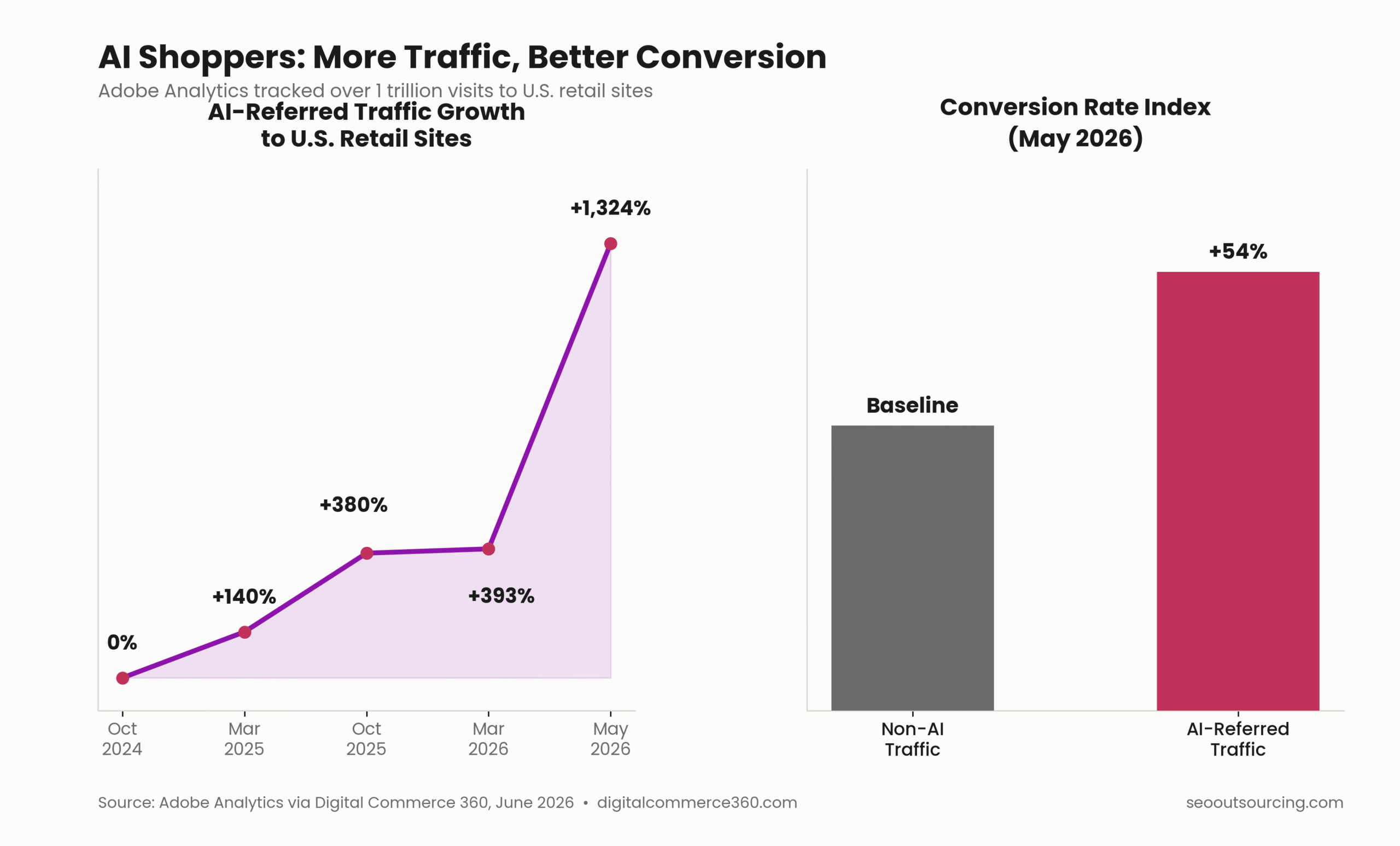
If you run marketing for a retail or e-commerce brand and you’re not tracking AI referral traffic separately from organic search, you’re flying blind on one of the fastest-growing channels in commerce today. According to Digital Commerce 360, AI-referred traffic to U.S. retail sites has grown 1,324% since October 2024 — and those AI-referred visitors now convert 54% better than traffic from non-AI sources.
That second number is the one that should get a marketing team’s attention. Growth in a new channel is interesting. Growth in a new channel paired with dramatically higher conversion intent is a strategic signal. A year ago, AI-referred shoppers converted at roughly half the rate of everyone else. That relationship has now completely flipped.
This isn’t a niche trend confined to early adopters or tech-forward retailers. It’s happening across the entire U.S. retail sector, and it’s accelerating month over month. Brands that treat AI-referred traffic as a rounding error in their analytics dashboard are leaving a rapidly growing, high-intent audience for competitors to capture.
The Data: What Adobe Analytics Found
Adobe’s dataset, drawn from more than 1 trillion visits to U.S. retail sites and reported by Digital Commerce 360 on June 17, 2026, lays out just how far AI referral traffic has come in under two years:
- 1,324% cumulative growth in AI-referred traffic to U.S. retail sites since October 2024
- 138% year-over-year growth as of May 2026 alone
- 54% better conversion rate for AI-referred visitors compared to non-AI traffic in May 2026 — a full reversal from the prior year, when AI-referred conversions ran nearly 50% behind non-AI traffic
- 15% higher overall engagement among AI-referred shoppers
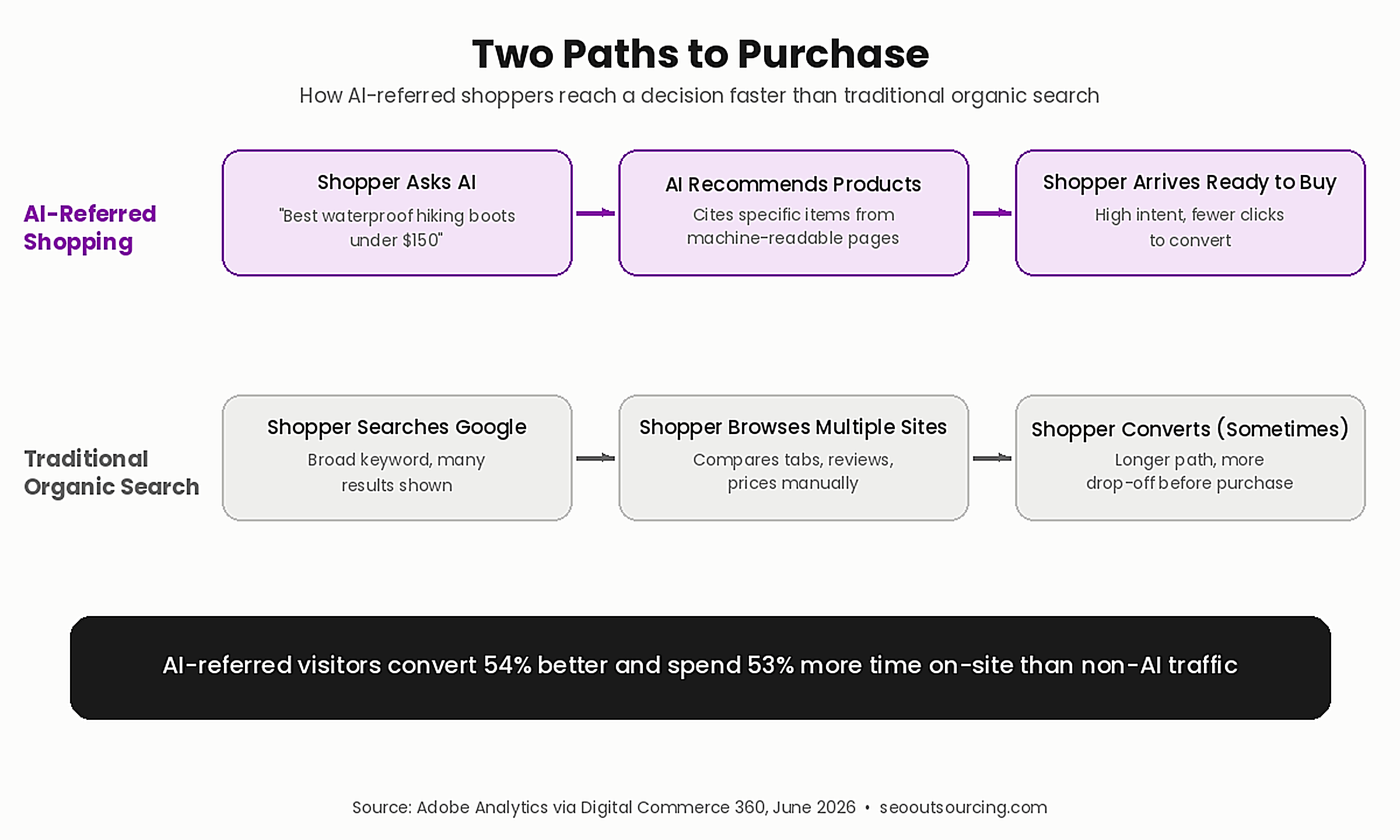
- 53% more time spent on retailer websites by visitors arriving via AI referral
- 23% more pages browsed per visit — roughly double the rate recorded just two months earlier, in March 2026
- Category readiness for AI varies widely: cosmetics (63%) and electronics (56%) content is most AI-readable, while grocery (48%) and furniture & home (47%) lag behind
That last point matters as much as the headline growth number. AI systems can only recommend what they can read and understand. Categories with clearer, more structured product content are winning a disproportionate share of AI-driven recommendations right now.
More Evidence: The Trend Is Accelerating Through 2026
The Digital Commerce 360 figures aren’t an isolated data point. A separate analysis of the same Adobe Analytics dataset, published on Adobe’s own business blog, tracked the trend earlier in the year and found it was already moving fast: AI-driven traffic to U.S. retail sites grew 393% year-over-year in Q1 2026, with the 2025 holiday shopping season alone posting 693% year-over-year growth. By March 2026, AI traffic was already converting 42% better than non-AI traffic — up from converting 38% worse just twelve months earlier.
That same Adobe research introduced a machine-readability score that measures how well retail content can actually be parsed by AI models. The results are telling: while FAQ pages score a relatively strong 80% and homepages 75%, product pages average just 66% — the weakest major page type on most retail sites. Top-performing retailers hit 82.5% readability, while the lowest performers sit at just 54.2%. In other words, the gap between retailers capturing this traffic and those missing out isn’t about budget — it’s about whether AI systems can actually understand their product content.
Consumer behavior backs up the analytics. The same research found that 39% of U.S. consumers now report using AI tools for online shopping, and 85% of those consumers say the experience has improved their shopping journey. This is a demand-side shift as much as a technology one — shoppers are actively choosing to start their purchase journey with an AI assistant instead of a search engine.
Why This Matters for AI and Digital Marketing
For years, “SEO” meant optimizing for a search engine results page dominated by ten blue links. That’s no longer the full picture. When a shopper asks an AI assistant to recommend “the best noise-canceling headphones under $200” or “a waterproof jacket for hiking in the rain,” the AI doesn’t return a list of links to click through — it names specific products and retailers directly, based on which sites it can read, trust, and cite.
This changes the calculus for marketing budgets in several concrete ways:
- Traffic quality is shifting upward. AI-referred visitors arrive further along in the buying journey because they’ve already had their initial questions answered by the AI. That’s why conversion rates are running so far ahead of traditional channels — the intent filtering happens before the click, not after.
- Content structure is now a ranking factor for a new kind of engine. Product pages, spec sheets, and comparison content need to be written and marked up in ways that large language models can parse cleanly, not just in ways that satisfy traditional keyword-based search crawlers.
- Category-level content debt is now visible and measurable. The AI-readability gap between cosmetics (63%) and furniture (47%) shows that some retail categories have accumulated years of unstructured, image-heavy, or inconsistent product content that AI systems simply can’t use — and that debt is now costing real traffic and revenue.
- Budget allocation needs a new line item. Retailers that continue to fund only traditional SEO and paid search while ignoring AI discoverability are optimizing for a shrinking share of how shoppers actually find products.
None of this means traditional SEO and paid channels stop mattering. It means the addressable channel mix retailers need to plan for has expanded, and the winners will be the brands that treat AI referral traffic as a measurable, optimizable channel — not an unpredictable side effect.
How to Adapt: A 5-Step Playbook for Capturing AI-Referred Traffic
Turning this trend into revenue requires treating AI discoverability as its own discipline, distinct from (but complementary to) traditional SEO. Here’s a practical playbook for e-commerce and retail brands.
1. Make Product Pages Machine-Readable
Product pages are the weakest link in most retailers’ AI readiness, averaging only 66% machine-readability in Adobe’s data. Fix the fundamentals: implement complete Product and Offer schema markup, write specs and attributes in clean, semantic HTML rather than burying them in images or PDFs, and make sure pricing, availability, and variant information are exposed in a structured, consistently formatted way an AI model can extract with confidence.
2. Answer Buying Questions Directly
AI assistants favor content that answers a specific question clearly and concisely. Build out FAQ sections on product and category pages that address real buying questions — “does this run small,” “is this dishwasher safe,” “what’s the return policy” — and mark them up with FAQ schema. This is the core discipline of answer engine optimization: writing for the question, not just the keyword.
3. Close Category-Level Content Gaps
Use the category breakdown as a diagnostic, not just a data point. If your brand sells furniture, grocery items, or apparel — the categories Adobe found lagging in AI-readability — audit those product lines first. Standardize attribute naming, add missing specs, and rewrite thin descriptions before investing further in categories that are already AI-ready.
4. Publish Citable Comparison and Buying-Guide Content
AI systems favor sources that make a clear recommendation and back it up with specifics. Buying guides, “best of” roundups, and side-by-side comparison pages that name products, prices, and use cases explicitly give AI tools a reason to cite your brand by name instead of a competitor’s.
5. Track AI Referral Performance as Its Own Channel
You can’t optimize what you don’t measure. Segment analytics to isolate traffic from AI sources — ChatGPT, Perplexity, Gemini, and AI Overviews — separately from standard organic search. Track conversion rate, average order value, and engagement for this segment specifically, and report on it the same way you’d report on paid search or email performance. 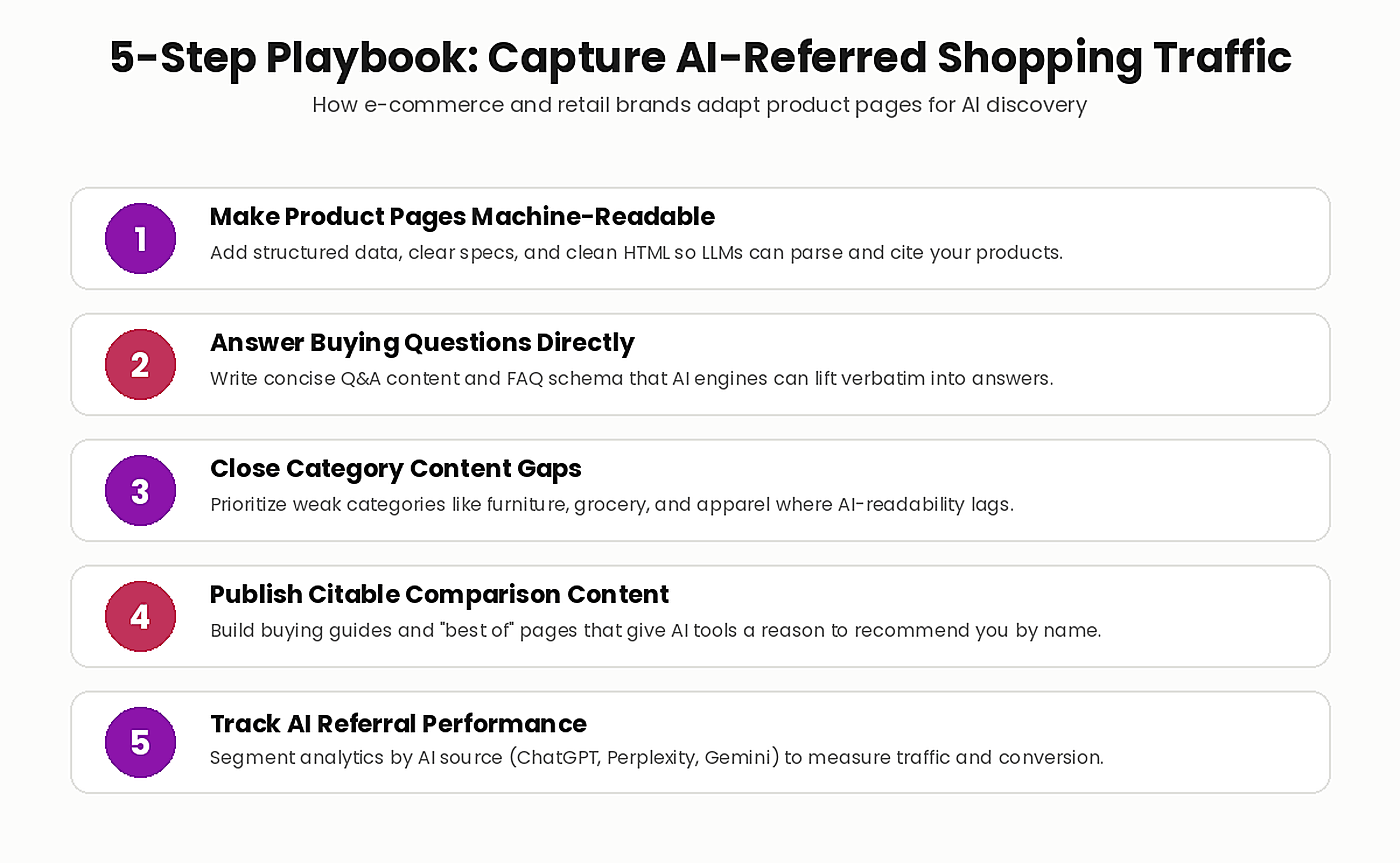
FAQ
What is AI-referred traffic in e-commerce?
AI-referred traffic refers to website visits that originate from AI tools and assistants — such as ChatGPT, Perplexity, Gemini, or AI Overviews in search results — recommending or linking to a specific product or retailer, rather than visitors arriving through a traditional search engine results page.
How much has AI-referred traffic to retail sites grown?
According to Adobe Analytics data reported by Digital Commerce 360, AI-referred traffic to U.S. retail sites grew 1,324% since October 2024, with 138% year-over-year growth recorded in May 2026 alone.
Why does AI-referred traffic convert better than other traffic?
AI-referred shoppers typically arrive after an AI assistant has already helped answer their initial research questions, meaning they land on a retailer’s site further along in the buying journey with higher purchase intent. Adobe data shows this traffic now converts 54% better than non-AI sources.
How can a retail brand optimize for AI-referred traffic?
Brands should focus on making product pages machine-readable with structured data, answering common buying questions directly in FAQ content, closing content gaps in weaker categories, publishing citable comparison content, and tracking AI referral performance as a distinct analytics segment.
Is this trend limited to certain retail categories?
No, but the impact varies by category. Adobe’s data shows cosmetics (63%) and electronics (56%) content is currently most readable to AI systems, while grocery (48%) and furniture & home (47%) lag behind — meaning brands in those categories have the most immediate opportunity to close the gap.
Contact Us
AI-referred traffic isn’t a future trend to plan for someday — it’s already up more than 1,300% and converting better than almost every other channel your brand runs. The retailers capturing that traffic today are the ones treating AI discoverability as a core part of their SEO and content strategy, not an afterthought.
SEO Outsourcing helps e-commerce and retail brands optimize product pages, content, and technical structure to get found and recommended by AI shopping assistants — while strengthening the traditional SEO performance that still drives the majority of organic revenue. Call 813-397-3665 to get an AI-readiness and SEO audit for your product catalog.