If you run marketing for a small business, you already know the math doesn’t work: too many channels, too little time, and a budget that never quite stretches as far as your competitors’ does. New research suggests AI is finally closing that gap. A national survey of 1,000 marketers found that AI marketing for small business teams saves an average of 13 hours per week — nearly a full workday — while cutting operating costs by $4,739 per month. For an industry built on doing more with less, that’s not a minor efficiency bump. It’s a structural shift in what a lean marketing team can accomplish.
The Data: A Full Workday Reclaimed, Every Week
The headline number comes from a study called “13 Hours Back Each Week,” commissioned by marketing automation platform ActiveCampaign and conducted by Talker Research, which surveyed 1,000 marketers nationally between May 21 and June 12, 2025. According to Forbes’ reporting, marketers who use AI in their daily workflows save 13 hours per person each week — roughly one-third of a standard 40-hour workweek — and reduce operating costs by an average of $4,739 per month per team.
The competitive angle is just as important as the raw savings. Among marketers who use AI daily, 89% say it helps them compete with larger, better-funded companies. That number drops to just 61% among infrequent users, which tells you the benefit isn’t just “using AI” in the abstract — it’s using it consistently, as part of the actual workflow, not as an occasional experiment. Forbes also flagged a telling gap in the same data: only 23% of marketers currently use AI across the complete marketing cycle, from planning through execution and measurement. Most SMBs are still using AI for isolated tasks — a caption here, a subject line there — rather than embedding it into the full campaign lifecycle where the time and cost savings compound.
That gap is the opportunity. The businesses seeing 13 hours back and nearly $4,800 in monthly savings aren’t doing anything exotic. They’re simply using AI more completely and more consistently than the other three-quarters of the market. 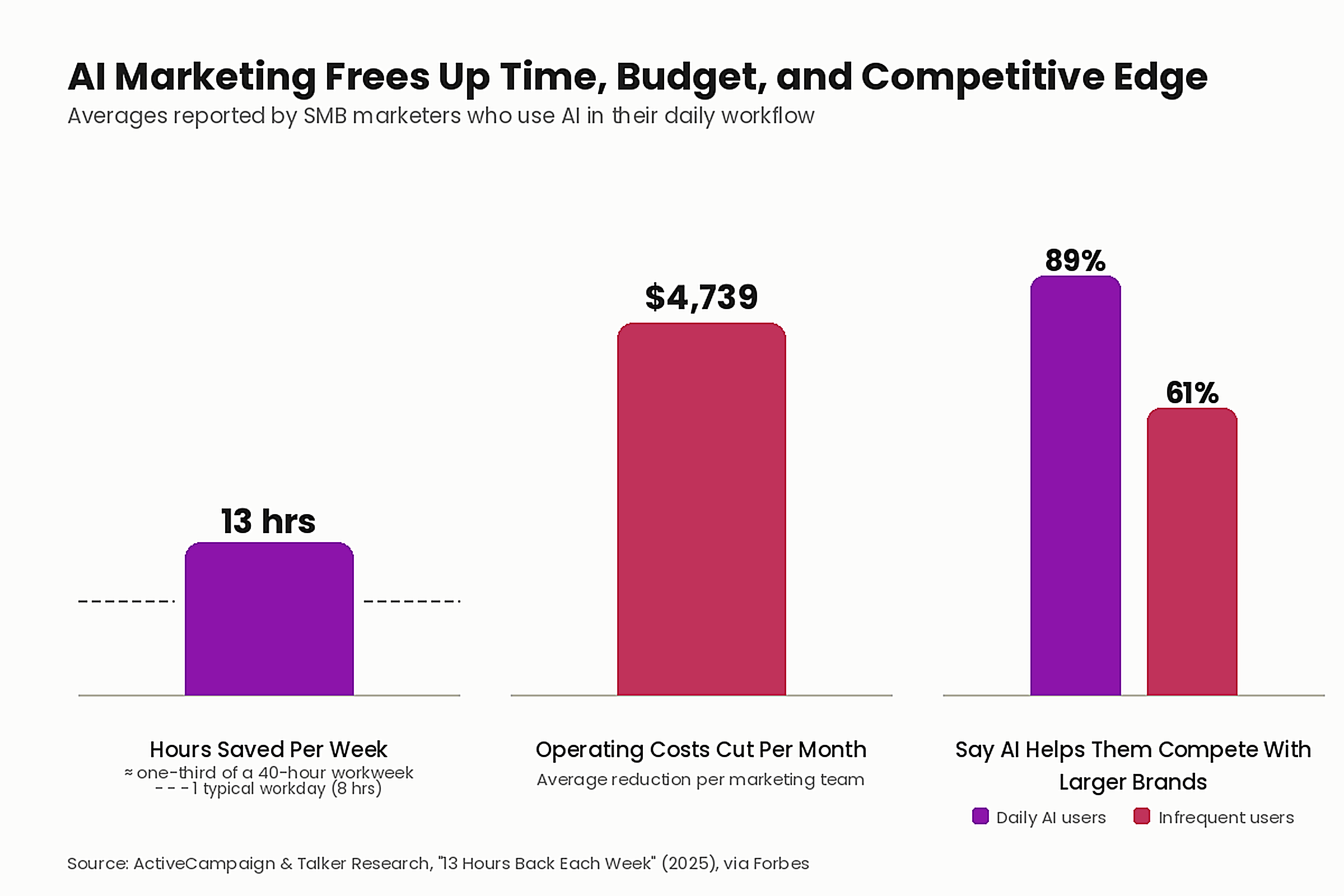
The 2026 Trend: Adoption Is Accelerating Fast
The ActiveCampaign findings aren’t an outlier — they’re part of a much larger adoption wave that’s been building through 2025 and into 2026. Constant Contact’s Q1 2026 “Small Business Now” report, which surveyed more than 1,500 SMB owners across five countries, found that 54% of small businesses already use AI marketing tools, with another 27% planning to adopt them in 2026 — putting total adoption on pace to cross 80% by year’s end, according to Forbes’ coverage of the report. The most common use cases mirror what you’d expect from time-strapped teams: 45% use AI to analyze trend data, 44% use it to draft content, and 40% use it to generate images and visual assets.
Constant Contact’s follow-up Q2 2026 report pushed the number even higher, finding that 87% of U.S. small businesses had adopted AI in marketing by April 2026 — up from just 26% in 2023. Half of global users cited “saving time” as the single biggest benefit, and the report noted that AI can cut email production time by up to 23%, while 40% of SMBs said they’re using AI and automation specifically to manage marketing workload rather than simply hiring more people or spending more on ads.
Put the two data sets together and the trend line is unmistakable: AI-powered marketing has moved from “interesting experiment” to “default operating mode” for small businesses in under three years, and the businesses adopting it fastest are the ones reporting the biggest gains in both time and budget.
Why This Matters for AI and Digital Marketing
For decades, the advantage in marketing belonged to whoever had the biggest budget and the biggest team. A national brand could run five campaigns at once, A/B test everything, and staff a dedicated analytics function. A ten-person local business could not. AI is the first technology in a long time that meaningfully narrows that gap rather than widening it.
Thirteen hours a week is roughly 650 hours a year — the equivalent of adding a part-time employee’s worth of capacity without adding headcount. Nearly $4,739 a month is over $56,000 annually — capital that can go toward better creative, more ad spend, or an actual hire, instead of being burned on manual, repetitive tasks like drafting social captions, building email sequences from scratch, or manually pulling performance reports. That’s the real story behind the 89% figure: daily AI users don’t just feel busier or more efficient, they feel like they can genuinely go toe-to-toe with competitors who have ten times their budget.
This also reframes AI adoption as a competitive-parity issue, not just a productivity one. As adoption climbs toward the 80-87% range that Constant Contact’s research projects, businesses that haven’t integrated AI into their marketing workflow aren’t just missing out on convenience — they’re operating at a structural disadvantage relative to competitors who’ve already reclaimed a full workday of capacity every week. 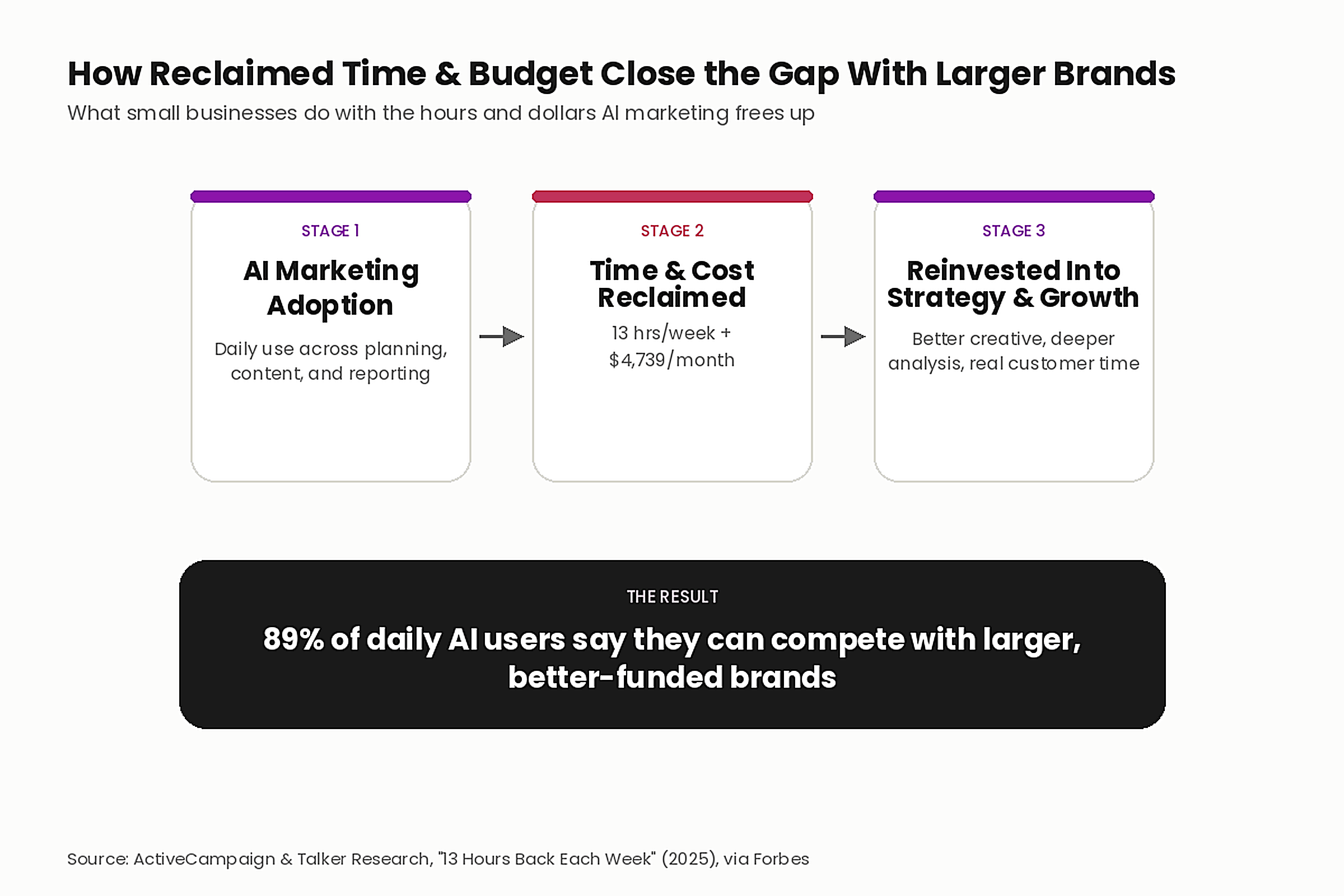
How to Adapt: A 5-Step Playbook
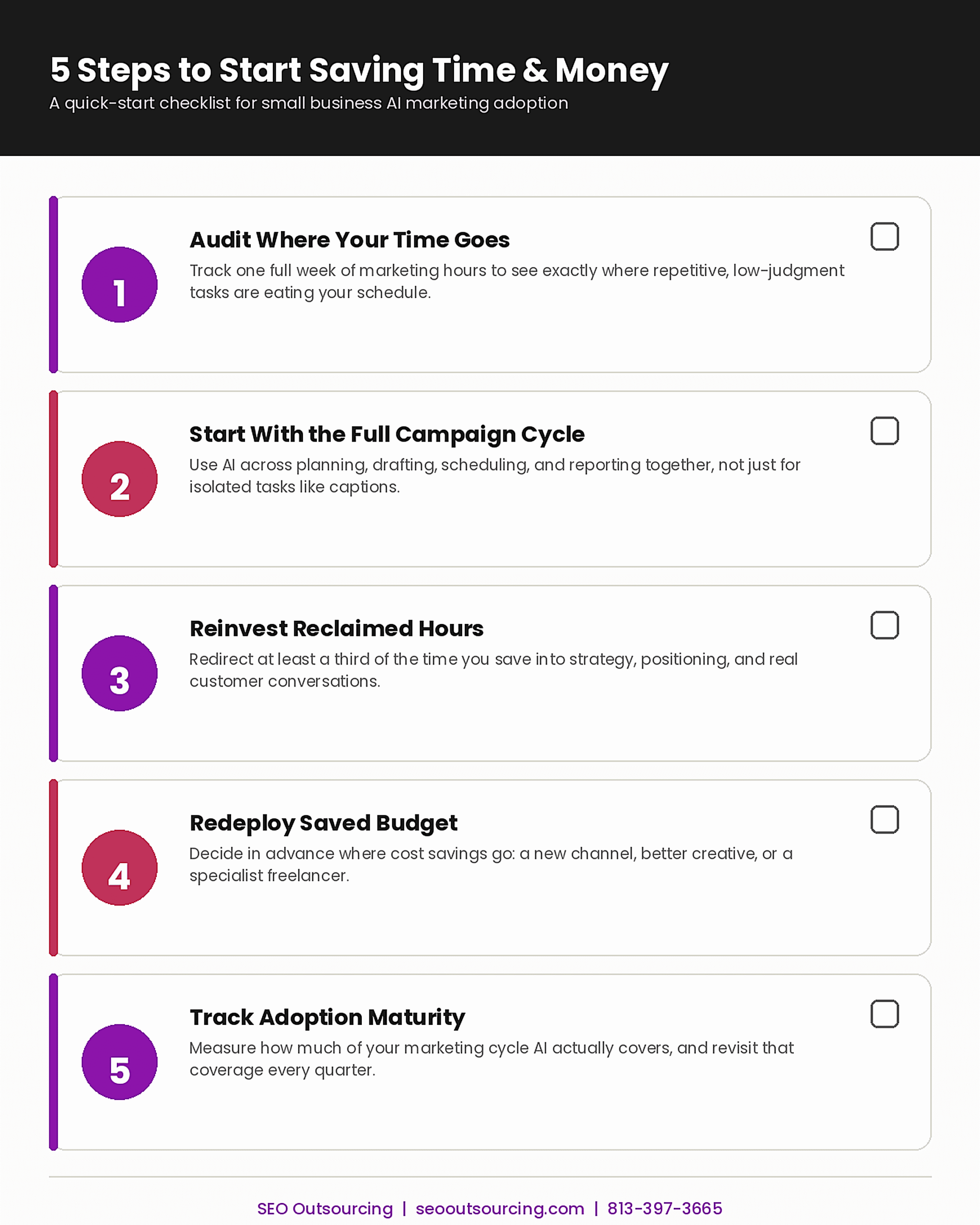
1. Audit where your time actually goes
Before adding any tool, spend one week tracking exactly how marketing hours are spent — content drafting, scheduling, reporting, research, customer follow-up. Most small business owners are surprised to find that 60-70% of “marketing time” is spent on repetitive, low-judgment tasks that AI tools handle well. This audit tells you where to point AI first for the fastest payoff.
2. Start with the full campaign lifecycle, not isolated tasks
Remember that only 23% of marketers use AI across the complete planning-to-measurement cycle — and they’re the ones capturing the biggest gains. Instead of using AI only for a caption or a subject line, look for tools that can help with planning, drafting, scheduling, and reporting in one connected workflow, so the time savings compound rather than staying isolated.
3. Reinvest reclaimed hours into strategy, not just more output
The temptation with newfound time is to simply produce more content. Resist it. Redirect at least a third of the hours you reclaim into higher-level work AI can’t do — reviewing what’s actually converting, refining your positioning, or having real conversations with customers. That’s where the competitive edge over larger brands actually comes from.
4. Redeploy saved budget deliberately
If AI trims your monthly marketing costs, decide in advance where those dollars go — whether that’s testing a new paid channel, investing in better photography or video, or finally affording a specialist freelancer for the skill your team lacks. Savings that just disappear into general operating costs won’t move the needle on growth the way a deliberate reinvestment will.
5. Track adoption maturity, not just tool count
Don’t measure success by how many AI tools you’ve bought — measure it by how much of your marketing cycle they actually cover. Revisit your workflow quarterly and ask: are we still doing manually what AI could now handle? As the market moves toward the 80%+ adoption Constant Contact projects for 2026, staying at “isolated task” usage means falling behind competitors using AI end-to-end.
Frequently Asked Questions
How many hours can AI marketing actually save a small business?
Research from ActiveCampaign and Talker Research found marketers save an average of 13 hours per week when they use AI in their daily marketing workflow — close to a full 40-hour workday reclaimed weekly. The exact number varies by business, but the pattern holds: consistent, daily AI use produces meaningfully larger time savings than occasional or task-specific use.
How much money can AI marketing tools save each month?
The same study found an average monthly operating cost reduction of $4,739 per marketing team. That savings comes from reduced need for manual labor on repetitive tasks like content drafting, scheduling, and reporting — work that AI tools can now handle at a fraction of the time and cost.
Is it too late for a small business to start using AI marketing?
No — while adoption is accelerating quickly (Constant Contact reports 87% of U.S. SMBs had adopted AI in marketing by April 2026, up from just 26% in 2023), most businesses are still using AI for isolated tasks rather than the full marketing cycle. There’s still significant advantage available to businesses that adopt AI thoughtfully and comprehensively now.
What’s the best way for a small business to start with AI marketing?
Start by auditing where your team’s time currently goes, then apply AI to the most repetitive, time-consuming tasks first — typically content drafting, social scheduling, and performance reporting. From there, expand toward tools that support the full campaign lifecycle, since research shows businesses using AI end-to-end capture the largest time and cost savings.
Ready to Get a Full Workday Back Every Week?
Reclaiming 13 hours a week and thousands of dollars a month isn’t about buying more software — it’s about implementing AI marketing strategically, in the right order, with the right tools for your business. SEO Outsourcing helps small businesses build AI-powered marketing and SEO programs that actually deliver on this kind of efficiency, without the trial-and-error most teams go through on their own. Call us at 813-397-3665 to talk through what an AI-powered marketing plan could look like for your business.