45% of Consumers Now Ask AI for Local Business Recommendations — Is Your Business Ready?
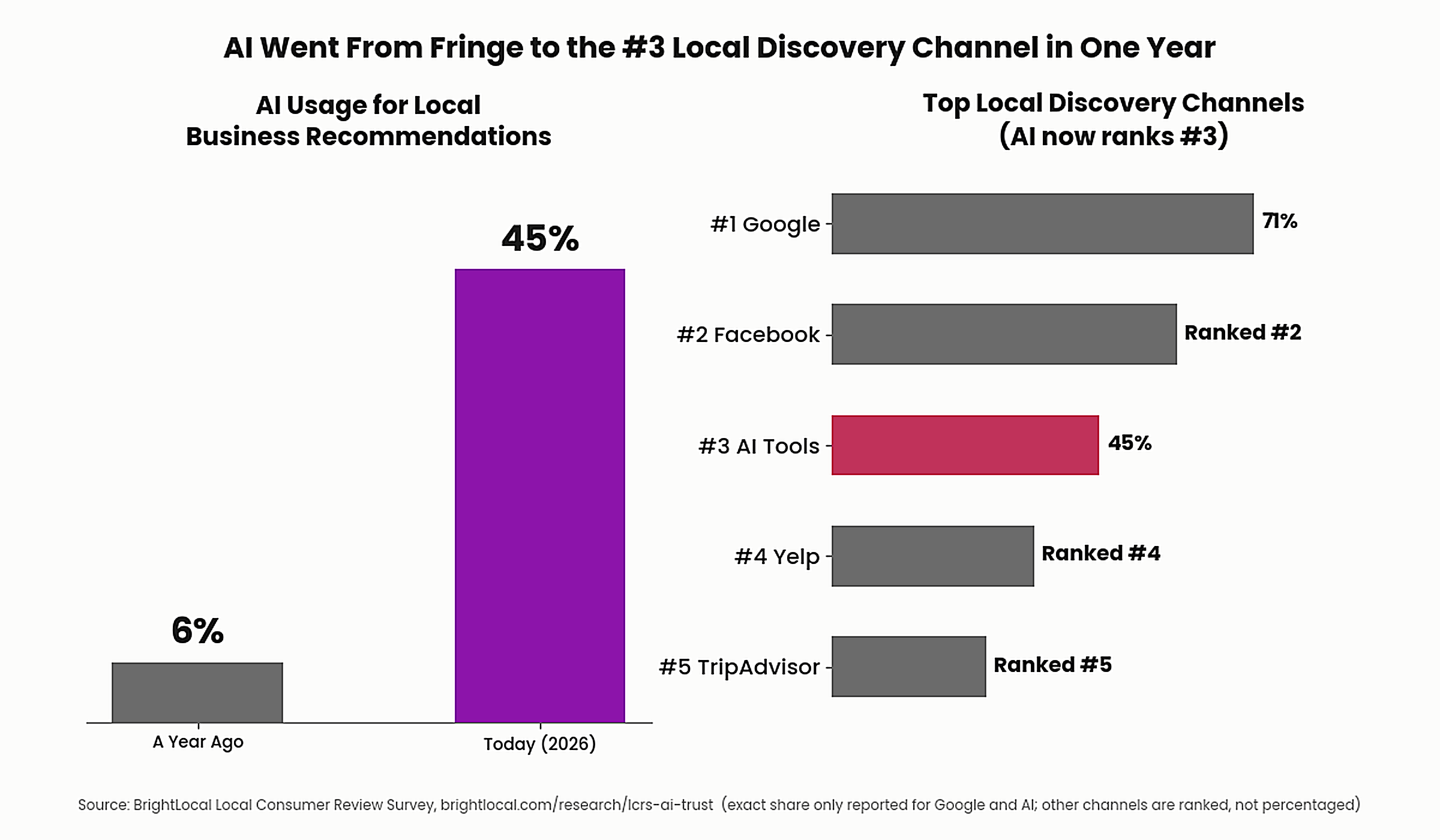
A year ago, almost nobody asked a chatbot where to get their car fixed or which dentist to see. Today, nearly half of them do. According to BrightLocal’s Local Consumer Review Survey, 45% of consumers now use AI tools to get local business recommendations — up from just 6% the year before. That’s not incremental growth. That’s a channel going from irrelevant to mainstream in twelve months.
The same research puts AI in third place among discovery channels, trailing only Google and Facebook and already ahead of long-established players like Yelp and TripAdvisor. For local and multi-location businesses, that ranking matters more than the headline percentage. It means a meaningful share of “which plumber should I call” and “best Italian restaurant near me” moments are now happening inside a chat window instead of a search results page or a map pin — and most business owners have no visibility into whether they’re being mentioned there at all.
This isn’t a story about whether people trust AI advice (that’s a separate question). It’s a story about where customers are starting their search for a local business, and what determines whether AI recommends you or your competitor when they ask.
The Data: How Fast AI Became a Local Discovery Channel
BrightLocal surveyed 1,002 US adult consumers, then drilled into the 455 respondents who had used an AI tool for a local recommendation in the past year. The numbers tell a clear adoption story:
- 45% of consumers currently use AI tools to find local business recommendations, per BrightLocal’s research.
- That figure is up from just 6% a year earlier — a more than seven-fold increase in twelve months.
- AI now ranks as the #3 discovery channel for local businesses, behind only Google (71%) and Facebook, and ahead of Yelp and TripAdvisor.
- Among consumers who use AI for local recommendations, ChatGPT leads at 31% usage share, followed by Google AI Mode at 23%, with Gemini, Microsoft Copilot, and Claude trailing behind.
- Adoption skews younger but is far from a niche behavior: consumers aged 30–44 show the highest usage at 64%, while adoption among those over 60 sits at 24% — still nearly a quarter of that age group.
The SERP Is Confirming It: AI Overviews Now Dominate Local Search Results
The BrightLocal survey captures consumer behavior — what people say they do. A separate 2026 study from local SEO firm Whitespark shows the same shift happening on the results page itself. Analyzing 540 queries across three US cities and six local business categories (plumbers, dentists, personal injury lawyers, optometrists, medical clinics, and real estate agents), Whitespark found that AI Overviews now appear in 68% of local business-type queries, compared to just 39% for traditional local packs.
The breakdown by search intent is the important part for local businesses. AI Overviews show up in only 15% of narrowly local-intent queries (the map-pin type searches where the local pack still dominates at 93%), but jump to 92% of informational queries and 97% of hybrid-intent queries — the “best,” “how much does,” and “what’s the difference between” searches that precede a large share of local buying decisions. In other words, AI isn’t replacing the local pack for “plumber near me.” It’s inserting itself earlier in the journey, at the research stage, before a consumer ever gets to a map.
Together, the two studies describe the same phenomenon from two angles: consumers are consciously turning to AI assistants for recommendations, and Google’s own results pages are surfacing AI-generated answers for the exact query types that lead to those recommendations.
Why This Matters for AI and Digital Marketing
For a single-location business, losing visibility in one discovery channel is a problem. For multi-location and franchise businesses, it compounds across every market, every location page, and every local listing simultaneously. A few implications stand out:
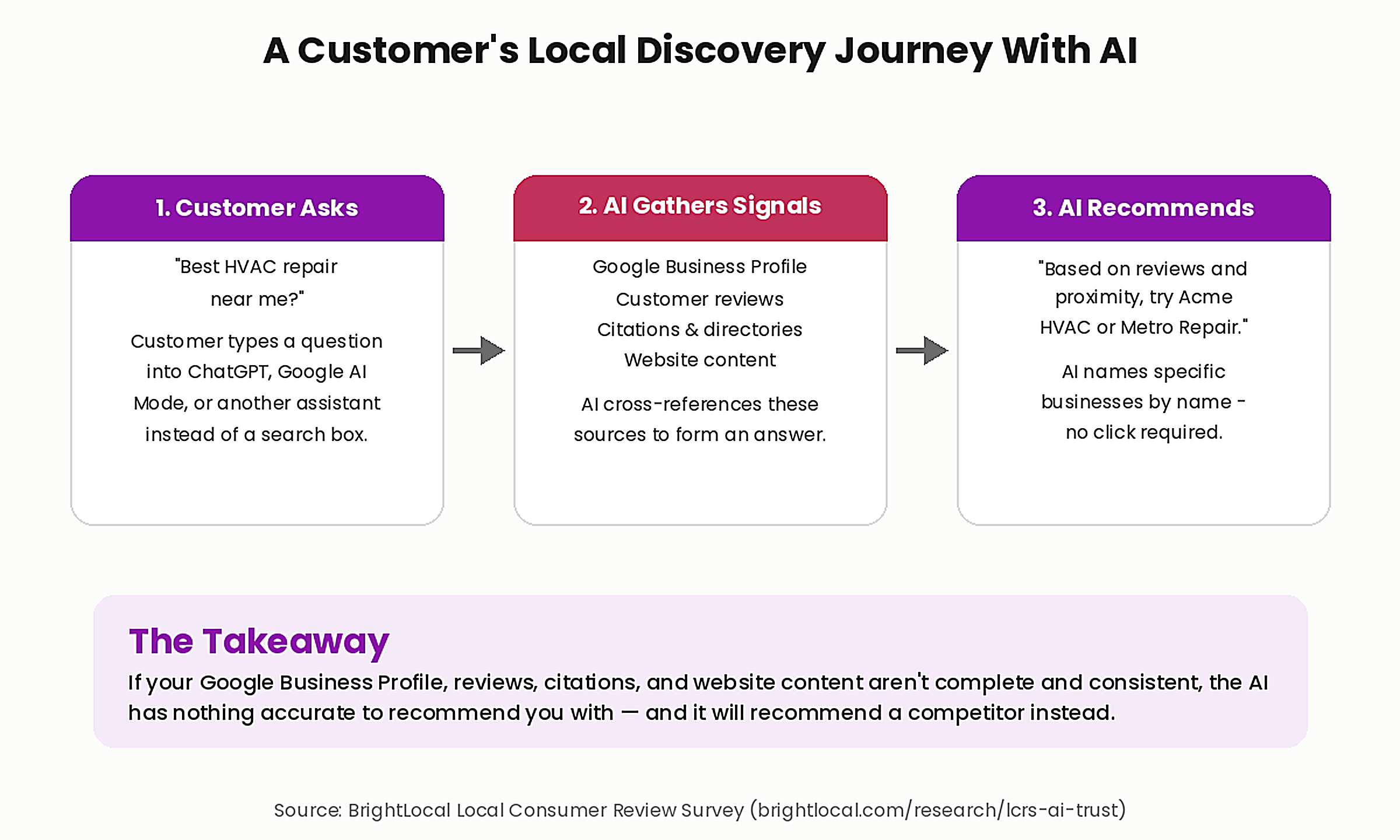
- AI recommendations aren’t tied to a search box. Google Business Profile still matters for the map pack, but AI tools like ChatGPT and Google AI Mode synthesize answers from a wider net — reviews, website content, citations, and third-party mentions — meaning your visibility now depends on signals you may not be actively managing.
- The “research phase” has moved upstream. Because AI Overviews dominate informational and hybrid queries rather than narrowly local ones, businesses that only optimize for “near me” searches are missing the moment when AI is actually forming its shortlist of recommendations.
- Consistency across locations is now an AI-trust signal, not just a Google-ranking one. AI tools cross-reference the same NAP (name, address, phone) consistency, review volume, and review recency that traditional local SEO has always cared about — but errors or gaps now get baked into an AI-generated answer that a customer may never question.
- This is a widening gap, not a plateau. A jump from 6% to 45% in one year suggests this channel is still accelerating. Businesses that build AI visibility now have a head start; those that wait are optimizing for a shrinking share of a channel that used to be everything.
How to Adapt: A 5-Step Playbook for Getting Recommended by AI
Getting recommended when a customer asks an AI assistant for a local suggestion requires a different playbook than ranking in the local pack. Here’s where to start.
1. Audit and Fully Optimize Your Google Business Profile
Google AI Mode and Google’s AI Overviews draw heavily on Google Business Profile data — category selection, attributes, services, posts, Q&A, and photos. An incomplete or outdated profile is invisible input for the AI systems pulling from it. Claim every location, fill in every field, and keep hours, services, and categories current across all locations.
2. Build a Consistent, Reviewable Reputation Everywhere
AI tools weigh review volume, recency, and sentiment when forming recommendations, and they pull from more than just Google — Yelp, Facebook, and industry-specific platforms all feed the picture. Set up a system to request reviews consistently after every transaction, and respond to reviews (positive and negative) so the platform-level signal of an actively managed business is unmistakable.
3. Publish Content That Directly Answers “Best” and “How Much” Questions
Since AI Overviews dominate informational and hybrid-intent queries, create content that answers the exact questions customers ask before they’re ready to search “near me” — pricing guides, comparison pages, service-area FAQs, and “what to look for” content. Structure it in clear, extractable answer blocks so AI systems can cite it directly.
4. Strengthen Citations and Third-Party Mentions
AI recommendation engines cross-reference your business across the web, not just on your own site. Ensure your NAP data is identical across directories, industry associations, local news mentions, and partner sites. Inconsistent citations create doubt that can knock you out of consideration entirely.
5. Monitor Your AI Visibility, Not Just Your Search Rankings
Traditional rank tracking doesn’t tell you whether ChatGPT or Google AI Mode is recommending your business. Start regularly querying AI tools with the same questions your customers would ask, and track whether — and how — your business is mentioned. Treat gaps the same way you’d treat a lost keyword ranking: as a signal to fix underlying data and content. 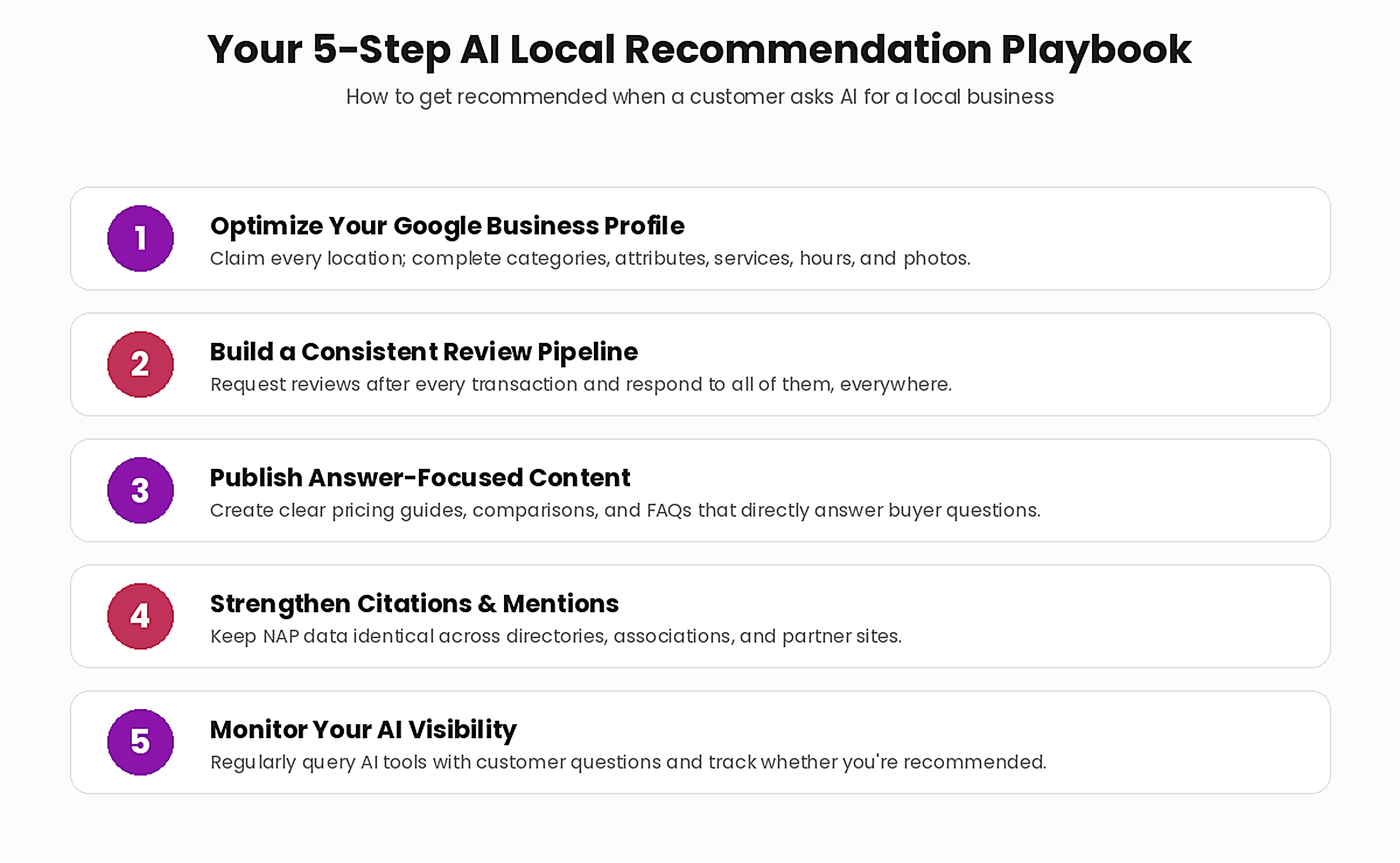
FAQ
Q: What percentage of consumers use AI to find local businesses?
A: 45% of consumers currently use AI tools to get local business recommendations, according to BrightLocal’s Local Consumer Review Survey — up from just 6% a year earlier.
Q: Is AI more popular than Yelp for finding local businesses?
A: Yes. BrightLocal’s research ranks AI tools as the #3 discovery channel overall, behind only Google (71%) and Facebook, and ahead of Yelp and TripAdvisor.
Q: Which AI tool do consumers use most for local recommendations?
A: ChatGPT leads with 31% usage share among consumers who use AI for local recommendations, followed by Google AI Mode at 23%.
Q: Do AI Overviews really show up that often for local searches?
A: According to a 2026 Whitespark study of 540 queries, AI Overviews appeared in 68% of local business-type queries overall, and in 92-97% of informational and hybrid-intent local queries specifically.
Q: What’s the single most important first step to get recommended by AI?
A: Start with a fully optimized, consistently updated Google Business Profile and a steady stream of recent reviews — these are foundational data sources that AI tools draw on when forming local recommendations.
CTA
AI is now the third-most-used channel customers rely on to find a local business — and that share is still climbing. If your Google Business Profile, reviews, citations, and content aren’t built to feed AI recommendation engines, you’re invisible in a growing share of the moments that lead to new customers.
SEO Outsourcing helps local and multi-location businesses get found in exactly this shift — from Google Business Profile optimization to AI-visibility monitoring. Call 813-397-3665 or visit www.seooutsourcing.com to get a free assessment of how your business shows up when customers ask AI for a recommendation.