There’s a persistent myth in marketing circles that AI-written content is a shortcut to mediocrity — thin, generic, and easy to spot. The data says otherwise. According to Semrush’s latest content marketing research, 79% of businesses report an increase in content quality thanks to AI. Not “no change.” Not “a slight dip.” An increase, according to the businesses actually using it. If you’ve been holding back on AI-assisted content because you’re worried it will cheapen your brand, it’s time to update that assumption with what the numbers actually show.
The Data: What Semrush’s 79% Quality Stat Really Means
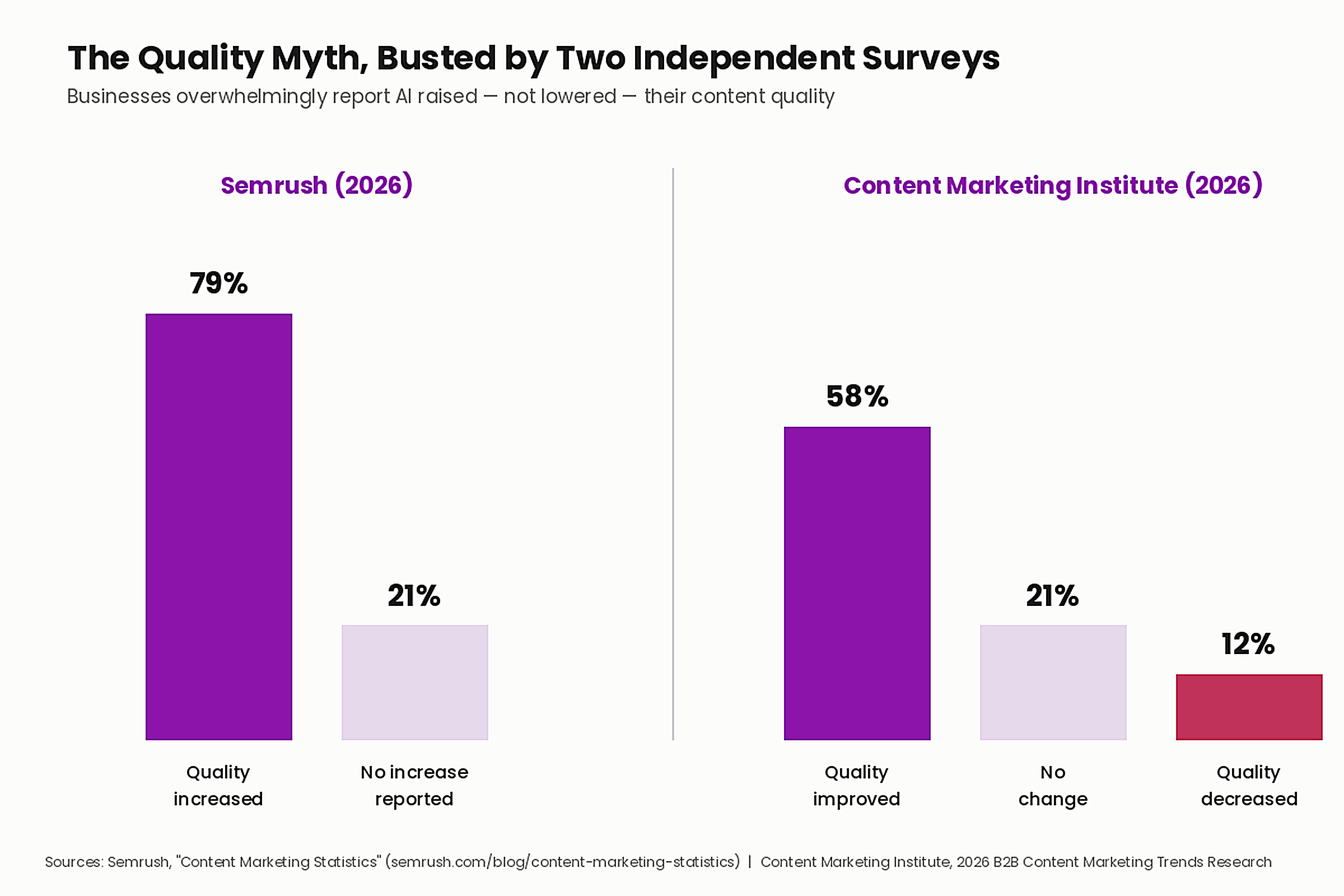
Semrush’s research is unambiguous on this point: 79% of businesses report an increase in content quality thanks to AI, based on self-reported feedback from the marketers and content teams actually producing that content. This statistic sits inside a broader wave of AI-content data from Semrush’s content marketing statistics research, which tracks how AI is reshaping content operations across planning, production, and performance.
Think about what that figure implies. The people closest to the content — the ones who can see the drafts before and after AI enters the workflow, who know what “good” looked like a year or two ago, and who are accountable for the results — are telling us AI made their output better. That’s a meaningful signal, because it’s not coming from AI vendors marketing their tools; it’s coming from the practitioners actually grading the work.
It’s also worth being precise about what this stat is and isn’t measuring. It’s a self-reported perception metric, not an independent third-party quality audit. But self-reported perception is exactly what shapes editorial decisions inside real companies: whether a content director green-lights more AI-assisted output, whether a CMO expands the budget for AI tools, and whether a brand keeps using AI for its blog, its landing pages, and its email content. On that dimension, the fear of “AI equals lower quality” simply doesn’t match what practitioners report experiencing.
The 2026 Trend: Independent Research Backs the Same Pattern
The Semrush number isn’t an outlier. Look at the Content Marketing Institute’s 2026 B2B Content Marketing Trends Research, a separate, independently fielded survey of B2B marketers. It found that 58% of marketers say content quality improved with AI-assisted content creation, while 21% reported no change and only 12% said quality decreased. Two different research organizations, two different survey populations, and the same directional conclusion: quality gains from AI vastly outnumber quality losses.
CMI’s report adds an important nuance, though, and it’s one every business should sit with: the researchers note that “AI helps marketers type faster, not think better” for teams that treat it as a pure automation tool rather than a collaborative one. In other words, the quality gains aren’t automatic — they show up when AI is paired with strategy, expertise, and editorial judgment, not when it’s used as a “generate and publish” shortcut.
That distinction is reinforced by a separate 2026 SERP performance study from Digital Applied’s AI vs. human content research, which tracked 200 paired AI and human articles across 14 domains over six months. The AI articles in that dataset that underperformed had one thing in common: zero human revision before publishing. The researchers explicitly noted that closing the performance gap “requires an editor pass,” not a different AI model. Put simply: unedited AI content is where quality risk lives. Edited, quality-controlled AI content is where the 79% and 58% improvement numbers come from.
Why This Matters for AI and Digital Marketing
For years, the assumption in marketing was that “scaling content” and “maintaining quality” pulled in opposite directions — more volume meant more corner-cutting. AI breaks that trade-off, but only when it’s implemented correctly. That’s the real story behind these statistics: quality fears about AI content are outdated for teams that build a real editorial process around it, and entirely justified for teams that don’t.
This matters for three groups specifically:
Brands worried about reputation risk. If your concern is that AI content will look “off-brand” or generic, the fix isn’t to avoid AI — it’s to make sure a human is shaping voice, adding original expertise, and reviewing every draft before it publishes. That’s precisely the difference between the businesses reporting quality gains and the minority reporting quality losses.
SEO teams worried about rankings and E-E-A-T. Google’s guidance has never penalized content for being AI-assisted; it penalizes content for being low-quality, unhelpful, or unoriginal — the same standard applied to human-written content. Since human editorial oversight is what drives the quality gains businesses are reporting, a solid AI-plus-human workflow is also a solid SEO strategy.
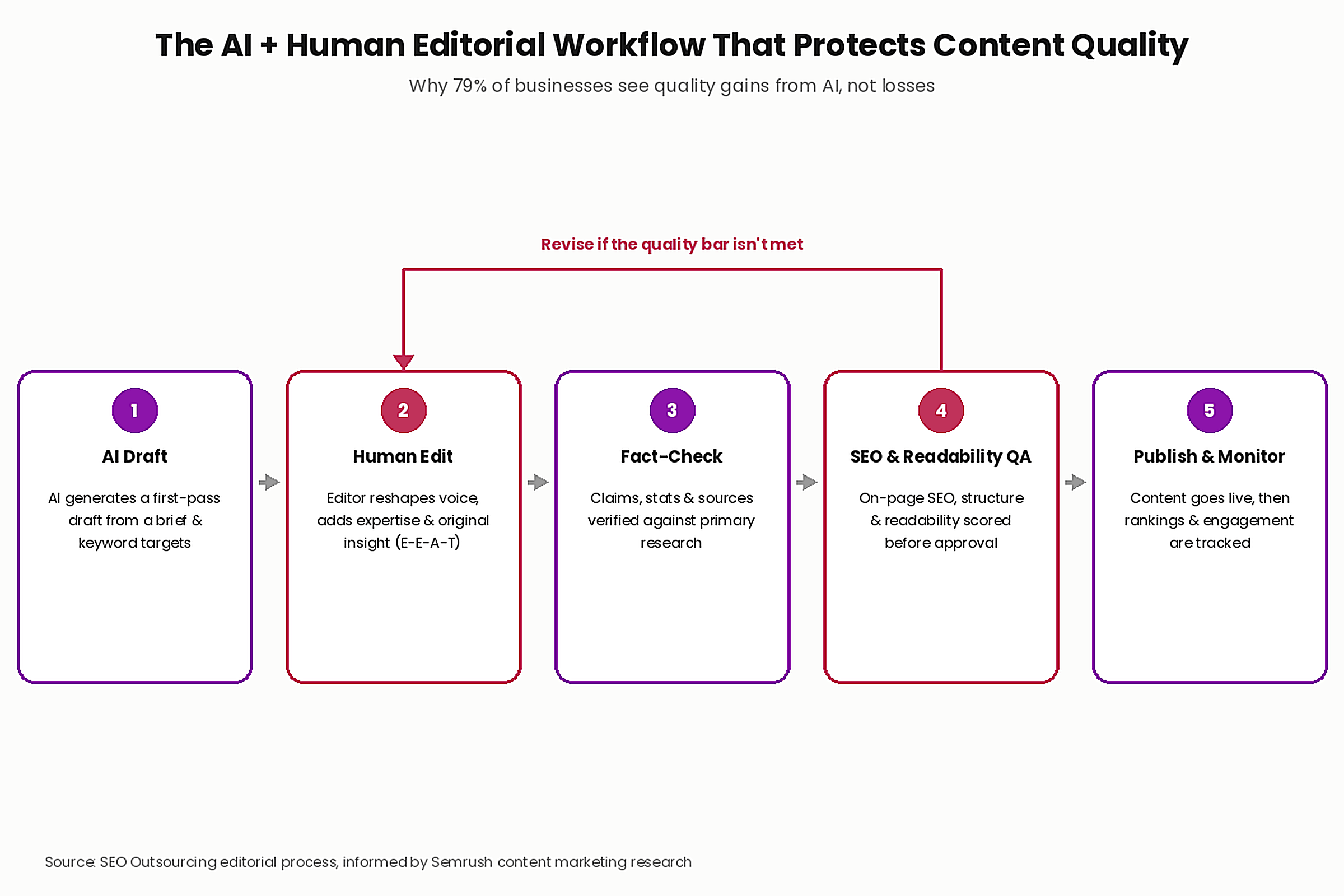
Agencies and internal teams scaling output. The businesses seeing the biggest wins are using AI to handle first drafts, research synthesis, and structural groundwork, freeing up human editors to focus on expertise, nuance, and strategic judgment — the parts of content that AI genuinely cannot replicate on its own. That’s a force multiplier, not a shortcut.
How to Adapt: A 5-Step Playbook
1. Brief the AI like you’d brief a junior writer, not a vending machine
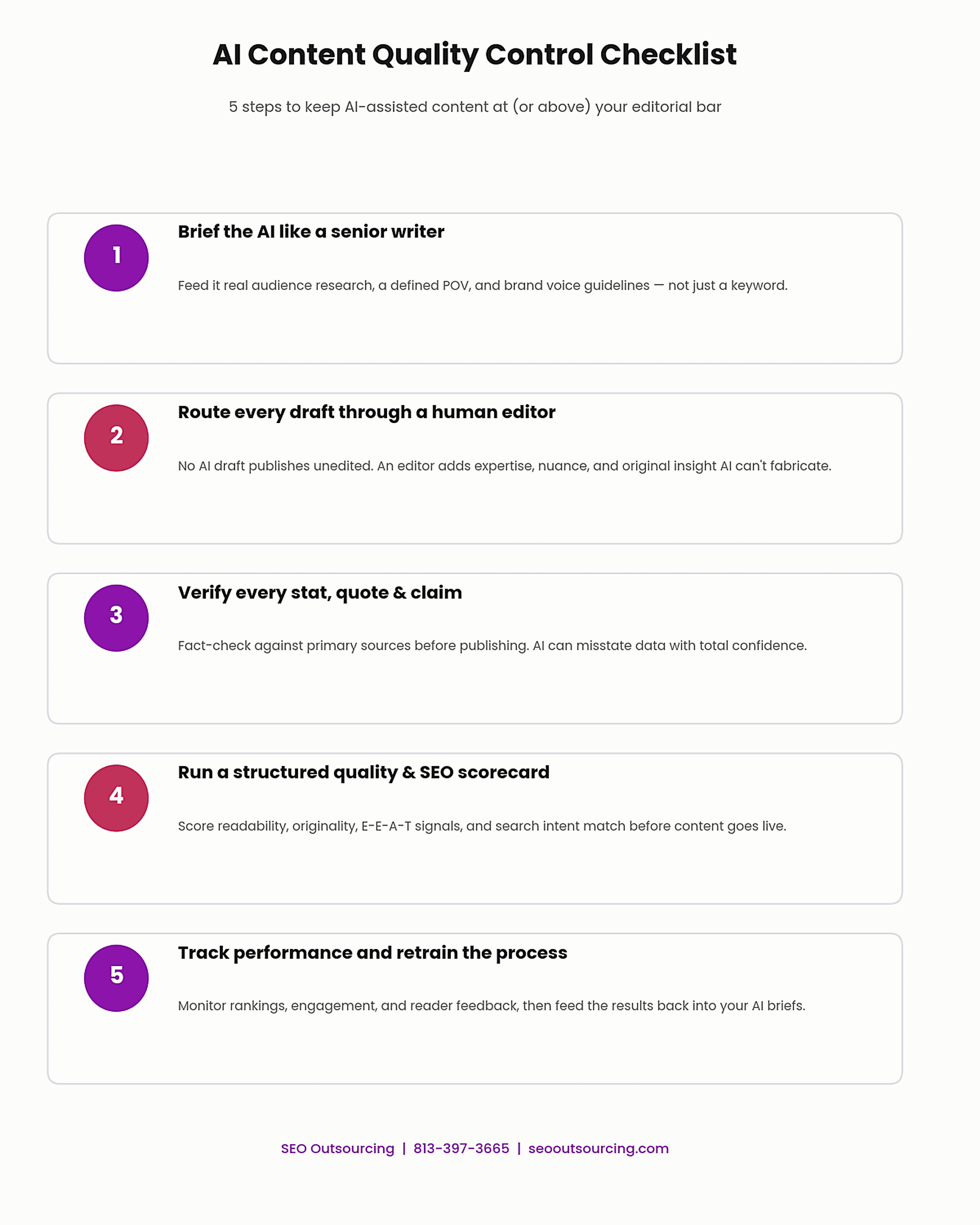
Feed your AI tools real audience research, a defined point of view, competitive context, and brand voice guidelines rather than a bare keyword. The quality of the output is directly tied to the quality of the input — vague prompts produce generic drafts, and generic drafts are exactly what fuels the “AI content is low quality” narrative.
2. Make human editing a non-negotiable step, not an afterthought
No AI draft should go live without a human editor reshaping structure, tightening arguments, and injecting original expertise, examples, or data the AI couldn’t have known. This single step is the biggest differentiator between the 79% of businesses reporting quality gains and the smaller group reporting quality losses.
3. Fact-check every statistic, quote, and claim before publishing
AI models can state incorrect information with total confidence, which is a real risk to both credibility and search performance. Build a verification step into your workflow where every number and claim is checked against a primary source before the piece is approved.
4. Run a structured quality and SEO scorecard on every piece
Score each draft on readability, originality, keyword and search-intent alignment, and E-E-A-T signals like expertise and firsthand insight before it’s published. A repeatable scorecard turns “does this feel good enough” into a measurable, consistent quality bar across every writer and every AI tool you use.
5. Track performance after publishing and feed it back into your process
Monitor how each piece performs in rankings, engagement, and conversions, then use that data to refine your AI briefs, editorial checklist, and topic selection going forward. Quality control with AI isn’t a one-time setup; it’s a loop that gets sharper the more data you feed back into it.
Frequently Asked Questions
Does AI content actually rank as well as human-written content?
Yes, when it goes through human editing and fact-checking. Independent research, including a six-month SERP study from Digital Applied, shows that unedited AI content underperforms, but the performance gap narrows significantly once an editorial pass is added. Ranking well has always come down to quality, relevance, and E-E-A-T signals — factors human oversight directly improves.
Why do 79% of businesses say AI improved their content quality?
Because most businesses using AI successfully aren’t publishing raw AI output — they’re using AI to accelerate research, drafting, and structure, while humans handle expertise, voice, and judgment. That combination consistently outperforms either AI alone or unassisted human writing on speed, and according to Semrush’s data, on perceived quality as well.
What’s the biggest risk of using AI for content without quality control?
Publishing unedited, unverified drafts. The research consistently shows that quality problems cluster around AI content that skips human review — inaccurate claims, generic phrasing, and a lack of original insight. Teams that treat AI as the entire process, rather than one step in it, are the ones reporting quality declines.
How can I tell if my AI content strategy is actually working?
Track the same quality signals you’d use for any content: organic rankings, time on page, conversion rate, and editorial review scores. If quality is improving under a defined AI-plus-human workflow, those metrics should trend upward over time — consistent with what the majority of businesses in the Semrush and CMI research report are experiencing.
Ready for AI Content That Doesn’t Sacrifice Quality?
The data is clear: AI doesn’t have to lower your content quality — for most businesses using it well, it raises it. The difference between the 79% reporting gains and the minority reporting losses comes down to process: expert briefing, human editorial oversight, fact-checking, and structured quality control at every step. SEO Outsourcing builds exactly that kind of quality-controlled, AI-assisted content process for our clients — pairing efficient AI drafting with experienced human editors, SEO strategists, and fact-checkers so every piece we publish meets a real editorial bar, not just a word count. Call us at 813-397-3665 to see how we combine AI efficiency with human-verified quality for your content program.