If your content calendar feels perpetually behind and your budget for new hires is flat, you are not alone — and you don’t need either problem to persist. According to HubSpot’s latest research, 71% of marketers now say AI content creation tools help them produce significantly more content, and the average piece takes roughly three hours less to complete than it used to. That is not a marginal efficiency gain; it’s the difference between publishing once a week and publishing three times a week with the exact same team. For business owners and marketing leaders trying to compete for search visibility without expanding payroll, this is the single most actionable data point in content marketing right now.
This post breaks down what the data actually says, why a growing body of 2025-2026 research backs it up, and — most importantly — the concrete playbook for turning “AI helps us create more content” into a repeatable, quality-controlled production system.
The Data: What HubSpot’s Research Actually Found
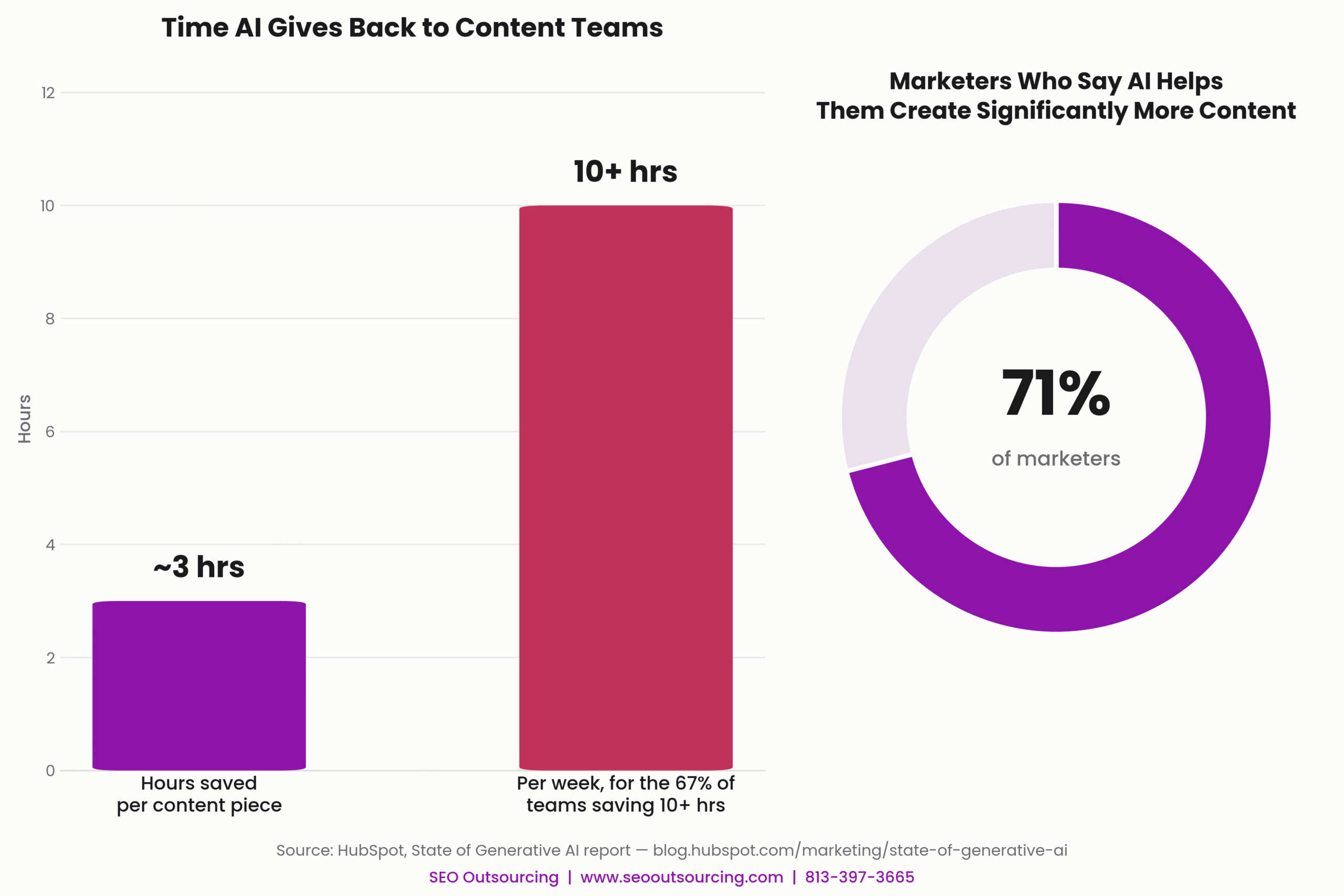
HubSpot’s State of Generative AI report surveyed marketers on how generative AI tools have changed their day-to-day content workflows, and the headline number is striking: 71% of marketers say AI helps them create significantly more content than they could without it. That’s nearly three out of every four marketers reporting a meaningful, not marginal, increase in output.
The report also quantifies the time savings behind that output increase. For content creators, AI translates to roughly three hours saved per piece of content — time that previously went into research, first drafts, outlining, and formatting. HubSpot’s data goes a step further to show this compounds at the team level: 67% of marketing teams report saving 10 or more hours per week through AI use, and 68% say AI has meaningfully increased their overall productivity.
Put those numbers together and the picture is clear. This isn’t a story about AI replacing content teams. It’s a story about the same team producing dramatically more, because each individual piece of content now costs a fraction of the time it used to. Three hours saved per blog post, case study, or landing page is enough to cut a full workday out of a five-piece content sprint — hours that can go straight back into strategy, promotion, or simply publishing more.
The 2026 Trend: Content Volume Is Tripling While Budgets Barely Move
HubSpot’s numbers aren’t an outlier. A 2025 B2B Content Marketing Report from 10Fold, based on a survey of 400 senior marketing executives conducted by Sapio Research, found that 91% of marketers are increasing content output in 2025, and 46% are producing three to five times more content than they did the year before. Critically, 75% of those same teams received only modest budget increases of 1-10%, meaning the output gains had to come from somewhere other than new spending.
That report points squarely at AI as the mechanism: 67% of global marketers say they now use AI tools frequently or constantly for content creation, with U.S. adoption reaching 75%. Just as important for anyone worried about the “AI will replace my team” narrative, 83% of marketers in the study did not reduce staff as a result of AI adoption — and more than a third of that group actually grew their teams, redirecting people toward strategy, promotion, and quality control instead of pure production.
Together, the HubSpot and 10Fold data tell a consistent 2026 story: AI content creation tools are not primarily a cost-cutting tool for eliminating jobs. They are a volume multiplier that lets existing teams compete at a scale that used to require hiring. For businesses that have been priced out of “more content” because it meant “more headcount,” that changes the calculus entirely.
Why This Matters for AI and Digital Marketing
For most small and mid-sized businesses, content output has always been a headcount problem. Every additional blog post, service page, or case study meant more hours from a writer, editor, or agency retainer — and budgets rarely scale as fast as content ambitions. The efficiency gains documented by HubSpot and 10Fold break that link. When a single piece of content costs three fewer hours to produce, a team that used to publish four articles a month can realistically publish twelve, without adding a single new line item to payroll.
That has direct implications for SEO and organic visibility. Search engines and AI-driven answer engines alike reward sites that consistently publish relevant, well-structured content across a topic cluster. A business that can triple its publishing cadence without tripling its costs gains a structural advantage over competitors who are still bottlenecked by manual production — more indexed pages, more opportunities to rank for long-tail keywords, and more fresh signals for AI Overviews and generative search tools to cite.
The catch, and it’s an important one, is that raw volume without quality control is a liability, not an asset. Search engines have gotten sharper about detecting thin, generic, unedited AI output, and publishing more mediocre content faster is not a strategy — it’s a risk. The businesses winning with this trend are the ones treating AI as a research and drafting accelerator, while keeping human editors, subject-matter experts, and brand voice firmly in control of what actually goes live. That reallocation — from typing to judgment — is where the real competitive advantage sits. 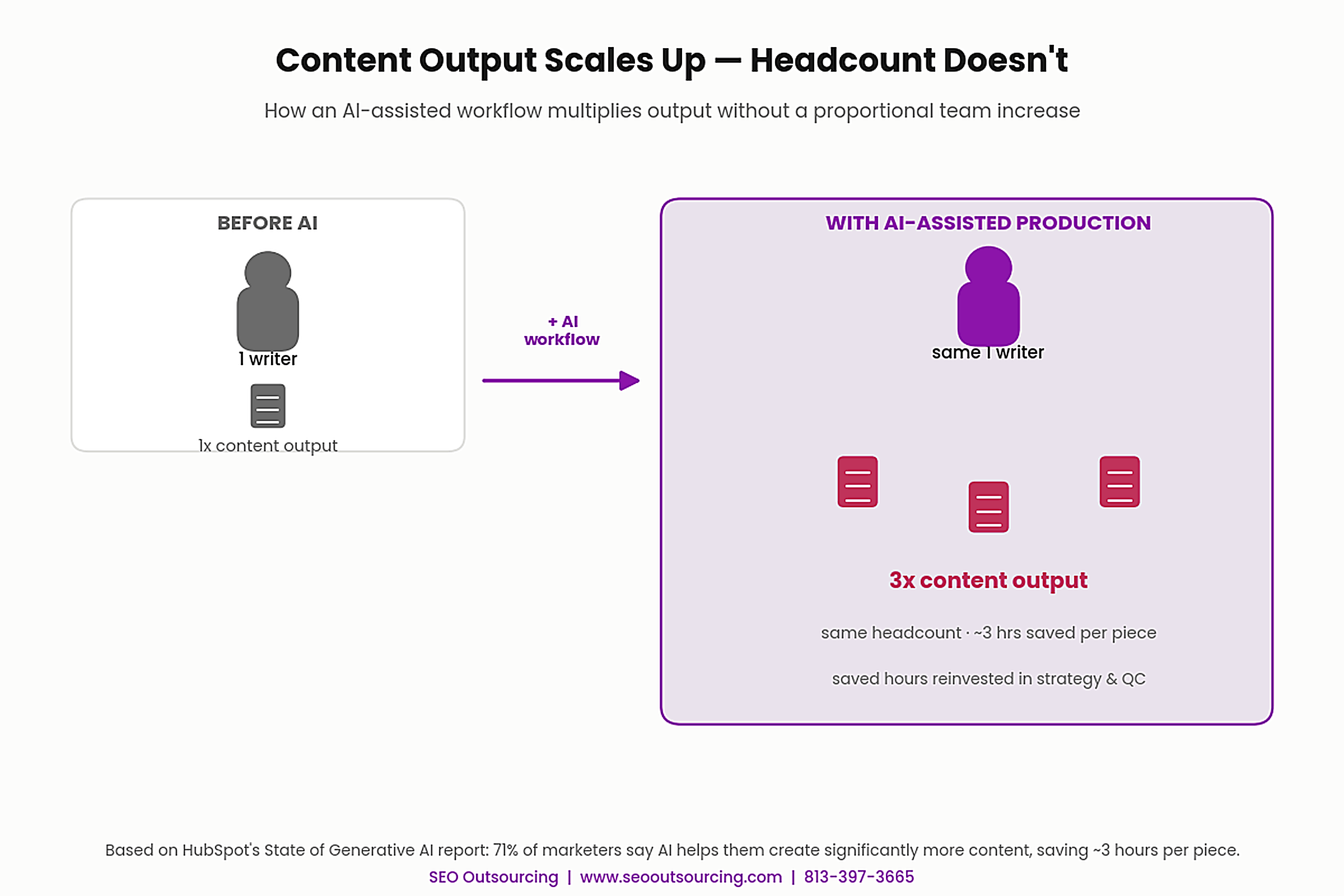
How to Adapt: A 5-Step Playbook
1. Audit your current content time costs
Before you can measure improvement, you need a real baseline. Track how many hours your team actually spends per piece today — research, outlining, drafting, editing, formatting, and publishing — broken out by content type. Most teams are surprised by how much time goes into steps AI can now compress, like initial research and first drafts.
2. Standardize briefs, prompts, and brand voice
The three-hour time savings HubSpot reports only materializes when AI tools have clear, reusable inputs to work from. Build standardized content briefs, style guides, and prompt templates that encode your brand voice, target keywords, and formatting requirements, so every AI-assisted draft starts closer to publish-ready instead of requiring a full rewrite.
3. Assign AI to drafting, humans to judgment
Use AI tools for the tasks it’s genuinely good at: research synthesis, outlines, first drafts, and repurposing existing content into new formats. Keep human writers and strategists focused on fact-checking, brand alignment, original insight, and the expertise signals that both readers and search algorithms are looking for.
4. Build a non-negotiable quality-control checkpoint
As output scales, the temptation to skip review grows — resist it. Insert a mandatory human editing pass before anything publishes, checking for factual accuracy, tone consistency, and genuine expertise (E-E-A-T), not just grammar. This is the step that determines whether tripled output helps your rankings or quietly erodes them.
5. Reinvest saved hours, don’t just bank them
The point of AI-driven time savings is to reallocate that time, not eliminate it from the budget entirely. Redirect the roughly three hours saved per piece into keyword research, internal linking, content promotion, and performance analysis — the strategic work that turns a bigger content library into more traffic, leads, and revenue.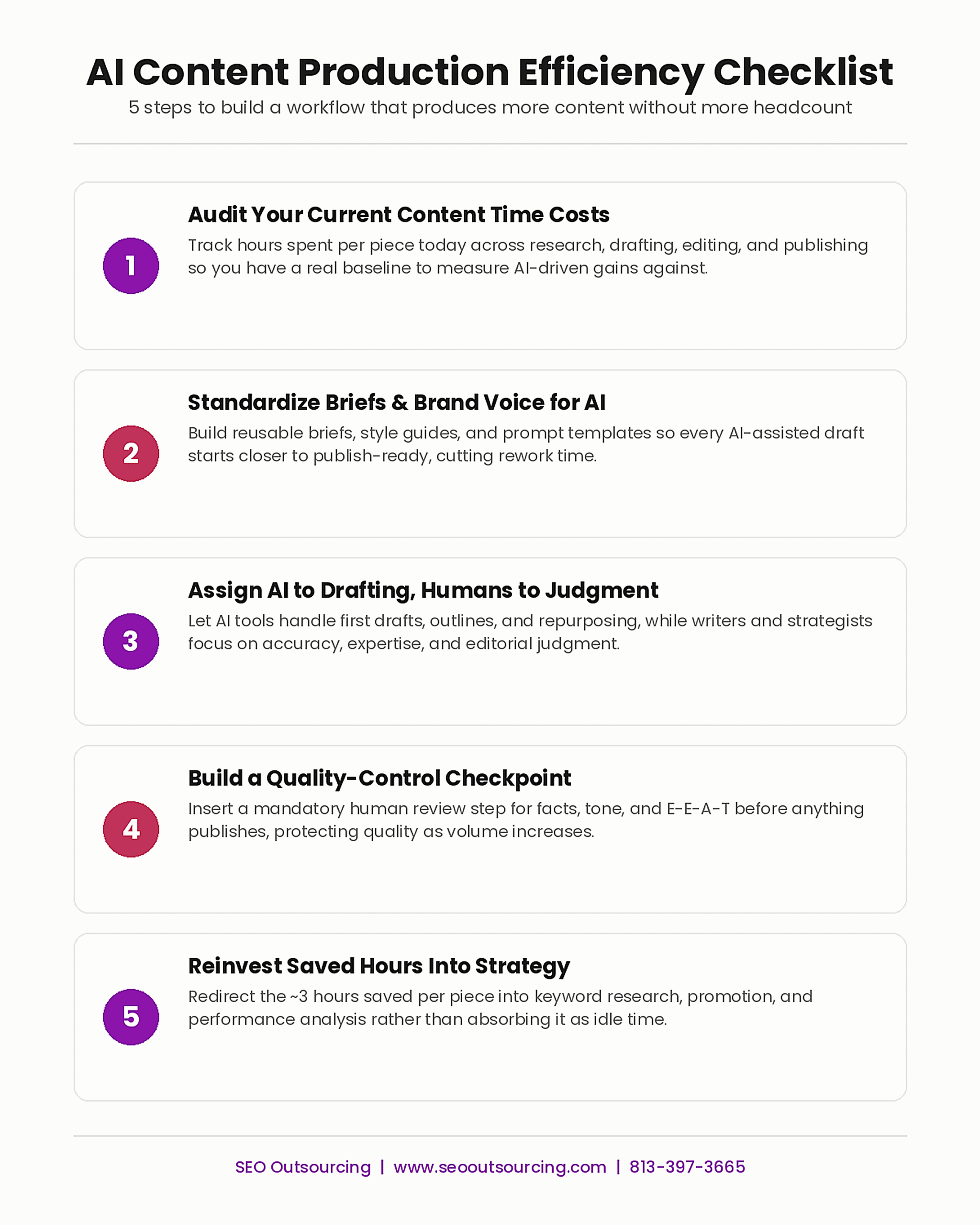
Frequently Asked Questions
Does using AI to create more content hurt SEO rankings?
Not inherently. Search engines don’t penalize content simply because AI assisted in producing it; they penalize content that is low-quality, inaccurate, or unhelpful regardless of how it was made. The risk comes from skipping human review and quality control as volume increases, not from using AI itself. A structured process with editorial oversight lets you scale output while maintaining the accuracy and expertise standards search engines reward.
How much time can AI realistically save on a single blog post?
HubSpot’s research puts the average at roughly three hours saved per piece of content, once a team has established reusable briefs, prompts, and workflows. That figure covers research, drafting, and formatting time; final human editing and fact-checking should still be budgeted separately to protect quality.
Can a small business really produce 3x more content without hiring?
Yes, according to both HubSpot’s data (71% of marketers report significantly more output using AI) and a 2025 industry report finding 46% of B2B marketers already producing three to five times more content year-over-year without proportional budget increases. The key is building a standardized AI-assisted workflow rather than treating AI as an occasional shortcut.
What’s the biggest mistake businesses make when scaling content with AI?
The most common mistake is skipping quality control to chase volume. Publishing more thin, unedited, or inaccurate AI-generated content can hurt search rankings and brand trust faster than slow output ever would. The businesses seeing sustainable gains keep a human review checkpoint on every piece before it goes live.
Ready to Multiply Your Content Output?
Producing more content without adding headcount isn’t a one-time hack — it’s a workflow that needs the right combination of AI tools, editorial standards, and SEO strategy to actually move the needle on rankings and revenue. SEO Outsourcing builds scalable, AI-assisted content production systems for businesses that want to publish more without sacrificing quality or blowing up their budget. Call us at 813-397-3665 to talk through a content production plan built for your team’s capacity and growth goals.