94% of Marketers Use AI Content Creation in 2026
If you’re still debating whether AI belongs in your content process, the debate is effectively over. According to HubSpot’s marketing statistics, 94% of marketers plan to use AI in their content creation processes in 2026 — including blog articles. That’s not an early-adopter trend anymore. That’s the industry standard, and it means the marketers who aren’t using AI are the exception, not the rule.
For years, “should we use AI for content?” was a legitimate strategic question. In 2026, it isn’t. The question that actually matters now is how the 94% are using AI, and whether they’re doing it well enough to compete. This post breaks down what the 94% figure really means, backs it up with corroborating industry research, and gives you a practical playbook for adopting AI content creation the right way — not just fast, but well.
The Data: HubSpot’s 94% Adoption Figure
HubSpot’s marketing statistics roundup, drawn from its ongoing State of Marketing research, puts the number plainly: about 94% of marketers plan to use AI in their content creation processes — including blog articles — in 2026. That figure sits inside HubSpot’s broader content marketing and blogging statistics, and it represents one of the highest adoption rates HubSpot tracks for any marketing technology category.
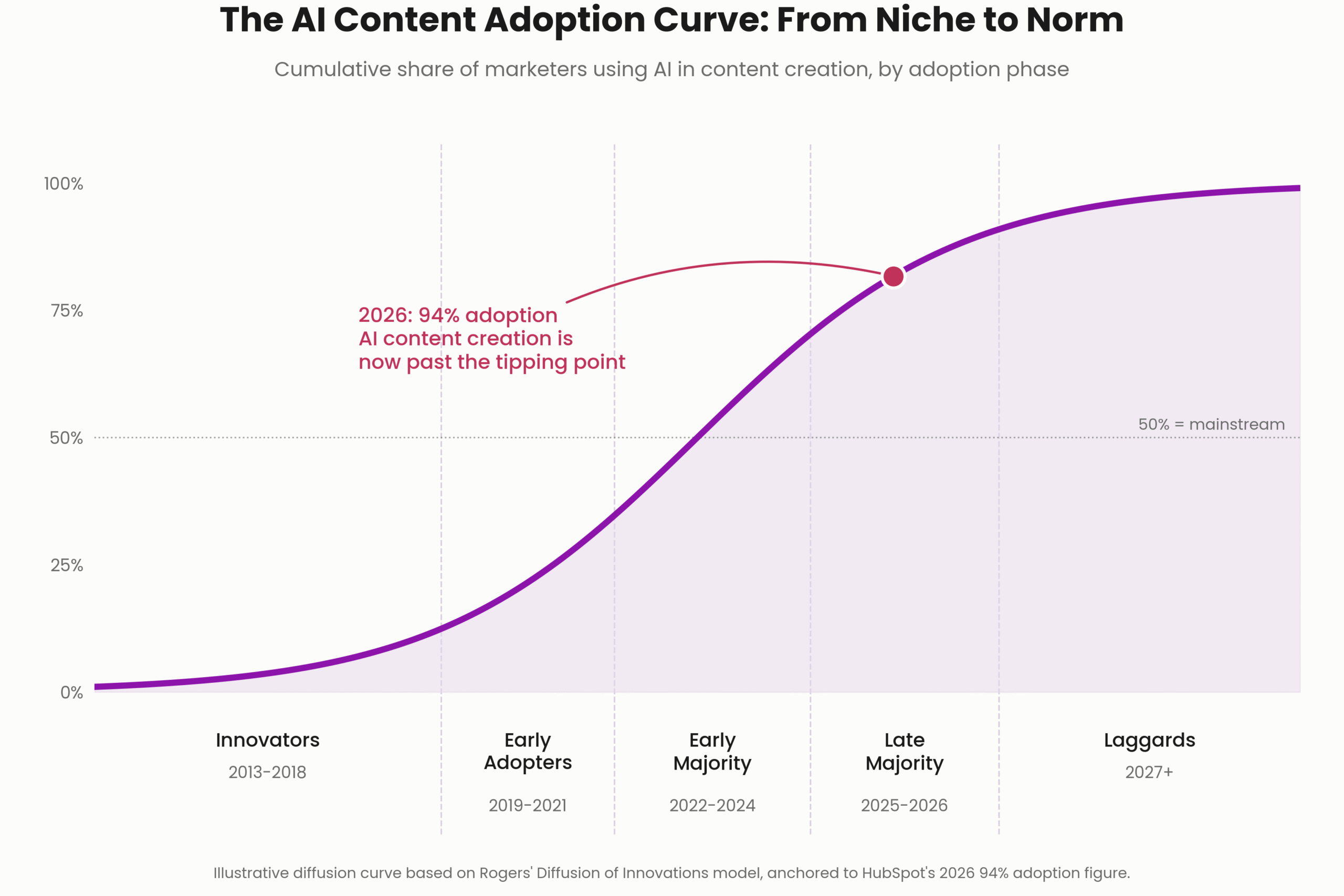
Think about what a 94% adoption rate actually implies. In most technology categories, that level of saturation only shows up once a tool has moved well past “innovative” and into “assumed default,” the same territory occupied by email marketing platforms or basic analytics dashboards. AI in content creation has completed that same journey in a fraction of the time. A capability that was a competitive differentiator as recently as 2022–2023 is now baked into how the overwhelming majority of marketing teams operate.
That’s the core point of this data: 94% isn’t a ceiling marketers are working toward. It’s where the market already stands. The remaining 6% — not the AI users — are now the outliers who need to explain their approach, not the other way around. 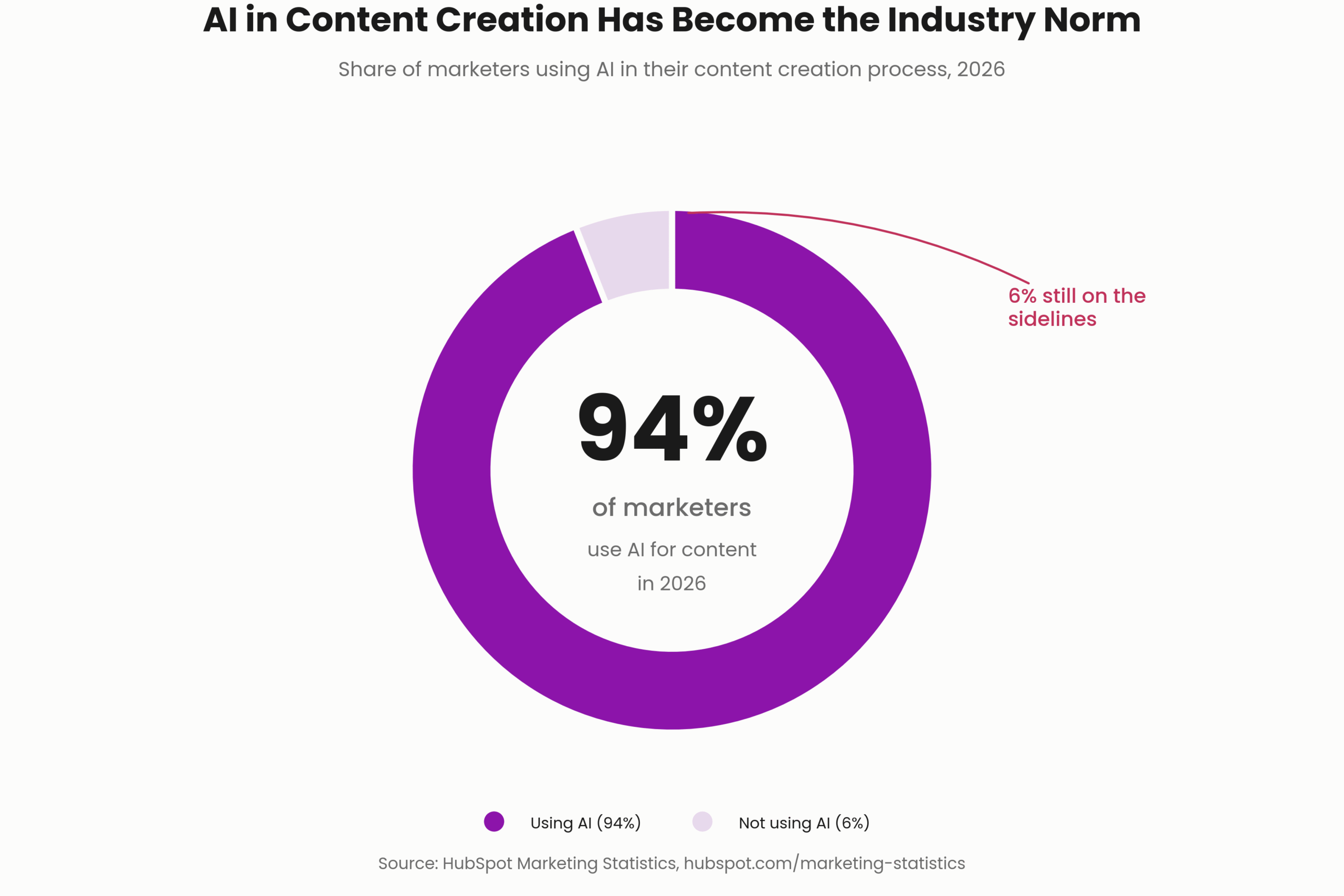
The 2026 Trend: Corroborating Research Confirms Near-Universal Adoption
HubSpot’s number isn’t an outlier. Independent research from other major marketing organizations tells the same story from different angles, which is exactly what you’d expect if AI content adoption has genuinely become the industry norm rather than a HubSpot-specific finding.
The Content Marketing Institute’s 2026 B2B content marketing research found that 95% of B2B marketers are now using AI applications somewhere in their workflow — a figure essentially identical to HubSpot’s, despite coming from a different survey population and methodology. Separately, Salesforce’s State of Marketing 2026 report found that 75% of marketers have adopted AI outright, with adoption climbing as teams lean on it to close the gap between the personalized content customers expect and what human teams can produce alone.
Three independent studies, three different survey panels, one consistent conclusion: AI is no longer a niche tactic used by a handful of forward-thinking marketing teams. It’s the default operating mode for the content marketing profession. The interesting nuance across all three studies isn’t whether marketers use AI — it’s how much of a gap exists between using it and using it well. CMI’s research, for instance, found that despite 95% adoption, fewer than 4 in 10 marketers say AI is actually improving their results. That gap is exactly why the playbook in this article matters more than the adoption number itself.
Why This Matters for AI and Digital Marketing
When a practice reaches 94% adoption, its competitive meaning flips. Early on, using AI for content creation was a differentiator — it signaled efficiency, innovation, and a willingness to experiment. At 94% saturation, that’s no longer true. Using AI doesn’t make you stand out anymore; it makes you table stakes. Not using it, on the other hand, now stands out — and not in a good way.
Here’s why that shift matters for anyone responsible for content or organic growth:
AI adoption alone is no longer a competitive advantage. If 94% of your competitors are already using AI in their content process, matching that baseline doesn’t win you anything. It just keeps you in the game. Differentiation in 2026 comes from how AI is used — the quality of the prompting, the depth of human editorial oversight, and the strategic judgment layered on top of AI-generated drafts.
The 6% are the ones carrying real risk. Falling into that shrinking minority isn’t a neutral choice anymore. It means slower production cycles, higher per-piece costs, and a widening output gap against competitors who’ve built AI-assisted workflows. In a content landscape where publishing velocity and topical coverage directly affect organic visibility, that gap compounds month over month.
Quality control is now the real battleground. As CMI’s research shows, adoption and performance aren’t the same thing. The marketers pulling ahead in 2026 aren’t the ones who simply turned on an AI tool — they’re the ones who built rigorous editorial, fact-checking, and brand-voice processes around it. That distinction is where SEO outcomes, reader trust, and search engine quality signals are actually decided.
Search engines and AI Overviews reward substance, not just speed. Google’s helpful content systems and AI-driven search experiences are explicitly designed to reward original insight, accuracy, and expertise — and to demote generic, unedited AI output. Near-universal AI adoption raises the volume of mediocre content online, which makes genuinely well-executed AI-assisted content (rigorously reviewed, expert-informed, and well-optimized) more valuable by comparison, not less.
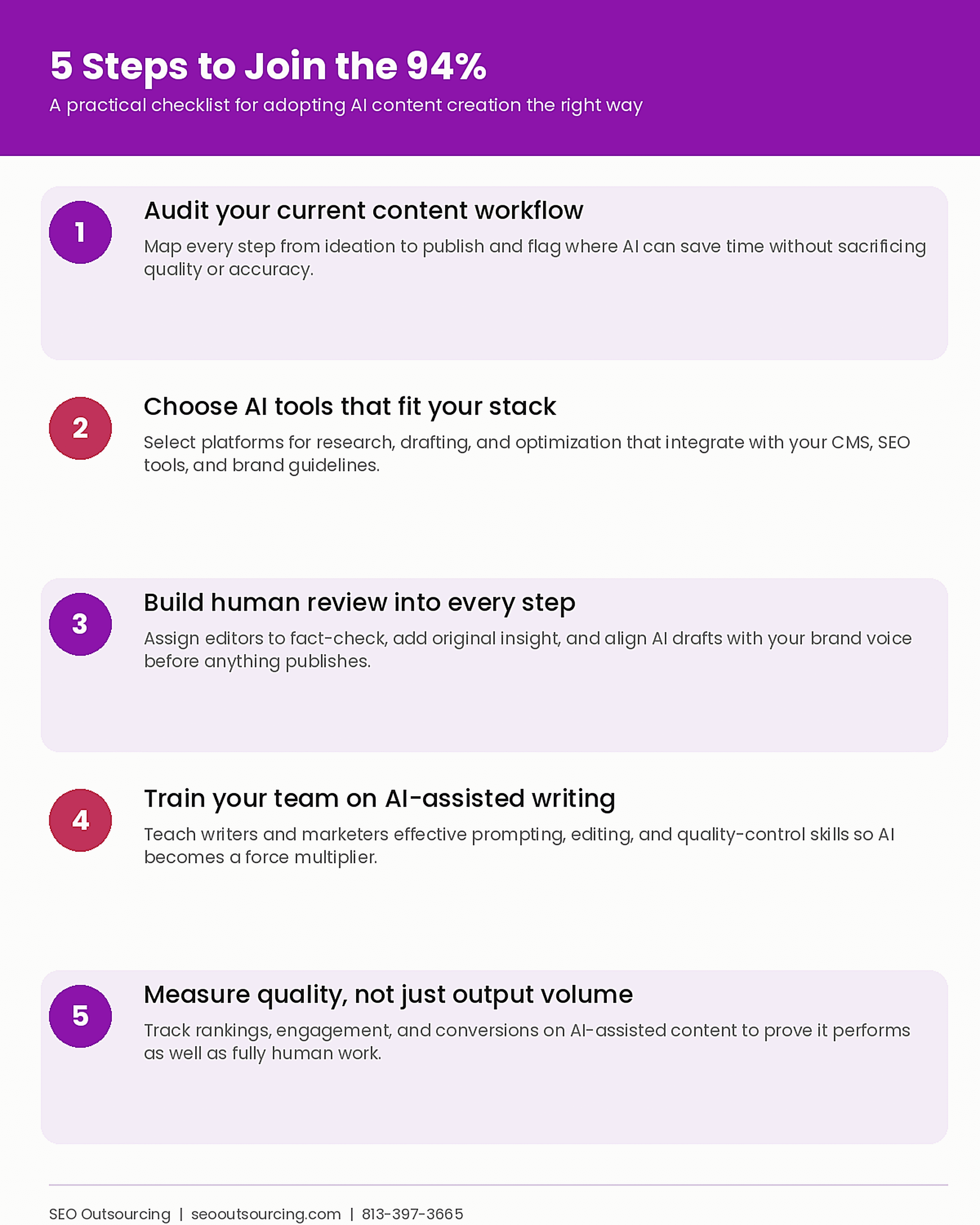
How to Adapt: A 5-Step Playbook
Getting to “we use AI” is the easy part; 94% of the market has already cleared that bar. The playbook below is built for teams that want to move past basic adoption and actually compete on quality and results.
1. Audit Your Current Content Workflow
Before adding or expanding AI tools, map your existing process end to end — from topic research and outlining through drafting, editing, SEO optimization, and publishing. Identify the stages where AI can genuinely save time (research synthesis, first drafts, outline generation) versus the stages that require human judgment (strategic angle, original insight, final quality control). This audit prevents the common mistake of bolting AI onto a broken process instead of redesigning the process around it.
2. Choose AI Tools That Fit Your Stack
Not all AI content tools are interchangeable. Select platforms that integrate cleanly with your CMS, your existing SEO and keyword research tools, and your brand style guide, rather than adopting a generic tool in isolation. The goal is a connected workflow, not a patchwork of disconnected AI outputs that someone has to manually reassemble before anything gets published.
3. Build Human Review Into Every Step
This is the step the underperforming half of the 94% skips, and it’s the single biggest factor separating AI content that ranks and converts from AI content that quietly underperforms. Assign experienced editors to fact-check claims, inject original expertise and data, and align every AI-assisted draft with your brand voice before it ever goes live. Treat AI output as a first draft from a fast, tireless junior writer — not as a finished, publish-ready asset.
4. Train Your Team on AI-Assisted Writing
Effective AI content creation is a skill, not a switch you flip. Invest in training your writers and marketers on prompt engineering, structured editing of AI drafts, and quality-control checklists specific to your industry and audience. Teams that treat AI as a force multiplier for skilled writers consistently outperform teams that treat it as a replacement for writers altogether.
5. Measure Quality, Not Just Output Volume
It’s tempting to track AI adoption success by how much content you’re publishing. Resist that temptation. Track organic rankings, engagement metrics, time on page, and conversion rates for AI-assisted content specifically, and compare that performance against your historical, fully human-written benchmarks. If AI-assisted content isn’t matching or beating your quality bar, that’s a signal to tighten your editorial process — not a reason to abandon AI, and not a reason to keep publishing more of the same.
Frequently Asked Questions
What percentage of marketers use AI for content creation in 2026?
According to HubSpot’s marketing statistics, 94% of marketers plan to use AI in their content creation processes in 2026, including blog articles. Independent research from the Content Marketing Institute found a nearly identical figure — 95% of B2B marketers using AI somewhere in their workflow — confirming that adoption is now the industry norm rather than an outlier trend.
Does using AI for content creation hurt SEO rankings?
Not inherently. Search engines like Google evaluate content on quality, accuracy, and helpfulness regardless of how it was produced, not on whether AI was involved in drafting it. What hurts rankings is unedited, generic, or inaccurate content — which can come from AI or humans alike. Content that combines AI-assisted drafting with strong human editorial review, original expertise, and proper SEO optimization performs well.
If 94% of marketers already use AI, is it too late to adopt it?
No — it’s more urgent to adopt it well, not too late to adopt it at all. Being part of the 94% doesn’t automatically make a marketing team competitive; the research shows a real gap between simply using AI and using it effectively. Teams that build disciplined workflows now, with strong human oversight, can still outperform competitors who adopted AI earlier but never refined their process.
What’s the biggest risk of not using AI in content creation?
The primary risk is falling behind on production velocity and cost-efficiency while competitors scale their content output using AI-assisted workflows. With 94% of the market already using AI, teams that don’t adopt it are working with a structural disadvantage in speed and volume, which compounds over time as organic content libraries grow further apart.
Ready to Join the 94%?
Adopting AI in your content process the right way — with strategy, editorial rigor, and SEO expertise built in — is exactly what SEO Outsourcing does for clients every day. If your team is still figuring out how to move from basic AI adoption to AI-powered content that actually ranks and converts, we can build and manage that workflow for you. Call us at 813-397-3665 to get started.